Copyright Battleground: Why "It's AI" Is No Longer a Legal Shield for Creators
The explosion of generative AI tools—from text-to-image models to sophisticated music composition engines like SunoAI and Udio—has brought creativity and copyright law to a volatile breaking point. For years, the debate simmered: If a machine creates the work, who owns it? Can it even be owned?
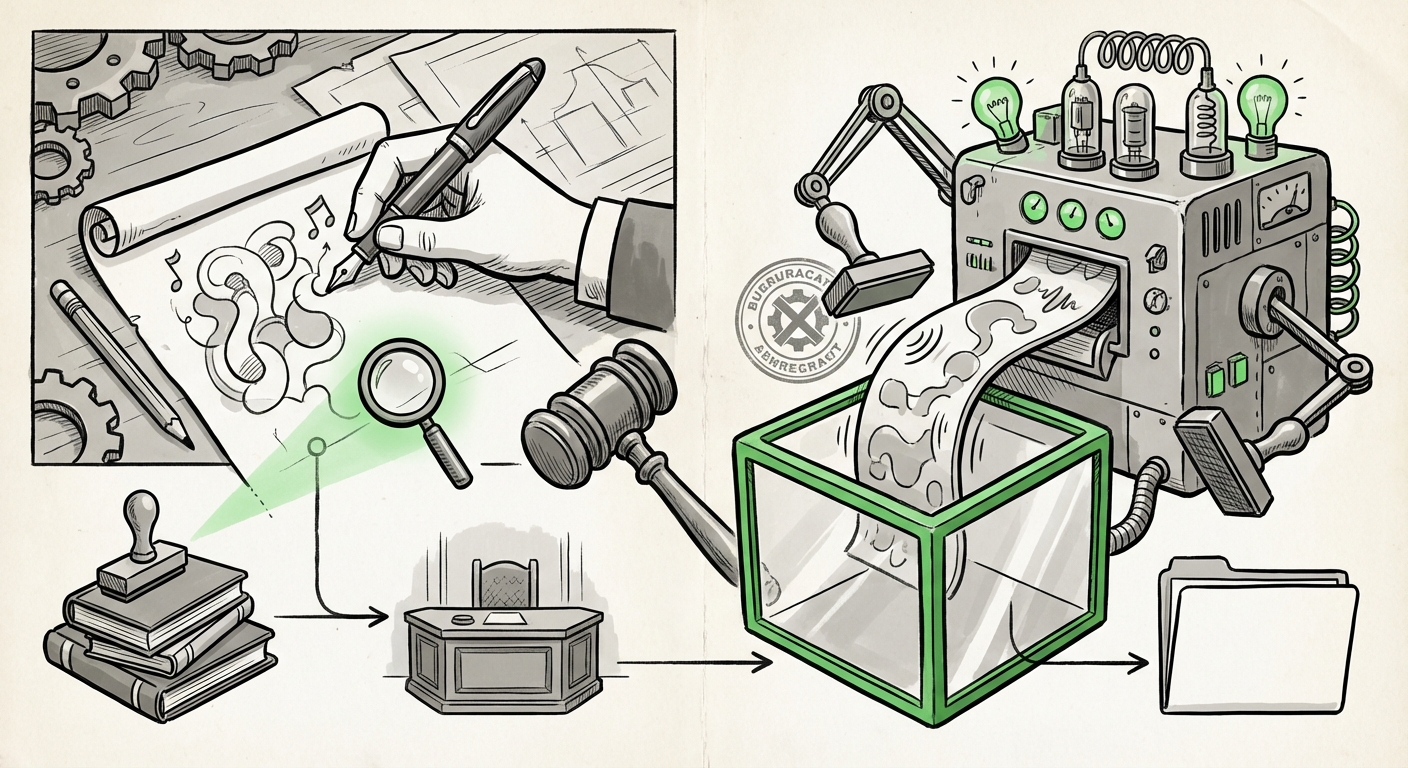
A recent ruling from a German regional court provides a sharp, clarifying answer, at least for now: **Simply declaring that a work is AI-generated is not enough to void its copyright protection.** In this specific case, lyrics written by a human remained protected, even if the accompanying music was AI-assisted. This decision is more than a legal footnote; it’s a critical pivot point indicating that the law is moving away from blanket skepticism toward a granular assessment of human intent and contribution.
The Core Tension: Authorship in the Age of Automation
For centuries, copyright law has been built on the bedrock principle of human authorship. A work must stem from the creative intellect of a person to deserve legal protection. When AI entered the scene, two primary camps emerged:
- The Zero-Copyright Camp: Argued that purely machine-generated content cannot be copyrighted because it lacks a human author, rendering it instantly public domain.
- The Prompt-as-Authorship Camp: Argued that the human who writes the complex prompt (the instruction set) is the functional author, similar to commissioning an artist.
The German court ruling elegantly sidesteps this binary. By protecting the human-written lyrics while leaving the AI-generated music potentially unstated, the court suggests a future where copyright is *fragmented* based on verifiable contribution. For the lyricist, their work was original enough to stand on its own, regardless of the flawed or unprotectable music partner.
For business leaders and creators, this introduces nuance: AI tools are not a legal monolith. They are collaborators whose outputs must be scrutinized based on the jurisdiction and the nature of the creative input.
International Context: Contrasting Jurisdictions
To understand the weight of this German decision, we must look internationally. The debate is not confined to European courts. In the United States, the **US Copyright Office** has taken a firm stance emphasizing the necessity of *human authorship*.
The guidance issued by the USCO following high-profile cases clarifies that if an AI system acts as the primary generator of content—with only minimal human prompting—that content is not eligible for registration. This echoes the German court's underlying premise: protection requires a **human creative spark**. Where the German court differs is perhaps in the application—it upheld the protection of the human-authored component rather than denying the entire composite work outright.
This alignment between European judicial interpretation and US regulatory guidance suggests a global trajectory: **AI-generated content, standing alone, is legally fragile.**
*(For a deeper dive into the US standard, see the foundational guidance on works containing AI-generated material issued by the U.S. Copyright Office.)*
The Demand for Proof: The Technical Nightmare of Authorship Lineage
Perhaps the most significant implication of the German ruling is the shift from assertion to proof. If a creator claims copyright, they must now be prepared to prove which parts they authored and which parts were machine-assisted, especially if the opposing party challenges the creation process.
This elevates the importance of **traceability**. How does one prove the difference between a lyric typed by a human and a lyric suggested and polished by an LLM?
- Version Control: Traditional software development already requires robust version control. Creative workflows involving AI will increasingly need forensic-level documentation—showing early drafts, prompt inputs, iteration logs, and editing histories.
- The "Black Box" Problem: Generative models are notoriously opaque. Proving a *specific* output was *not* substantially derived from copyrighted training data is nearly impossible, just as proving *you* didn't use AI for your lyrics is difficult without external evidence.
This places an immense burden on creators and potentially opens new avenues for litigation focusing on **process documentation** rather than just final product comparison. Legal challenges will pivot to metadata, cloud activity logs, and the quality of the creator’s own evidence.
*(The complexity of verifying creative origins is why experts are intensely studying the "Burden of proof in intellectual property cases involving generative AI," transforming litigation strategy.)*
Navigating Tool-Specific Terms of Service
The legal analysis doesn't stop at the court door; it extends to the platform provider. Consider the generative music tools often cited in these discussions, like SunoAI or its competitors.
When a user generates music via these platforms, the ultimate ownership is often dictated by the Terms of Service (ToS). Some platforms grant broad commercial rights to the user based on subscription tier, while others retain latent rights or place strict usage limitations. The German court protected the *lyrics* because they were demonstrably human-created under general copyright law.
If the music component had been challenged, the case might have hinged entirely on contractual law (the ToS) rather than copyright originality. This creates a scenario where a single song could have:
- Human-authored lyrics (protected by German copyright law).
- AI-generated music (ownership potentially determined by the platform’s ToS).
*(Analyzing these agreements, such as in a "SunoAI vs. Udio: Who Owns the Music You Prompt?" comparison, reveals that creators must treat the ToS of their tools as critical components of their IP strategy.)*
The Road Ahead: Legislative Pressure and Transparency Mandates
While court rulings offer reactive guidance, the proactive future of AI regulation is being written in Brussels. The **EU AI Act** is poised to fundamentally change how synthetic content is treated across member states, including Germany.
This sweeping legislation introduces comprehensive transparency requirements for General-Purpose AI Models (GPAI). While much of the discussion centers on deepfakes and misinformation, the implications for creative works are profound. The Act will likely mandate that AI-generated or heavily manipulated content be clearly **labeled**.
If labeling becomes mandatory, the defense of "It’s AI" changes meaning entirely. It transitions from a potential liability shield to a **required disclosure**. Failure to label content correctly, even if the content itself is deemed original, could lead to regulatory fines, independent of any copyright infringement claim.
This legislative pressure strongly reinforces the German court's insistence on verification. The future legal system won't rely on the creator *admitting* AI use; it will *require* them to disclose it, making the burden of proof a matter of regulatory compliance as much as intellectual property defense.
*(Understanding the final text of the EU AI Act, especially its sections concerning transparency and GPAI, is essential for multinational companies preparing for compliance.)*
Practical Implications: Actionable Insights for Modern Creators and Businesses
This ruling—and the global regulatory response it signals—demands immediate adjustments in how we create, manage, and value digital assets.
For Individual Creators (Artists, Writers, Musicians):
Actionable Insight: Document the Prompt. If you use AI to generate elements, save the exact prompts, the iteration history, and any subsequent human editing you performed. If you wrote the lyrics yourself, archive the initial draft documents showing incremental human refinement. Your evidence is your protection.
For Technology Developers and Platform Owners:
Actionable Insight: Enhance Metadata and Provenance. If your platform is used to create hybrid works, embedding provenance data (metadata showing the exact model version, prompt used, and human-edited segments) will become a necessary feature, not a novelty. This preempts costly litigation by offering verifiable data.
For Business and Legal Teams:
Actionable Insight: Audit Your IP Portfolio. Review all assets created in the last 18 months that utilized generative tools. Determine which components meet the "human authorship" threshold in relevant jurisdictions (US, EU). Clearly separate assets where only the prompt was provided versus those where the human dictated significant creative direction.
Conclusion: The New Authorship Contract
The digital creation landscape is maturing rapidly. The era where developers could hide behind the ambiguity of machine generation—either to claim work as their own or to escape liability—is drawing to a close. The German court’s decision underscores a vital truth: **The law still centers on the human element.**
Whether you are crafting the next chart-topping song or designing marketing assets, the future demands meticulous documentation. AI is a powerful tool, but it is not a legal scapegoat. Creators must now actively prove their contribution. The contract between humanity and artificial intelligence is no longer just about what the machine can do, but about what the human can document.
Supporting Context and Further Reading
- Context on US Policy (Search Query 1): US Copyright Office Issues Guidance on Works Containing AI-Generated Material (Analyst Note: Placeholder for specific USCO link found via Query 1)
- Tool Comparison (Search Query 2): SunoAI vs. Udio: Who Owns the Music You Prompt? A Terms of Service Deep Dive (Analyst Note: Placeholder for specific industry analysis found via Query 2)
- Burden of Proof Analysis (Search Query 3): Burden of proof in intellectual property cases involving generative AI (Analyst Note: Placeholder for technical legal analysis found via Query 3)
- EU Regulatory Future (Search Query 4): The EU AI Act and the Transparency Mandate: What It Means for AI-Generated Content Labeling (Analyst Note: Placeholder for EU AI Act analysis found via Query 4)