The "Tool vs. Author" Precedent: How AI Copyright Rulings Define the Future of Digital Creation
The rapid evolution of generative Artificial Intelligence has thrust long-established legal frameworks into sudden crisis. Nowhere is this conflict more visible than in the realm of copyright, where the lines between human inspiration and machine execution are constantly blurring. A recent, pivotal decision from a German regional court has provided much-needed clarity, suggesting that the law is currently choosing to favor the human hand guiding the digital brush.
The ruling, stemming from a case involving song lyrics created with AI tools like SunoAI, established that simply pointing at an AI generator is not a magic wand to strip a work of its intellectual property protection. For the work to be unprotected, one must prove a lack of sufficient human contribution—not just point to the existence of the tool. This is more than a minor legal technicality; it is a foundational precedent that signals how courts, regulators, and entire industries will adapt to the AI-powered creative economy.
The Core Conflict: Defining Authorship in the Age of Automation
For centuries, copyright law has rested on a relatively simple premise: a work must originate from a human author. Copyright incentivizes human creativity by granting exclusive rights to the creator. Generative AI fundamentally challenges this by automating complex creative tasks, leading to the central question:
When an AI creates something that looks, sounds, or reads like a human creation, who is the author?
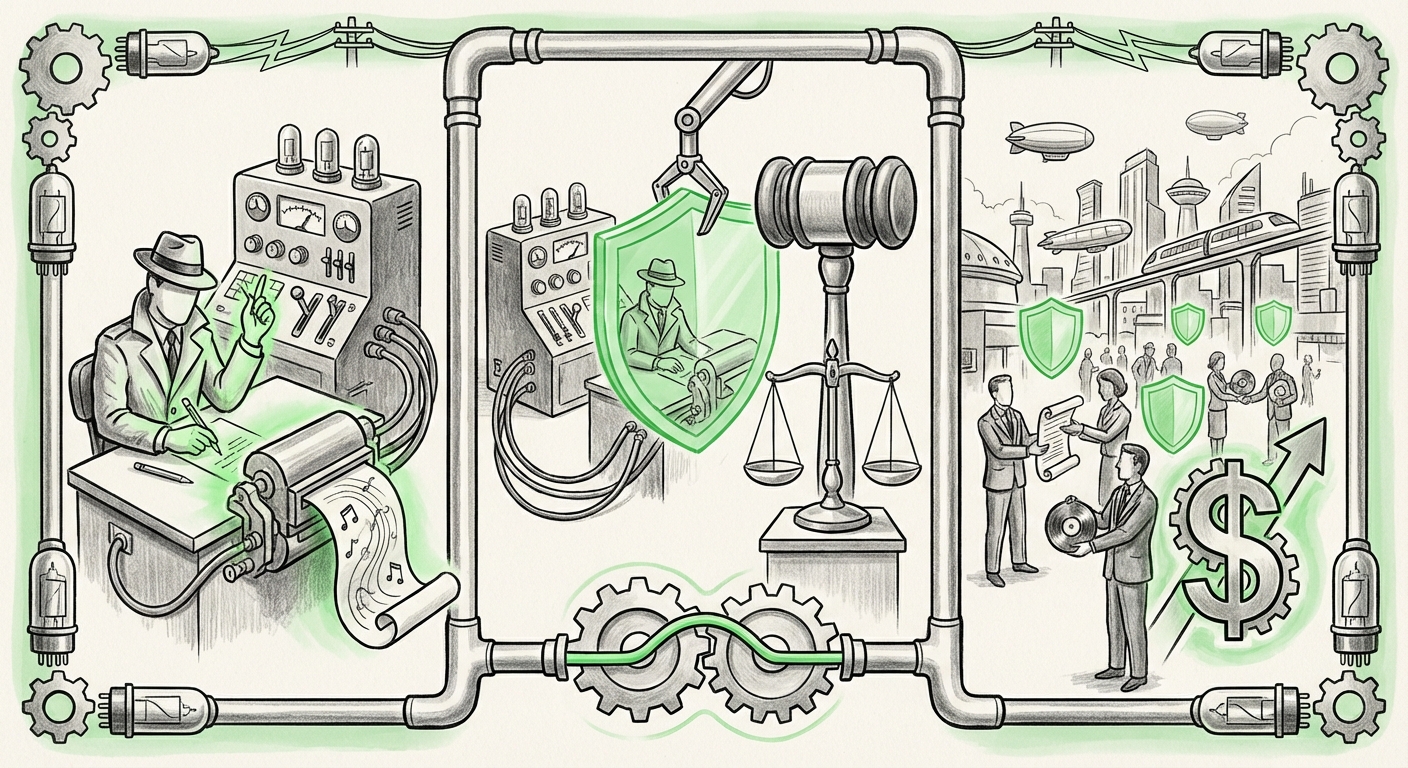
The German court’s decision leans toward the **"tool theory"** of AI integration. In this view, tools like Photoshop, digital audio workstations, or even advanced language models are simply instruments. If an artist uses a hammer to sculpt wood, the copyright belongs to the artist, not the hammer manufacturer. The court suggests that the same logic applies here: if a human provides the necessary creative direction, structure, and final approval, the output is theirs, even if the machine executed the fine details. This is excellent news for creators who see AI as a powerful co-pilot rather than a replacement.
The Global Echo: Seeking Corroboration on Hybrid Creation
To understand the impact of this German ruling, we must gauge its resonance across international jurisdictions. Our analysis suggests this isn't an isolated event but part of a developing global trend emphasizing **human intervention**.
For instance, in the United States, the U.S. Copyright Office has taken a firm stance: works generated solely by a machine without sufficient human creative control are uncopyrightable. They require evidence of creative choices—selection, arrangement, or modification—made by a natural person. This mirrors the German court’s implied reasoning. Legal experts researching this intersection—looking at queries like `"AI generated content" copyright human intervention authorship US EU`—are finding alignment that centers on creative spark, regardless of the medium or technology used to capture it.
This international consensus on "human agency" is vital. If major economic blocs agree that copyright protection must remain tied to a conscious creator, it prevents the wholesale creation of vast, unprotectable libraries of AI content that could flood markets and devalue human work.
Diving into the Machine: The Nuances of AI Music Creation
The technical specifics of tools like SunoAI are critical to understanding why this ruling is robust. When a user prompts SunoAI, they aren't just typing "write a song." They are typically specifying:
- Lyrics: Providing specific text or concepts.
- Genre/Style: Directing the model toward specific musical traditions (e.g., 1980s synth-pop, classic blues).
- Structure: Dictating verse-chorus-bridge progression.
- Vocal Tone/Emotion: Setting the mood for the performance.
Research into the technical process—exploring areas like `SunoAI music generation process vs human songwriting structure`—reveals that while the AI handles the orchestration and vocal performance synthesis, the human is still performing the crucial roles of editor, curator, and conceptual director. The human provides the seed of intent. The court seems to recognize that the "lyrics" portion mentioned in the case—the core narrative element—likely involved significant human authorship, which the AI merely rendered into musical form.
This distinction is key: the output is a *synthesis* of human direction and algorithmic execution. Future legal battles will likely revolve around defining the *threshold* of input required—is a one-word prompt enough, or must there be an entire written script?
The Global Watchdog: WIPO’s Role in Harmonization
The trajectory set by national courts is increasingly being scrutinized by international bodies. Discussions at the World Intellectual Property Organization (WIPO) regarding the `definition of authorship in the age of generative AI` reveal a consistent push to maintain the primacy of human creation. WIPO recognizes that if purely machine-generated works are granted the same rights as human works, the entire system of intellectual property breaks down. The German ruling serves as a powerful real-world application of the principles WIPO is currently debating.
Economic Implications: Stabilizing the Creative Market
The most profound effect of this ruling extends far beyond courtrooms; it impacts the multi-trillion-dollar creative economy. If the German court had ruled that any AI input immediately voids copyright, the economic future for musicians, writers, and visual artists using these tools would be catastrophic.
If AI-assisted content automatically defaults to the public domain, two major problems emerge, which directly concern songwriters and publishers investigating the `"AI authorship" economic impact`:
- Incentive Collapse: Why would an artist spend hours refining an AI-generated track if they cannot license it or earn royalties? The economic incentive for human participation disappears.
- Market Saturation: Unprotected works can be exploited by anyone immediately, driving down the market rate for similar human-created content.
By upholding the copyright protection for the human contributor, the ruling validates the business models built around AI-assisted creation. It ensures that artists who use these new tools can still secure licensing fees, earn streaming royalties, and maintain ownership over their contributions. This stability is what allows established media companies and emerging startups to invest confidently in AI workflows.
What This Means for the Future of AI and Business Strategy
This legal clarity provides actionable intelligence for technology developers, content producers, and policymakers alike. We are entering an era of **Hybrid Creation**, where the most valuable works will often be those born from the synergy between human intelligence and artificial processing power.
1. For AI Developers: Focus on Control and Traceability
Tools must be designed to maximize demonstrable human control. Developers should prioritize features that allow users to track every modification, iteration, and creative choice made during the generation process. The ability to generate a verifiable audit trail that proves substantial human input will become a core feature, not a niche add-on, for B2B platforms.
2. For Content Industries: Redefining Acquisition and Licensing
Music publishers, film studios, and publishing houses must immediately update their acquisition contracts. The focus should shift from whether an AI was *used* to determining the *percentage and quality* of the human contribution. New royalty structures will need to be developed to account for hybrid works, potentially separating royalties for lyrical/structural contribution (human) from mechanical/performance aspects (machine-assisted).
3. For Individual Creators: Mastering the Prompt and the Polish
The skill set required for creative success is evolving. Technical proficiency with the AI tool (prompt engineering) is only half the battle. The real value lies in the **editorial refinement**—the ability to take an AI suggestion and elevate it through superior taste, narrative understanding, and unique human perspective. Creators must treat AI outputs as raw materials requiring heavy refinement.
Actionable Insights: Navigating the New Creative Landscape
The German court has drawn a necessary line in the sand, but the terrain ahead remains complex. Here are concrete steps for stakeholders to prepare for a world defined by human-AI co-creation:
Actionable Insight A: Develop "Human Contribution Audits"
Businesses utilizing generative AI for commercial content should implement internal systems to document the human decision-making process. This audit trail—recording prompt evolution, selection criteria, and final edits—will be the primary defense in future copyright disputes.
Actionable Insight B: Embrace International IP Strategy
Given the global nature of digital distribution, legal teams must coordinate strategies across jurisdictions (US, EU, etc.) to ensure that works benefiting from the "human agency" interpretation in one region are equally protected in others, anticipating harmonization efforts by bodies like WIPO.
Actionable Insight C: Invest in "Curation Literacy" Training
For employees and contractors involved in content creation, training should focus less on basic AI operation and more on advanced creative direction, stylistic nuance, and deep editorial review. The future value is in curation.
Conclusion: Human Intent Secures the Future
The debate over AI authorship is not about rejecting technology; it is about protecting the value chain that creativity generates. The German court's ruling is a vital affirmation that, for now, the law recognizes the engine of creation remains the human mind.
By focusing on human input, creative control, and robust documentation, creators and industries can confidently integrate generative AI not as a loophole, but as the most powerful collaborative tool ever invented. The future of digital creation is hybrid, but its foundation remains resolutely human.