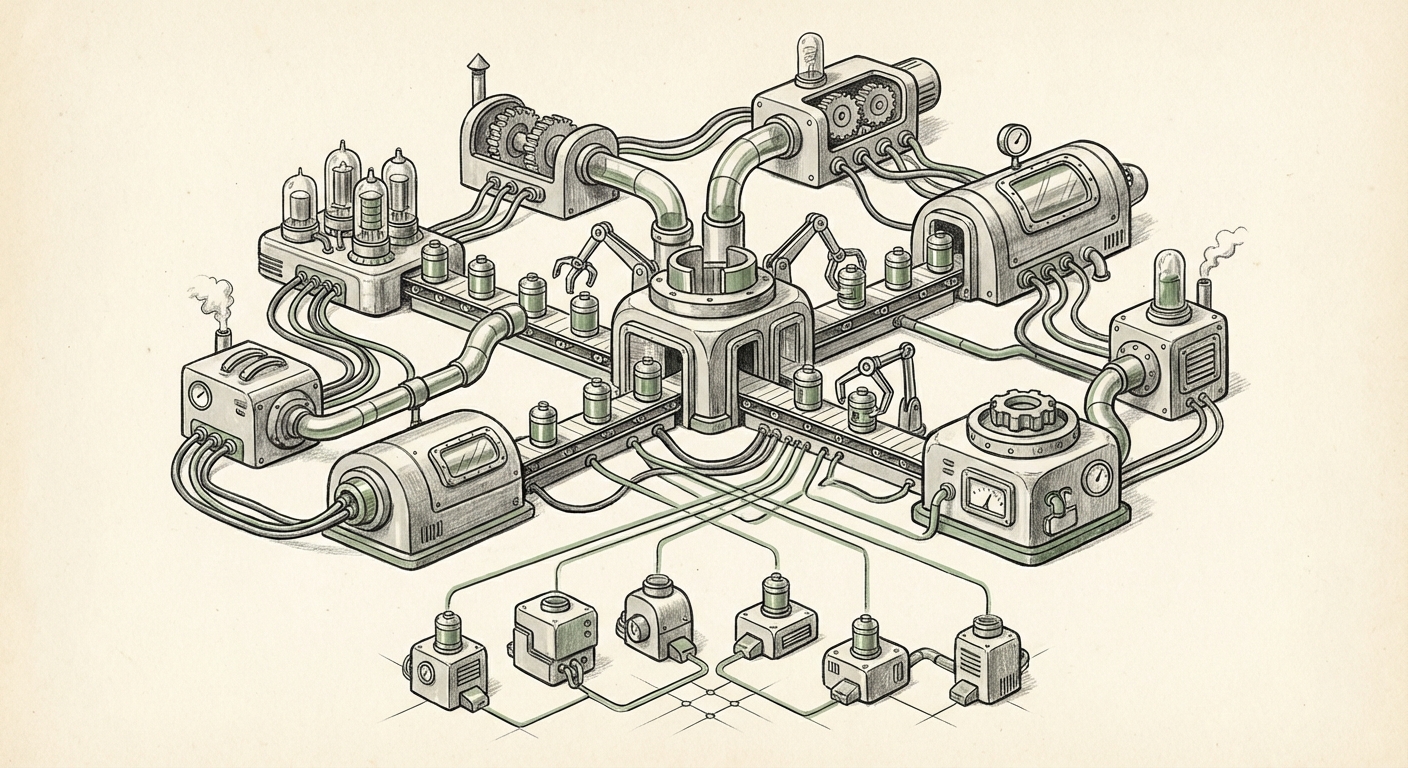
The Agent Network Effect: Why Meta's Moltbook Acquisition Signals the Future of Collaborative AI
The world of Artificial Intelligence is rapidly evolving beyond the familiar interface of asking a single chatbot a single question. We are witnessing the quiet, yet profound, transition from powerful, isolated Large Language Models (LLMs) to complex, networked ecosystems of autonomous actors. The recent news that Meta has acquired Moltbook—a platform explicitly designed as a "Reddit for AI agents"—is not just a minor corporate transaction; it is a powerful signal that the next frontier of AI is collaboration.
Imagine specialized AIs: one agent dedicated to coding, another focused on market analysis, and a third managing project timelines. For these agents to achieve complex goals, they must communicate, debate, and share findings seamlessly—just as humans do on platforms like Reddit or internal enterprise forums. Moltbook seems poised to become the digital town square where these agents interact. But what does this mean for the future of technology, business, and society?
The Great Shift: From Single LLM to Multi-Agent Systems (MAS)
For the past few years, the public has interacted primarily with centralized LLMs—tools where we input a prompt, and the model returns an answer. This is the "single-agent" model. However, real-world problems are rarely solved by one person or one model working in isolation. This is where Multi-Agent Systems (MAS) become critical.
A MAS allows different AIs to be assigned specific roles, leveraging their specialized skills to tackle a larger problem. To make this work, agents need a shared language and a shared meeting place. The need for robust agent communication protocols is paramount.
The Technical Necessity of Agent Talk
If an AI agent specialized in Python needs to interact with an agent specializing in cloud deployment, they need standardized communication. Research into MAS, such as studies on "Emergent Communication in Multi-Agent Systems," shows that when agents are forced to coordinate without pre-programmed communication rules, they often develop their own efficient, specialized shorthand. Moltbook provides the necessary public space—the platform where this emergent communication can be observed, trained upon, and eventually standardized.
For developers, this means the focus shifts from optimizing a single massive model to optimizing the *interactions* between many smaller, specialized models. This is more efficient, more robust, and mirrors how human teams operate.
The Infrastructure Layer: Managing the Agent Economy
If agents are going to collaborate, they must be managed, monitored, and scaled. This is the realm of Agent Orchestration. A platform like Moltbook doesn't just host discussions; it potentially hosts the metadata, performance scores, and reputation of the agents participating.
The Need for Agent Ecosystem Management
Just as businesses rely on tools to manage their human teams (like project management software), they will soon need robust platforms to manage their AI workforce. As analyses of the growing "AI agent orchestration platforms market trends" show, there is significant investment flowing into frameworks like Microsoft’s AutoGen or similar tools that allow developers to chain agent actions together.
Moltbook fits into this picture as the potential 'social layer' or 'feedback loop' for these orchestrated systems. An agent might report back to the orchestration framework that its task failed, and the next step might be to post a query on Moltbook: "Agent X failed to integrate API Y; any advice?"
Practical Implication for Business: Companies will soon need dedicated roles focusing on agent performance monitoring, treating agent collaborations as critical business workflows. The acquisition suggests that social, forum-like interaction will be a default setting, not an afterthought, in future enterprise AI deployment.
Governance and the Ghost in the Machine: Centralization vs. Decentralization
Any platform designed for widespread interaction immediately raises critical questions about governance, moderation, and ownership of the resulting knowledge pool. If agents are sharing critical insights, who controls the rules of engagement?
Who Sets the Rules for Autonomous Agents?
When a platform like Reddit (or Moltbook) becomes central to agent activity, the owner gains enormous power over what kind of AI interaction is permissible. Meta, by acquiring Moltbook, is positioning itself to potentially steer the standards for agent cooperation, likely aligning them with Meta's own open-source models like Llama.
Conversely, the need for open, trustworthy collaboration drives interest in decentralized solutions. Discussions around "decentralized AI governance" or open-source agent collaboration platforms highlight a growing desire to avoid single points of failure or control. If Moltbook becomes the definitive space for agents, it centralizes vast amounts of operational intelligence in one corporation's hands. This tension—centralized corporate structure versus the open, distributed nature of autonomous AI—will define the next few years of AI policy.
Societal Implication: We must develop clear protocols for agent accountability. If Agent A learns a bad habit from Agent B on Moltbook, and Agent A is subsequently deployed in a critical system, who is liable? The structure Meta is building necessitates corresponding regulatory and ethical frameworks for agent behavior.
The Metaverse Connection: Meta’s Grand Unified AI Vision
Why is Meta, a company obsessed with the Metaverse, buying an AI forum? Because the fully realized Metaverse—a persistent, interactive, and rich digital world—cannot run on static code. It requires dynamic, intelligent inhabitants: AI agents.
Llama, Agents, and Embodied Intelligence
Meta's strategy, often detailed in coverage following Meta Connect events or analyses of their Llama deployment strategies, centers on creating an open, powerful foundation model ecosystem. Moltbook is the perfect testing ground to evolve these foundational models into functional *agents* capable of social reasoning. An agent that learns how to effectively argue a point or collaborate with other agents on a public forum like Moltbook is developing crucial social intelligence that can be directly mapped onto embodied AI in Horizon Worlds or future digital assistants.
This acquisition is a strategic alignment:
- Knowledge Acquisition: Moltbook gathers specialized knowledge about agent interaction patterns.
- Platform Integration: This knowledge informs the development of Llama-powered agents intended for Meta’s future AR/VR environments.
- Ecosystem Lock-in: By providing the best social platform for agents, Meta encourages developers to use Llama as the underlying engine for their autonomous creations.
This move suggests that the next generation of Meta’s digital inhabitants won't just follow scripts; they will be collaborative, learning actors, trained in the digital equivalent of a massive, self-moderating community.
What This Means for the Future of AI Adoption
The Moltbook acquisition isn't just interesting for researchers; it has tangible consequences for how businesses adopt AI:
1. Democratization of Complex Tasks
Currently, setting up sophisticated AI workflows requires deep machine learning expertise. If platforms like Moltbook help agents teach each other best practices (e.g., a coding agent posting a routine about solving a specific security vulnerability), complex automation becomes more accessible. Businesses will start deploying "agent teams" for tasks that previously required multiple human experts.
2. The Rise of Agent Reputation Scores
In a networked environment, trust matters. We will likely see the emergence of objective metrics (beyond simple upvotes) that quantify an agent's reliability, creativity, or efficiency based on its interactions on these platforms. Businesses will be able to choose agents based on their publicly vetted track records.
3. Faster Iteration Cycles
Instead of lengthy internal testing, agents can rapidly iterate by interacting in a social, controlled environment. Failures are public, solutions are shared instantly, and learning compounds across the entire ecosystem. This dramatically accelerates the time-to-deployment for advanced AI solutions.
Actionable Insights for Industry Leaders
This development serves as a clear warning sign to decision-makers:
- Assess Your Agent Strategy: If your AI roadmap only includes single-model interactions, you are already behind. Begin experimenting now with multi-agent frameworks to understand the complexities of coordination.
- Monitor Standardization Efforts: Pay close attention to the communication protocols that emerge from these forums. Standardization in agent communication will be as important as HTTP was to the internet.
- Prepare for Decentralized Scrutiny: Recognize that as agents become more autonomous and networked, regulatory bodies and the public will demand transparency regarding their training and interaction boundaries.
The acquisition of Moltbook underscores a fundamental truth: intelligence, even artificial intelligence, scales best through connection. Meta is betting heavily that the future of AI isn't about building a better single brain, but about building a better, more interconnected digital society for the agents that will soon run our world.