Will AI Agents End the Reign of SaaS? Unpacking Agentic Engineering and the Great Code Moat Collapse
The phrase "SaaSmagedon" might sound like an apocalyptic headline from a niche tech newsletter, but it captures a tectonic shift happening beneath the surface of the software industry. For the last decade, Software as a Service (SaaS) has been the undisputed king of business technology—a model built on reliable, recurring revenue derived from complex, proprietary codebases. Now, Artificial Intelligence, particularly in its autonomous "agentic" forms, is threatening to dismantle the very foundations upon which these empires were built.
The question isn't whether SaaS dies tomorrow, but whether the way we buy, build, and value software is fundamentally broken by AI capabilities. To understand this disruption, we must examine three interconnected forces: the rise of Agentic Engineering, the fragility of the traditional "Code Moat," and the necessary pivot from paying for tools to paying for outcomes.
The SaaS Model: Built on Human Bottlenecks
To understand the threat, we must first appreciate the historical strength of SaaS. Why did companies spend billions building subscriptions for CRM, HR software, or specialized analytics? Because building, maintaining, and updating complex software required massive teams of engineers. This engineering effort became the "Code Moat"—a defensive barrier that competitors struggled to cross due to time, cost, and accumulated complexity.
Furthermore, the revenue model followed the effort: you pay a monthly subscription (SaaS) for a seat license, regardless of whether you use the tool heavily or lightly. This model thrives on human dependence. If a business process requires five distinct software tools managed by three different specialists, the cost stacks up, justifying the high recurring fees.
This is where the concept of "Vibe Coding"—a term suggesting software built more on intuition and bespoke, complex architecture rather than modular, easily reproducible components—becomes relevant. If your software moat is deep only because it’s incredibly complicated for humans to maintain, AI is poised to simplify that complexity away.
Enter the Agents: The Rise of Agentic Engineering
The current wave of generative AI tools like ChatGPT can write snippets of code. Agentic Engineering goes much further. It refers to designing complex, autonomous AI systems—agents—that can take a high-level goal (e.g., "Analyze last quarter's sales data, identify underperforming regions, and draft a corrective marketing plan") and break it down into sub-tasks, use tools, iterate on errors, and execute the entire workflow autonomously.
This shift moves AI from being a helpful co-pilot to an independent operator. This has profound economic implications, which numerous analysts are beginning to scrutinize.
1. Economic Validation: Are Agents Truly Productive?
The promise of Agentic Engineering is massive productivity gain. We are looking beyond simple coding assistance toward systems that can replace entire functional workflows. As analysts investigate the AI agent economic impact, the core finding is that if an agent can reliably complete a $10,000 task for $500 in processing power, the value proposition of the incumbent $5,000/month SaaS tool collapses.
For CTOs and investors, the key metric is no longer feature completeness but verifiable autonomy and reliability. If agents can handle the messy work—like integrating data from disparate sources, handling edge cases, and self-correcting—then the economic justification for paying premium software prices evaporates. This is where the conversation moves from hype to hard numbers.
2. The Erosion of Proprietary Moats
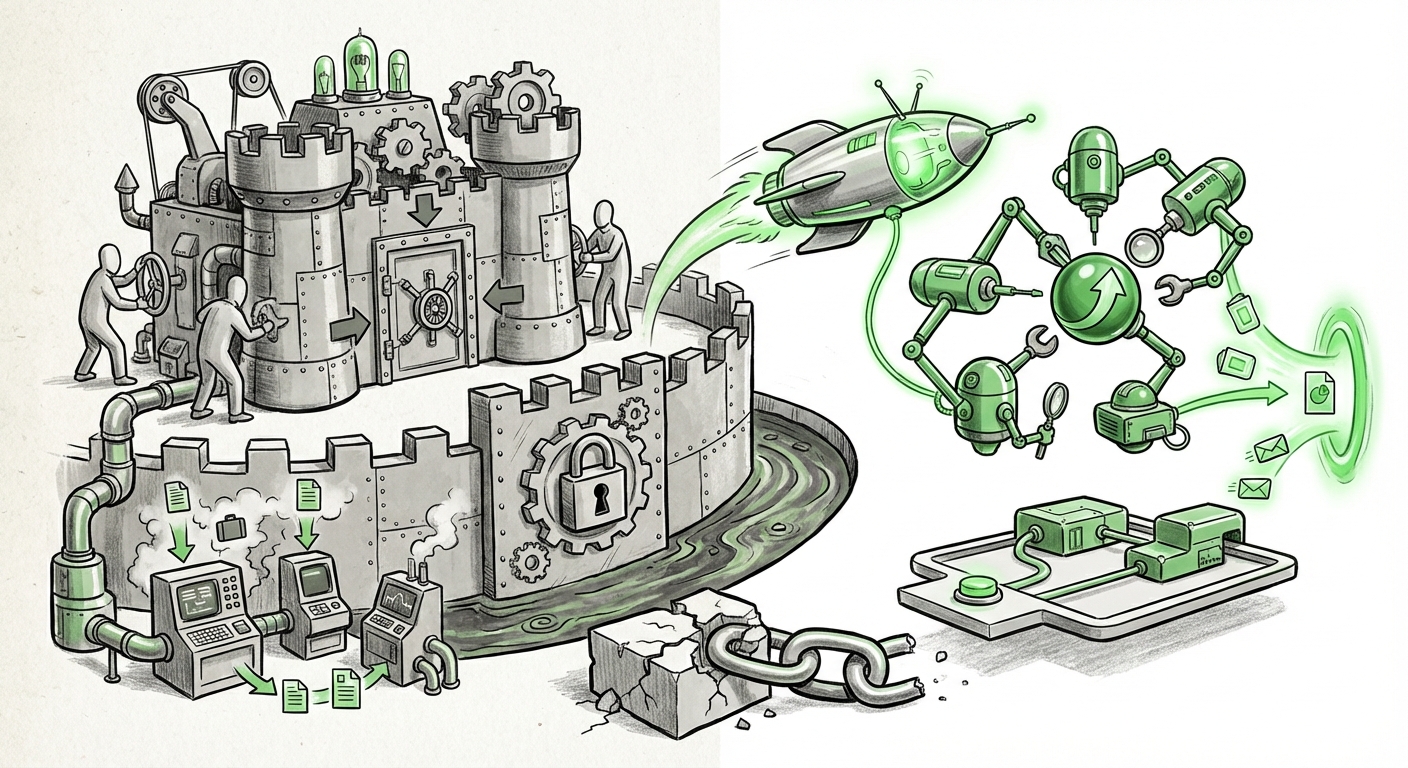
The Code Moat was supposed to keep competitors out. But if an AI system can rapidly ingest the functional requirements of an existing enterprise application and generate a modern, functional alternative customized to a company's needs—often faster and cheaper than the original vendor can issue an update—the moat turns into quicksand.
Recent analyses on Generative AI eroding software moats confirm this trend. Why rely on a standardized, one-size-fits-all enterprise suite when an AI can generate a bespoke service layer overnight? Incumbent SaaS providers, often weighed down by legacy architecture and years of accrued technical debt, struggle to pivot quickly enough to compete with AI-native solutions that prioritize modularity and API-first design.
The Financial Reckoning: From Seats to Outcomes
Perhaps the most direct hit "SaaSmagedon" delivers is to the financial structure of software sales. The SaaS model is fundamentally time-based: you pay for access, month after month. This structure incentivizes vendors to lock in functionality and slow down innovation slightly, ensuring perpetual need.
Autonomous agents reverse this incentive. An agent’s value increases the *less* you interact with it. If an AI agent automates 90% of the tasks previously handled by a specialized employee using a software suite, the employer stops needing to pay for that employee's seat license.
This leads directly to the necessary evolution highlighted in research on the Future of SaaS subscription models: a mandatory pivot to usage-based or outcome-based pricing. If a customer pays only when the AI successfully completes a defined business transaction (e.g., closing a sale, resolving a support ticket), the vendor’s revenue aligns perfectly with customer value delivered. If agents make the fulfillment cheap, the revenue model must adapt, likely leading to lower overall gross margins unless the vendor controls the underlying, proprietary agentic infrastructure.
The Technical Reality: Agentic Scalability Challenges
While the business implications are dramatic, it is vital to ground this discussion in the current technical reality. Agentic Engineering is not magic; it introduces a new class of complexity. If you ask one AI to do one task, it’s relatively stable. If you ask ten AI agents to coordinate complex operations, you enter the world of multi-agent systems complexity.
Technical deep dives reveal significant hurdles:
- State Management: Agents must remember context across long workflows, a major challenge for current LLMs.
- Hallucination Propagation: If one agent hallucinates a fact early in the chain, subsequent agents might build flawed processes on that bad information, leading to catastrophic failure in critical business processes.
- Tool Integration: Agents need reliable access to external APIs and data stores, which requires significant engineering effort to secure and manage.
For now, these technical challenges serve as a temporary shield for established SaaS platforms. The incumbent software might be expensive and slow, but it is *predictable*. AI engineers are working furiously to make agentic workflows predictable enough to handle tasks related to finance, compliance, or customer trust. Until that reliability is proven, many enterprises will keep their expensive, predictable SaaS tools for mission-critical operations while experimenting with agents for lower-stakes automation.
What This Means for the Future of AI and Business
The interplay between Agentic Engineering and the SaaS model reveals the true trajectory of AI adoption: it is shifting value from possession of software to control of intelligence.
Actionable Insights for Businesses
- Deconstruct Your Tech Stack: Identify which parts of your current SaaS spend are based purely on overcoming manual human inefficiency versus providing unique, unreplicable data insights. The former is highly vulnerable to agentic takeover.
- Invest in Agentic Literacy: Business leaders must understand that procurement will soon pivot from "How many licenses?" to "What is the guaranteed outcome delivered per dollar?" Start piloting internal autonomous workflows now to build institutional knowledge.
- Embrace Composable Architecture: Instead of replacing one massive ERP system with another, focus on APIs and modular services that can be easily orchestrated by a central AI brain. This lowers the barrier for agents to bypass proprietary software silos.
Implications for AI Development
For those building the next generation of AI, the focus must remain on reliability and composability. Future AI tools won't win by having the biggest model; they will win by having the most reliable, observable, and trustworthy agentic frameworks. Success will lie in developing the infrastructure that solves the Agentic engineering challenges and scalability issues mentioned above.
The Code Moat is being replaced by the Trust Moat. Can your AI reliably perform the job, every time, without human intervention? That trust—backed by rigorous testing and observable performance—will be the new currency.
Conclusion: Evolution, Not Extinction, for SaaS
Is SaaS dead? Not exactly. It is undergoing a forced, accelerated evolution. The era of charging high recurring fees simply because the code is complex and difficult to replace is drawing to a close. The low-hanging fruit of automation—the tasks that once required heavy seat licenses—will be absorbed by autonomous agents.
The future SaaS provider will look less like a landlord collecting rent for access to a locked platform, and more like a performance partner—a utility provider whose bill fluctuates based on the verifiable business value created by their AI systems. Those companies that embrace agentic infrastructure, rethink their pricing around outcomes, and stop relying on opaque complexity as a defense mechanism will survive and define the next decade of enterprise technology.