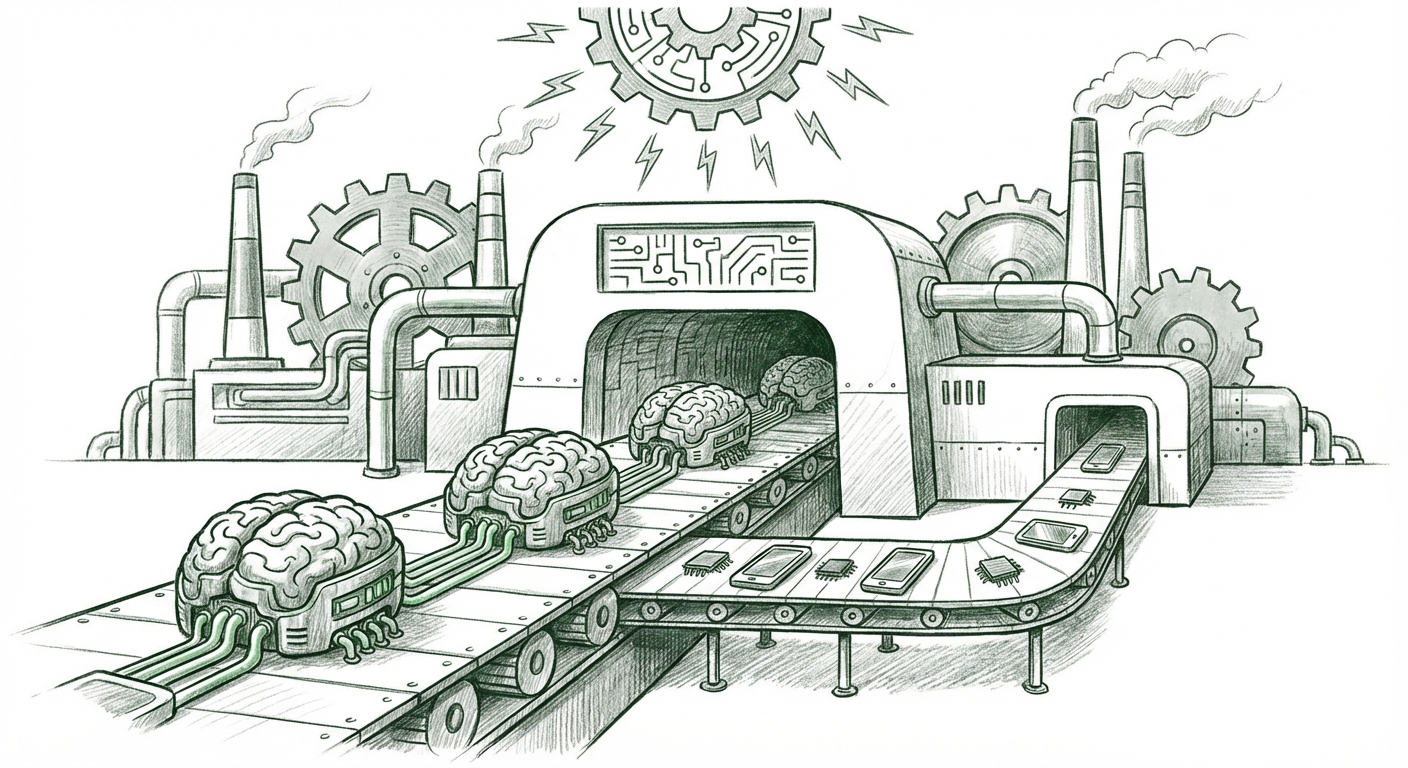
The Great Re-Prioritization: Why AI Chips Are Seizing TSMC's Best Manufacturing Lines
The global technology roadmap is currently being redrawn, not by a new consumer gadget, but by the insatiable hunger of Artificial Intelligence. A critical development has emerged from the world’s most important semiconductor foundry, TSMC: its most advanced production lines, specifically the 3-nanometer (N3) process, are being dominated by AI accelerators.
Reports suggest that by 2027, an astonishing 86% of TSMC's capacity on this leading-edge node could be dedicated solely to churning out the specialized chips—GPUs and custom ASICs—that power large language models, generative AI, and high-performance computing. This isn't just a small shift; it represents a massive industrial realignment where general-purpose computing, once the undisputed king of leading-edge silicon (like premium smartphones), is being pushed into a "buffer" role.
The Unstoppable Force: Quantifying AI's Demand
To grasp the significance of this story, we must first understand the scale of the AI boom. AI hardware is exponentially more demanding than traditional computing hardware. Training a massive model like GPT-4 requires thousands of specialized chips working in tandem for months. Inference—the process of using the trained model—is also rapidly scaling across cloud data centers.
This means hyperscalers (like Google, Amazon, and Microsoft) and chip designers (like NVIDIA and AMD) are ordering chips not just in the millions, but potentially in the *tens of millions* of units, all needing the absolute best performance per watt that the most advanced nodes can offer. This demand spike is validating what analysts have been tracking:
- Corroboration of the Shift: Independent market forecasts for AI accelerator demand stretching to 2027 strongly support this capacity squeeze. The sheer revenue potential of these AI components means customers are willing to pay a premium and commit capacity years in advance, effectively locking up the best manufacturing slots. (This analysis aligns with industry reports tracking GPU/AI chip market share, often found through specialized semiconductor reports.)
For businesses, this is a clear signal: AI capability is now the number one driver of technological investment globally. If you are building the next generation of AI, you get the best factory slots. Everything else waits its turn.
The Foundry Bottleneck: A New Hierarchy of Tech
TSMC’s N3 node is the current pinnacle of semiconductor manufacturing prowess. It allows engineers to pack more transistors (the tiny switches that make up a chip) into a smaller space, leading to faster, more efficient chips. Historically, this scarce, premium real estate was reserved for flagship smartphone System-on-Chips (SoCs).
When AI chips take over, the previous hierarchy collapses. Smartphones, which still rely on incredibly complex, power-efficient chips for everyday tasks, are now secondary. This forces smartphone makers to either accept slightly older, less advanced nodes (like N4 or N3 variations) or wait until the AI demand cools down—a prospect that seems distant.
What This Means for Consumer Technology
If flagship smartphones are bumped to overflow capacity, it means their performance gains might slow down. For the average consumer, this might not be noticeable today, but over the next few years, the annual leap in mobile processor speed and efficiency could become less pronounced because the best manufacturing tech isn't available to them.
This dynamic puts pressure on the entire ecosystem. Will the next generation of phones utilize advanced AI features *on the device* if the chip required for that feature is stuck waiting for a factory slot?
The Competitive Response: Can Competitors Step Up?
If TSMC is booked solid by AI, the industry naturally looks to competitors. This is where the strategic importance of Samsung Foundry and Intel Foundry Services (IFS) becomes evident. The question is simple: Can they meet the demanding specifications of AI hardware?
AI accelerators require extreme transistor density and near-perfect yields (the percentage of usable chips produced). Falling behind even one generation in process technology results in significantly worse power consumption and performance:
- Competitive Strain: Reports on Samsung’s efforts to secure major AI contracts highlight the intense race to match TSMC’s performance. If Samsung or Intel cannot offer a compelling, high-yield alternative at comparable process nodes, the capacity crunch at TSMC will persist, keeping prices high and innovation potentially bottlenecked for non-AI sectors. (The competition for advanced foundry deals confirms this tension in the market.)
For an Intel Foundry Services (IFS), this situation is both a challenge and a massive opportunity. If they can aggressively push their leading-edge roadmaps (like 18A), they could potentially capture the smartphone overflow, stabilizing that segment of the market and reducing overall reliance on a single foundry leader.
Future Implications: Structuring the Next Decade of Innovation
This prioritization is not temporary; it reflects a fundamental shift in technological value. We are moving from an era defined by the mobile internet to an era defined by ubiquitous, powerful AI. This has several deep implications:
1. Specialization Over Generalization
The dominance of AI chips suggests future chip design will become hyper-specialized. Instead of one powerful chip doing everything (like a smartphone SoC), we will see more specialized co-processors designed specifically for tasks like transformer calculations, graph neural networks, or memory management required by AI models.
2. The Software Pull for Hardware Innovation
Historically, hardware advanced, and software followed. Now, software (AI models) is pulling hardware innovation faster than ever before. Companies are designing the hardware needed for the next great algorithm, rather than waiting for the next process shrink to enable new software.
3. Geographic Diversification and Resilience
When one factory controls the production of the world’s most critical technology (AI chips), it creates a geopolitical and supply chain vulnerability. This concentration is forcing massive global investment into building new, highly advanced fabs in the US, Europe, and Japan. The goal is to create redundancy so that future AI breakthroughs are not entirely dependent on one region of East Asia.
Actionable Insights for Businesses
How should businesses—from startups to established enterprises—react to this new reality where the best manufacturing capacity is effectively reserved for AI?
For AI Developers and Startups: Secure Capacity Now
If your business model depends on leveraging the latest silicon for AI inference or training, you must secure your capacity agreements with foundries (or leverage partnerships with cloud providers who already hold TSMC capacity) well in advance. Planning cycles for next-generation silicon must now account for a longer lead time to access leading-edge nodes.
For Consumer Tech Companies: Strategic Node Planning
Companies producing smartphones, tablets, or traditional PCs must develop robust, multi-node strategies. This means designing chips that can achieve excellent performance on slightly older, more readily available nodes (like the N4P or N5 variants) while reserving the absolute bleeding edge for specialized, AI-focused features that provide a clear market differentiator.
For Semiconductor Equipment Manufacturers: Invest in AI Tools
The tooling and metrology required for advanced AI chips (which are often large, complex dies) are different from those for smaller smartphone chips. Companies providing lithography, etching, and inspection tools must aggressively tailor their offerings to the unique geometric and thermal challenges presented by massive AI dies.
Conclusion: The Age of AI Dominance is Cemented
The observation that AI chips are pushing smartphones off TSMC’s most advanced lines is the clearest signal yet that the technology industry has entered a new phase. AI is not just another application; it is the primary engine driving semiconductor capital expenditure and innovation prioritization.
This capacity struggle validates the economic imperative of AI. While the competition among foundries to catch up is fierce, the current reality dictates a clear pecking order. Those who control the compute—the AI accelerators—will dictate the pace of innovation, leaving the rest of the technology world to adapt to the resulting availability and timing constraints. Navigating this landscape requires forward-looking supply chain management and a deep understanding of where the true silicon priorities lie.