ByteDance's Malaysia Gambit: How Geopolitics is Reshaping the Global AI Supercomputing Map with Blackwell
The global AI race is no longer just about writing better code or designing superior algorithms; it is fundamentally a battle for hardware supremacy. At the heart of this contest lies the supply chain for advanced semiconductors, dominated almost entirely by American technology. When a major player like ByteDance, the parent company of TikTok, is reportedly securing access to 36,000 cutting-edge Nvidia Blackwell chips in Malaysia, it signals more than just a major data center upgrade—it signals a critical strategic maneuver in the ongoing high-stakes technological cold war.
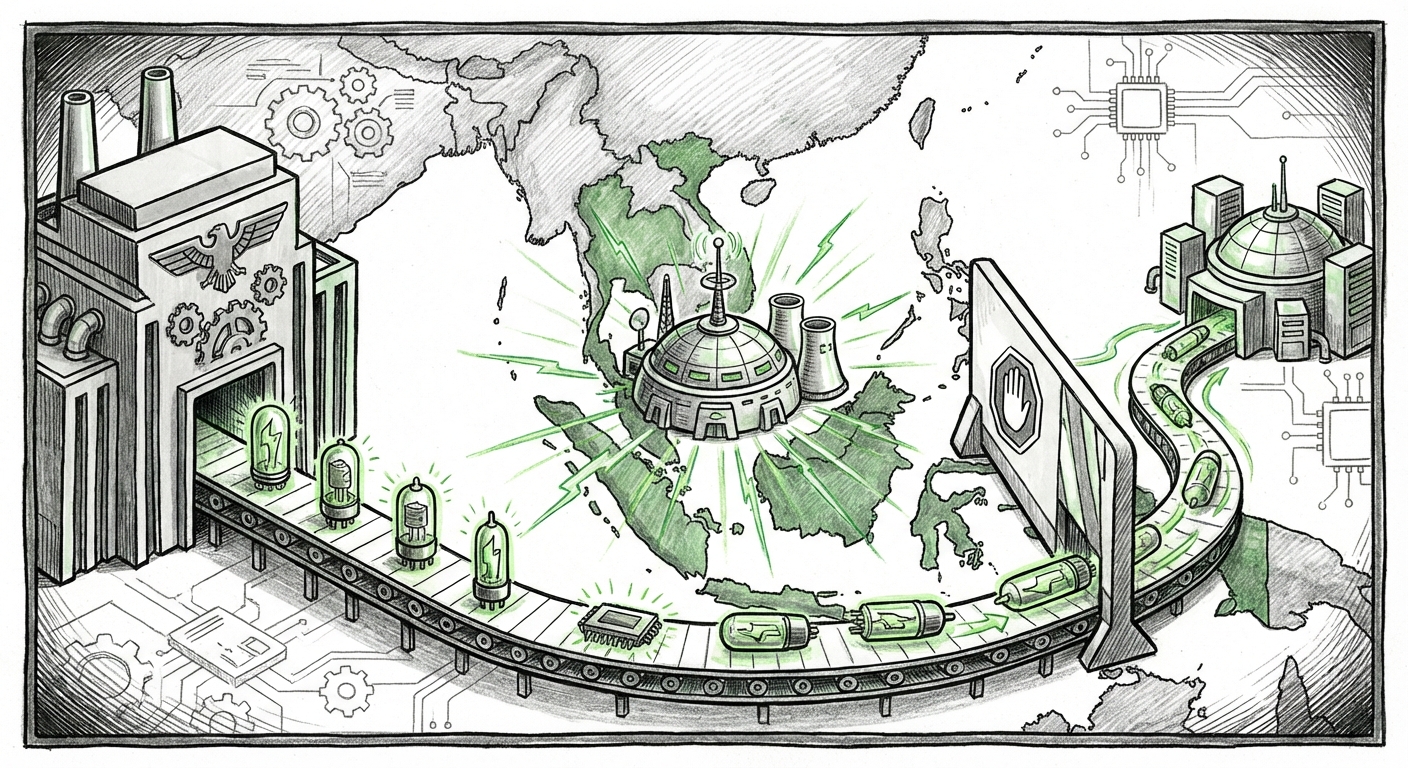
This development, which involves circumventing explicit US export controls designed to restrict access to China, highlights three seismic shifts occurring in the technology landscape: the tightening grip of US export policy, the desperate race for next-generation compute power, and the emergence of Southeast Asia as the new, crucial battleground for neutral data infrastructure.
The Wall Built by Washington: Understanding the Hardware Restrictions
To appreciate the boldness of ByteDance’s move, we must first understand the barrier they navigated. The United States government has implemented stringent export controls aimed at slowing the progress of advanced Artificial Intelligence capabilities in China. These restrictions, often updated by the Department of Commerce, target chips that exceed specific performance thresholds, particularly concerning raw compute power and, critically, the speed at which chips can communicate with each other (interconnect bandwidth).
The prior generation, the Nvidia H100, was already severely restricted. The newer Blackwell architecture (including the B200 GPU) represents an exponential leap in capability, essential for training the largest, most sophisticated Large Language Models (LLMs) and future recommendation engines like those underpinning TikTok's global success. These chips are specifically excluded from the relaxations recently considered by the Trump administration, demonstrating Washington's sustained intent to maintain a technological lead.
What this means for engineers: The difference between an H100 cluster and a Blackwell cluster for training a state-of-the-art model can be months of development time saved. For a company like ByteDance, whose core product relies on optimizing user engagement via AI, this time advantage is worth billions. They are not just seeking performance; they are seeking an uninterrupted path to the best possible performance that exists today.
The Technical Imperative: Why Blackwell is Non-Negotiable
Why go to such elaborate lengths for the Blackwell cluster? It boils down to sheer processing prowess. For non-technical readers, imagine trying to bake a thousand complex cakes simultaneously. The H100 is a very fast oven; the Blackwell is a massive, interconnected factory floor that can handle ten times the capacity with far less energy waste per cake.
Technically, Blackwell is designed specifically for the era of trillion-parameter models. It dramatically increases memory bandwidth (using HBM3e technology) and features specialized engines that accelerate specific AI calculations. If ByteDance intends to refine the already world-class personalization algorithms behind TikTok, or develop competitive foundational models to challenge Western and domestic rivals, they require this bleeding-edge hardware. Circumvention is not a matter of saving money on older chips; it is about retaining the ability to compete at the absolute apex of AI innovation.
Malaysia: The New Neutral Ground for AI Infrastructure
This brings us to the critical location: Malaysia. ByteDance is not building this cluster in Shenzhen; they are building it in a third-party nation. This represents a significant pivot in global data center strategy. Southeast Asia (SEA) is rapidly becoming the default meeting point for technological needs that cannot be fulfilled within the immediate geopolitical constraints of the US or China.
Data center investment across SEA—including Malaysia, Singapore, and Vietnam—is exploding. As noted in analysis concerning the growing role of Southeast Asia as an AI data center hub, these nations offer several advantages:
- Geographic Proximity: They are closer to major Asian markets than Europe or the US.
- Favorable Regulatory Environment: They offer relative political stability without the direct, active technology restrictions imposed by Washington on mainland Chinese entities.
- Attractive Incentives: Local governments are actively courting high-tech FDI with tax breaks and infrastructure support.
For ByteDance, establishing a cluster in Malaysia allows them to acquire the necessary hardware legally (as the chips are sold to the Malaysian entity) and operate the cluster without triggering direct US sanctions violation penalties applicable to operations based inside China. This infrastructure then services their global needs, effectively creating a "firewall" around their most sensitive, cutting-edge training assets.
The Broader Trend: China's Overseas Infrastructure Play
ByteDance’s move is illustrative of a larger, systemic trend. As geopolitical friction solidifies, Chinese technology giants are proactively shifting significant segments of their compute infrastructure overseas. This strategy is a form of de-risking and ensuring business continuity.
Reports detailing how Chinese tech companies are shifting cloud infrastructure overseas due to US sanctions show this is a pattern, not an isolated event. Companies like Alibaba Cloud and Tencent have long been expanding their global footprints, but now this expansion takes on a new urgency: it is about securing the necessary *supply chain for innovation* itself, not just customer service.
If a company cannot train its next-generation AI models within its home country due to hardware export bans, the logical strategy is to establish highly secure, proprietary compute centers in geopolitically neutral territories. These centers become the engines for the most advanced work, effectively creating a shadow ecosystem of AI capability that operates outside the direct purview of US export control enforcement zones.
Future Implications: Decentralization, Deterrence, and Digital Sovereignty
What does this global game of technological hide-and-seek mean for the future of AI development and global commerce?
1. The Balkanization of AI Supply Chains
We are witnessing the fragmentation of the technology ecosystem. In the past, the best hardware was generally available to the best bidder globally. Now, access is dictated by political alignment. This means two parallel tracks of AI development will accelerate:
- US-Aligned AI: Focused on domestic or allied data centers, benefiting from direct, immediate access to the latest innovations from Nvidia, AMD, and specialized startups.
- Rival AI Ecosystems: Forced to rely on complex workarounds, second-hand hardware acquisitions, or rapid development of domestic alternatives (which often lag significantly). ByteDance’s Malaysia setup represents the sophisticated first option for a rival.
2. The Rise of 'Compute Diplomacy'
Nations like Malaysia, Singapore, and the UAE will gain immense strategic importance. They are no longer just attractive markets; they are chokepoints for global technological progress. Their governments gain leverage, capable of offering incentives or placing restrictions based on which global power’s tech giants establish roots on their soil. Investment analysts must now factor geopolitical risk into data center location assessments alongside power costs and fiber availability.
3. The Endurance of the Recommendation Engine
ByteDance’s primary focus remains engagement metrics for platforms like TikTok. Their ability to secure Blackwell chips ensures that their recommendation AI—the core of their business moat—will continue to evolve at the fastest possible rate. This relentless pursuit of user attention, powered by unrestricted compute, maintains their competitive edge globally, even against domestic US-based competitors who might face different administrative hurdles in securing similar volumes of next-gen hardware for non-government-critical applications.
Actionable Insights for Stakeholders
This episode offers clear takeaways for various segments of the tech world:
For AI Engineers and Researchers: Understand that your access to top-tier compute may soon be dictated by the infrastructure provider's geopolitical standing, not just your institution’s budget. Collaboration might need to shift toward platforms with globally distributed, politically 'safe' compute environments.
For Corporate Strategists: If your AI roadmap requires performance beyond the current publicly available hardware in your primary operational zone, begin scouting alternative geographies now. Look closely at Tier 2 and Tier 3 nations aggressively courting data center investment, as they will become essential arbitrage points in the hardware supply chain.
For Policymakers: Export controls are proving effective at preventing direct hardware transfer, but they are inherently driving infrastructure *outward*. The focus must shift from blocking sales to monitoring the destination and operational use of chips sold legally into allied or neutral territories. The 'where' of computing is becoming as important as the 'what' is being computed.
The ByteDance maneuver in Malaysia is a masterclass in maximizing technological capability within the tight confines of international regulatory pressure. It confirms that the race for AI dominance is now intrinsically linked to real estate acquisition in the global digital geography. The future of AI won't just be written in code; it will be drawn on the map of data center locations.