The AI Cartographer: How Gemini is Turning Google Maps into a True Contextual Travel Advisor
The digital world has always been defined by maps. From crude sketches to vectorized GPS data, the ability to locate, navigate, and understand space is fundamental. However, the method of *asking* for directions has remained stubbornly transactional: Input A, Get Path B. Google’s recent infusion of its Gemini AI into Google Maps—specifically the introduction of "Ask Maps"—is not just a feature update; it represents a fundamental shift toward true **spatial intelligence**.
This development signals that the age of simple directory lookups is fading, giving way to AI-driven, contextual journey planning. As an AI technology analyst, I view this convergence of Large Language Models (LLMs) with geospatial data as one of the most important near-term applications of generative AI. It moves us beyond text generation and into the realm of real-world, physical action generation.
From Keywords to Context: The Power of Conversational Geospatial Search
What exactly does "Ask Maps" change? Historically, if you wanted a specific type of place—say, a bookstore with a quiet reading area that serves vegan pastries and is open past 7 PM on a Tuesday—you might have needed three separate searches, followed by manual verification of operating hours and ambiance reviews. Ask Maps promises to handle this complexity in a single, natural-language prompt.
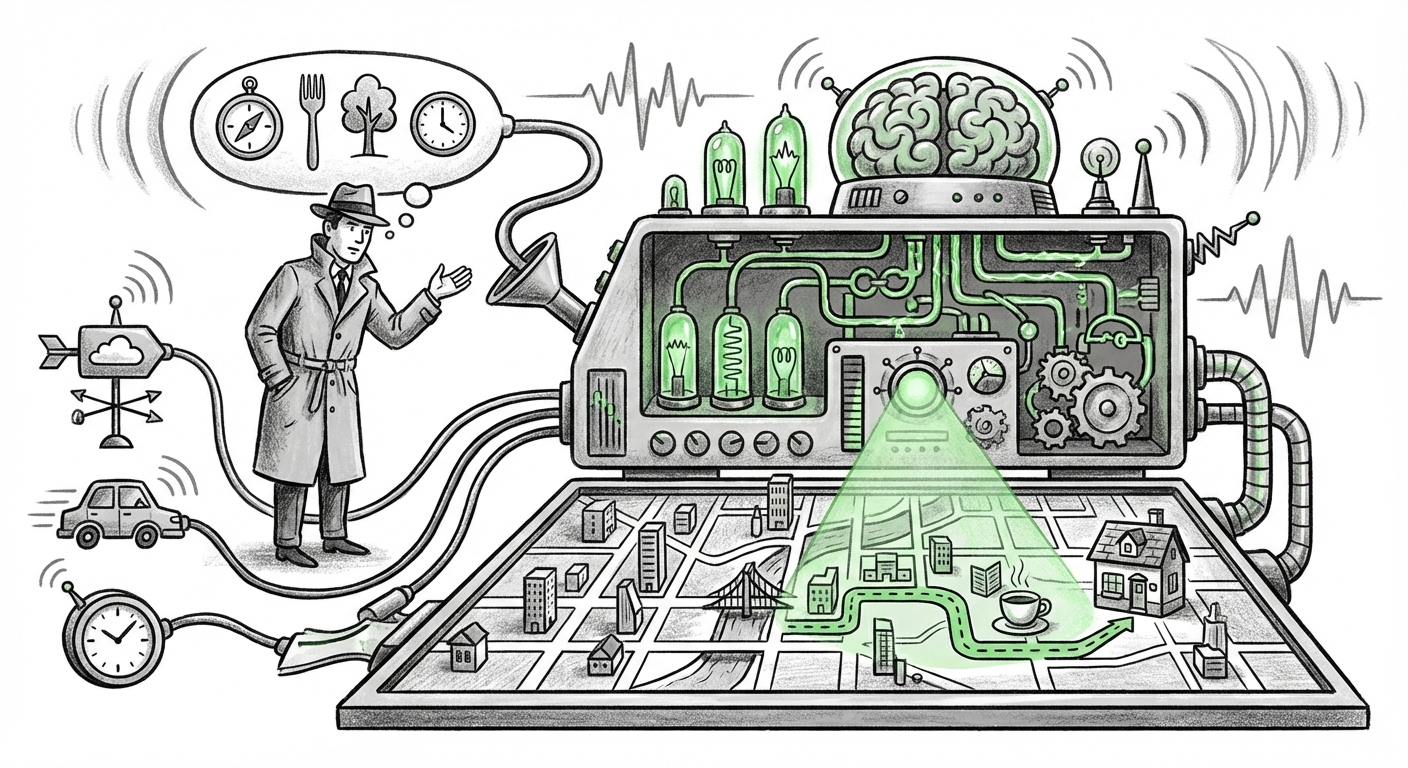
This capability hinges on the LLM’s ability to reason across multiple data types:
- Semantic Understanding: Gemini comprehends nuances like "quiet reading area" or "good for people-watching."
- Data Fusion: It cross-references this understanding with structured data (business categories, user reviews, operating hours).
- Spatial Reasoning: It anchors the result within the user's current geography or intended route.
For the layperson, this means a smoother experience. If you ask, "Where can I grab lunch near the museum district that my kids will also like?" the system won't just list restaurants; it will synthesize reviews mentioning family-friendliness and proximity to the museum entrance, presenting the results on a customized map. This is proactive assistance, bordering on a true digital travel advisor.
Corroborating the Trend: Beyond Maps
This Maps innovation is not an isolated event. Corroborating searches reveal that Google is aggressively embedding Gemini across its ecosystem. When we examine the integration of **Gemini AI in Google products beyond Search** (a key area for contextual analysis), we see a pattern: Google is building an AI operating layer that understands context across email, calendar, and now, location. For example, if Gemini sees a confirmed dinner reservation in your calendar (Workspace data), the "Ask Maps" feature can preemptively suggest the best transit route based on current traffic conditions (Maps data). This contextual continuity is the next frontier for personal computing.
The Visual Leap: 3D Navigation and Spatial Computing
The AI component is only half the story. Google also announced a revitalized 3D navigation system. While LLMs handle the *what* and *why*, the 3D environment handles the *where* in a visually rich way.
The convergence of conversational AI with rich 3D visualization defines the next stage of **spatial computing**. Think less about flat blue lines on a screen and more about an augmented reality overlay when you look up from your phone.
For developers and enthusiasts focused on the **future of 3D navigation and spatial computing in consumer apps**, this is crucial. Gemini can interpret a complex instruction, and the 3D map provides the high-fidelity environment needed to execute that instruction visually. Imagine asking, "Show me the entrance to the convention center that's closest to the subway exit," and the map zooms in, highlighting the exact door in a photorealistic 3D render. This is foundational work for the seamless integration of AR glasses into daily life.
Technical Hurdles and Real-World Reliability
While the promise is exciting, the analyst must address the elephant in the digital room: reliability. LLMs are prone to "hallucination"—making up facts with confidence. When an LLM hallucinates a poem, it’s amusing. When it hallucinates a restaurant’s closing time or the existence of a specific park feature, the user experience is broken, and trust is lost.
This brings us to the critical challenge highlighted by inquiries into the **challenges of grounding conversational AI in real-time geospatial data**. Google Maps is an immense, dynamic database. "Ask Maps" must ground Gemini’s reasoning in verifiable, minute-by-minute information: traffic flow, temporary closures, and fluctuating inventory/availability.
The success of this feature rests entirely on Google’s ability to build robust **Retrieval-Augmented Generation (RAG)** pipelines specifically tuned for geospatial veracity. If the grounding mechanism fails, the system reverts to being a very clever, but ultimately unreliable, map interface.
Implications for Business and Local Economies
The impact of conversational search on local businesses is perhaps the most significant economic implication of this technology. We must consider the **impact of generative AI on local business discovery**.
The New Discovery Funnel
For decades, local SEO focused on optimizing for keywords, location pages, and transactional searches (e.g., "best pizza near me"). If users start asking, "Where is a cozy, dimly lit Italian place that has good wine pairings for a first date tonight?" the traditional SEO playbook becomes obsolete.
Businesses will need to focus less on listing keywords and more on deep, qualitative data—the *ambiance*, the *service style*, the *vibe*. Businesses that have rich, verified qualitative data points (perhaps drawn from thousands of reviews translated by an LLM into descriptive tags) will gain visibility. Those relying on generic titles will be buried beneath the AI's sophisticated ability to match conversational intent with nuanced inventory.
Competitive Landscape in Travel Tech
Furthermore, we look at how this positions Google against specialized travel platforms. Analysis of **LLM powered personalized recommendation engines in travel tech** shows that companies like Airbnb and Expedia have been racing to integrate generative AI to streamline itinerary planning. Google Maps, however, holds the unique advantage of controlling the foundational layer: the *navigation itself*.
If a user plans a multi-stop tour using Gemini in Maps, Google controls the entire journey—from the initial recommendation to the turn-by-turn guidance. This creates a highly sticky environment, potentially cannibalizing the planning phase traditionally owned by dedicated travel apps.
Actionable Insights for Navigating the AI Future
For businesses, developers, and consumers, navigating this shift requires specific adjustments:
For Businesses (Especially Local SMBs):
Actionable Insight: Audit your qualitative data presence. Ensure your Google Business Profile is detailed, encouraging nuanced reviews. If your service excels at something subtle (e.g., "expert coffee grinding," "fastest lunch service in the district"), make sure those details are captured in user feedback that AI models can ingest and reason over.
For Technology Strategists:
Actionable Insight: Assume context flows seamlessly across platforms. When designing any new service, assume the user’s intent may originate in an email, a calendar invite, or a separate chat window. The successful platforms will be those that use unified AI backbones (like Gemini) to carry user context effortlessly between applications.
For Developers and Researchers:
Actionable Insight: Focus R&D on geospatial grounding techniques. The next major breakthrough in AI utility will come from developing more robust, lower-latency methods for verifying LLM output against dynamic, real-world sensor and API data. Accuracy in the physical world yields massive trust dividends.
Conclusion: The Map Becomes the Mind
The move to integrate Gemini into Google Maps is more than an iterative update; it is a profound statement about the intended role of AI in our daily lives. Maps is evolving from a static utility tool into a dynamic, predictive, and conversational partner. By merging powerful LLM reasoning with high-fidelity 3D visualization and real-time data, Google is creating the prototype for the next generation of spatial assistants.
We are moving toward a world where asking for directions is replaced by requesting an experience. "Take me to the place that feels like Paris but is only a 10-minute drive." The AI cartographer will not just plot the course; it will curate the destination based on your current mood, your history, and the fleeting nuances of the physical world around you. This fusion of the digital mind (Gemini) with the physical space (Maps) will redefine how we move, discover, and interact with our surroundings.