Grok's Reliability Revolution: Why Low Hallucination Beats Benchmark Scores in the Next Era of AI
For the past few years, the Artificial Intelligence industry has been locked in a relentless arms race driven by headline-grabbing benchmarks. Every quarter, we celebrate new peaks in complex reasoning, massive context windows, and multi-modal mastery, often driven by titans like Google’s Gemini and OpenAI’s GPT series. These models represent the absolute cutting edge—the rockets pushing the limits of what AI can do.
However, a recent development concerning xAI’s Grok 4.20 signals a potentially more significant shift for the real-world deployment of AI. While Grok 4.20 trails its top-tier rivals by a "wide margin" on traditional performance tests, it has simultaneously set a new record for not hallucinating. This distinction is not merely a footnote; it represents the transition from AI as a laboratory curiosity to AI as a trustworthy, dependable business utility.
The Benchmark Trap: Intelligence vs. Trust
To understand why this matters, we must first define the core problem: hallucination. In simple terms, an AI hallucination is when the model confidently asserts something that is factually incorrect, nonsensical, or unsupported by its training data. For creative writers or brainstorming sessions, a little fabrication might be acceptable. For a lawyer summarizing case law, a doctor diagnosing a condition, or an engineer debugging code, a single hallucination can be catastrophic.
The models leading the pack—the GPTs and Geminis—are primarily trained to maximize performance across every imaginable task. They are generalists aiming for the highest possible score on broad tests. This pursuit of maximum intelligence often comes at the expense of absolute factual purity. They are exploring the boundaries of knowledge, and sometimes they wander into fiction.
Context on Hallucination Benchmarking
The industry is actively struggling to solve this reliability challenge. Researchers constantly devise new, rigorous ways to test factuality, moving beyond simple knowledge recall to complex synthesis. As evidence, recent analyses emphasize the growing focus on AI Safety and Factuality as a distinct research discipline, suggesting that standard training methods aren't sufficient to eliminate fabricated outputs.
When a model like Grok 4.20 can demonstrably outperform established leaders in this crucial area, it suggests xAI may have prioritized a different training or fine-tuning objective: fidelity to truth over sheer reasoning complexity. This pursuit of factuality is exactly what CTOs and compliance officers are demanding.
The Emergence of the Two-Tier AI Market
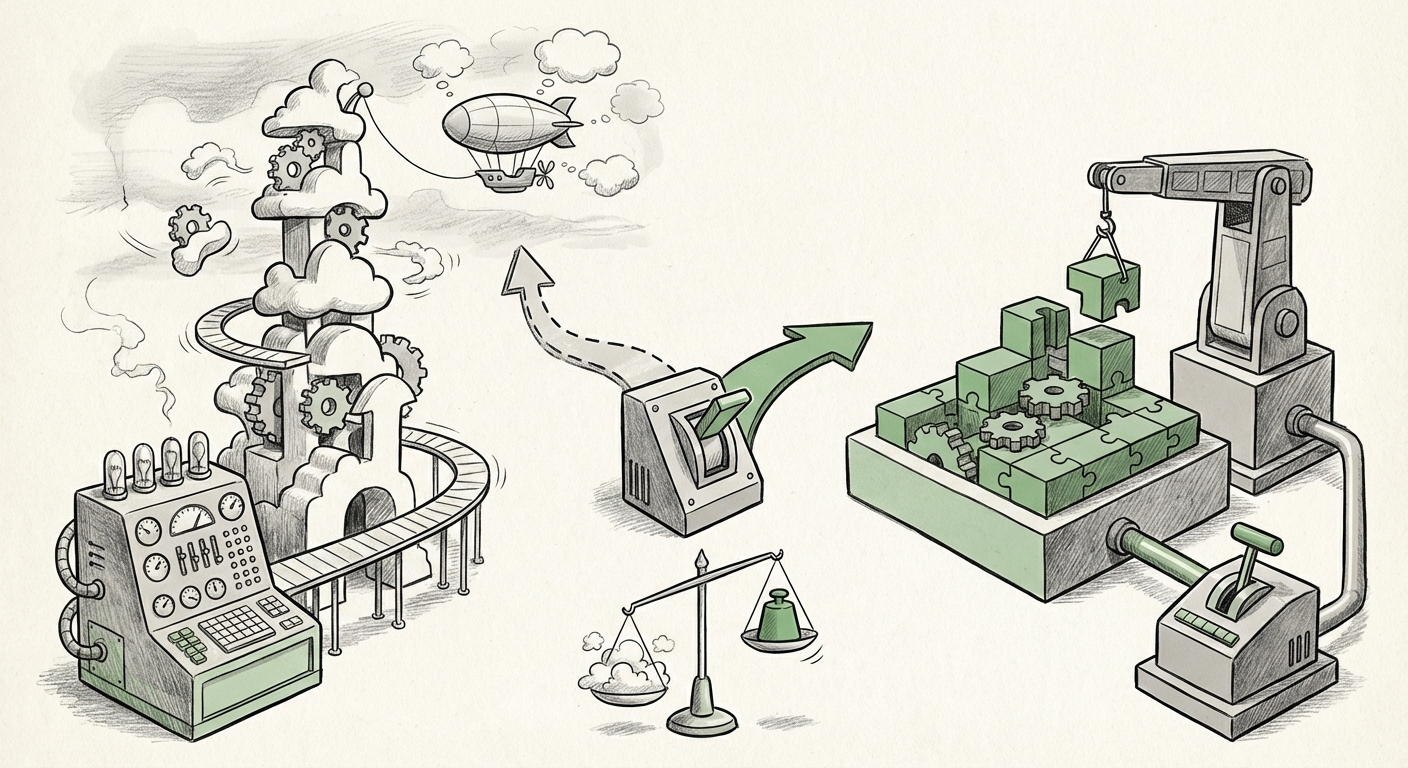
Grok’s performance profile—fast, cheap, and factually sound, yet trailing in overall intelligence—perfectly illustrates the **AI Utility Split**. We are seeing the market bifurcate into two essential tiers:
Tier 1: The Flagship Generalists (The Thinkers)
These are the GPT-5.4s and Gemini Ultras. They are essential for pushing scientific boundaries, writing groundbreaking code, creative ideation, and tackling novel problems that require deep, multifaceted reasoning. Their use cases often involve high creative output and lower immediate risk from occasional errors.
Tier 2: The Reliable Utilities (The Doers)
This is where Grok 4.20 seeks to dominate. These models are optimized for speed, low operational cost (TCO), and, critically, high reliability in narrow, high-volume domains. For many businesses, the Total Cost of Ownership (TCO) isn't just about the API call price; it's the cost of human oversight needed to correct factual errors.
As reports analyzing the cost-performance tradeoff in enterprise AI deployment show, massive, expensive models aren't always the best choice. If an organization needs to automate 10 million customer service responses a month, they need speed and a near-zero error rate far more than they need the ability to write a complex symphony. The marginal gain in intelligence offered by the flagship models does not justify the increased expense and the necessary layers of human verification required to catch hallucinations.
xAI's Strategic Bet: Trust as the Ultimate Differentiator
xAI’s focus appears to be less about winning the academic leaderboard and more about winning the enterprise contract that demands accountability. This strategic positioning leverages external data access and a targeted approach to model tuning.
Data Access and Factuality
One of xAI's inherent advantages lies in its close integration with the X platform. While this data is often messy and real-time, it provides a constant, diverse stream of contemporary information that helps train the model on "what is happening now," which can anchor factual retrieval better than static, older datasets.
Analyzing xAI’s strategy reveals a deliberate attempt to differentiate based on trust. If the market perceives Grok as the model that "tells the truth," regardless of how creatively it can argue, it unlocks applications in regulated industries—finance, legal, and healthcare—where *verifiability* is non-negotiable.
This mirrors competitive analysis suggesting that future AI differentiation will rely heavily on specialized expertise and proven reliability metrics, rather than chasing generalized scale alone. The marketplace is beginning to reward models that fit specific roles exceptionally well.
Practical Implications for Businesses and Society
The divergence between super-intelligent, fallible models and highly reliable, less intelligent models has massive practical implications across the economic landscape.
For Enterprise Adoption: The Compliance Layer
Businesses can now adopt a "right tool for the right job" approach with greater confidence. Before, the pressure was to use the best model available (usually GPT-4 or Gemini Advanced) for everything, creating bottlenecks where smaller, faster models could have sufficed, provided they were accurate.
- Customer Service & Support: Models with high factuality (like Grok 4.20) become ideal for answering specific product FAQs or processing standardized forms, reducing expensive human escalations caused by incorrect bot advice.
- Data Synthesis & Reporting: For internal reporting where the source documents are known (e.g., summarizing internal databases), reliability is paramount. A hallucination here means misreporting crucial business metrics.
- Regulatory Compliance: In fields dealing with legal texts or financial regulations, the ability to state "I do not know" or to strictly adhere to provided source documents (a proxy for low hallucination) is worth a premium over models that try to guess the answer.
Societal Impact: Rebuilding Trust in AI
On a broader scale, the proliferation of easily accessible, powerful, but occasionally untruthful AI has eroded public trust. Every major news cycle seems to feature an AI-generated image that is subtly wrong or a news summary that fabricates events. Grok's focus on factual accuracy, if validated widely, could be a critical step toward societal acceptance. People are more likely to adopt technology they believe they can trust implicitly.
Actionable Insights for Technology Leaders
As technology leaders navigate this evolving landscape, the focus must shift from simply *accessing* the latest foundational model to *integrating* the most *appropriate* model.
1. Audit Your Risk Profile, Not Just Your Performance Goals
Before signing the next massive enterprise license for a flagship model, ask: What is the cost of a factual error in this specific workflow? If the cost is high (financial loss, reputation damage, regulatory fines), prioritize models with proven low hallucination rates, even if they score lower on abstract reasoning tests.
2. Embrace Multi-Model Architectures
The future is not one model to rule them all. Adopt a tiered architecture. Use the high-powered models (Tier 1) for R&D, complex hypothesis testing, and creative design. Route high-volume, repetitive, or compliance-sensitive tasks to dedicated, highly factual, cost-effective models (Tier 2). This strategy maximizes ROI and minimizes systemic risk.
3. Demand Transparent Factuality Metrics
As a consumer of AI services, push vendors beyond generic benchmarks. Ask for proof regarding their model’s performance on your specific domain’s factuality tests. If a vendor cannot provide transparent data on how their model handles known pitfalls, treat their reliability claims with skepticism.
The Future is Reliable, Not Just Smart
The trajectory set by Grok 4.20 suggests that the AI narrative is maturing. We have successfully proven that AIs can be incredibly smart; now, we must prove they can be incredibly dependable. The current competitive dynamic between the giants pushing generalized intelligence and challengers optimizing for specific, vital qualities like factuality is healthy and necessary.
The next wave of genuine AI innovation won't just be about achieving higher IQ scores for our digital assistants; it will be about embedding them into the core infrastructure of global commerce and governance with the certainty that they will tell us the truth, or, perhaps even more importantly, know when to remain silent.