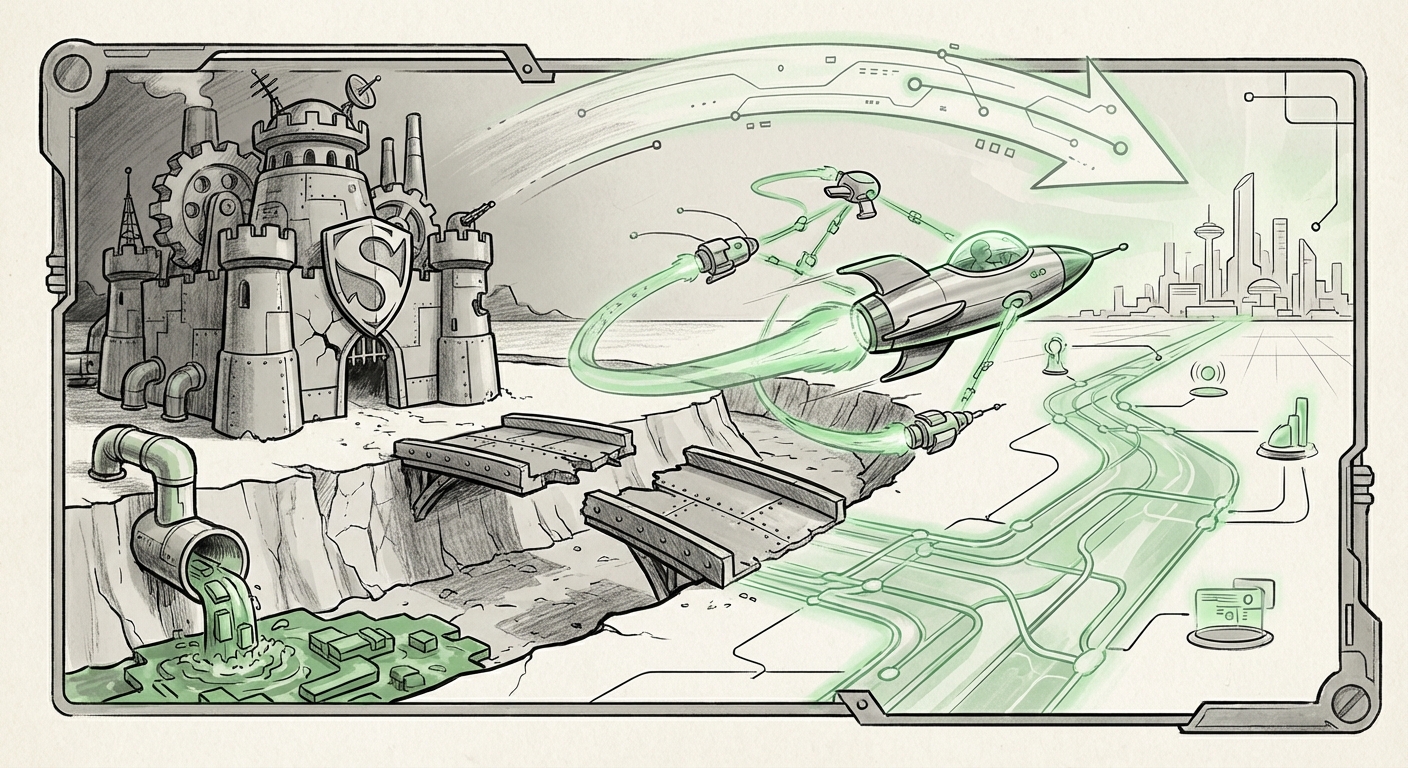
SaaSmagedon: Is Agentic AI Killing the Software Moat and Redefining SaaS?
For the last two decades, the software industry has operated under a seemingly unbreakable contract: Software as a Service (SaaS). Companies paid monthly or yearly fees for access to specialized, meticulously crafted applications that solved specific business problems. The barrier to entry wasn't just the idea; it was the sheer engineering effort required to build and maintain that complex software—the so-called "code moat."
However, a seismic shift is underway. Generative AI is not just providing better autocomplete; it is powering autonomous agents capable of understanding goals, planning steps, executing code, and learning from feedback. This evolution, dubbed "Agentic Engineering," suggests that the very nature of specialized software delivery might be fundamentally challenged. Is the era of monolithic SaaS tools coming to an end, replaced by flexible, goal-oriented AI agents?
The Catalysts: Agentic Systems and the New Engineering Paradigm
The argument hinges on the transition from passive software (where the user clicks through menus) to active software (where the system performs tasks based on high-level instruction). This is the essence of Agentic Engineering.
Think of it this way: a traditional CRM (SaaS) requires you to log in, navigate to the sales pipeline, manually update stages, and maybe run a report. An *agentic system*, conversely, might only require the instruction: "Analyze Q3 performance, identify all stuck leads, draft personalized follow-up emails, and schedule next steps."
This capability is validated by the rapid development in the field. We are moving beyond mere code completion tools (like early Copilot) toward frameworks designed for complex task orchestration. These systems are built to interact with tools, manage memory, and iterate on solutions—the necessary components for replacing multi-step application workflows. The focus is shifting to "Vibe Coding", where the user sets the overall intent or "vibe," and the agent handles the intricate execution details.
This technological shift demands corroboration. Analysis of agent frameworks shows a clear path toward increased autonomy. Engineers are validating the shift through research into orchestration tools, demonstrating that these agents can already handle significant portions of the development lifecycle, from testing to deployment. If AI can build, deploy, and iterate software faster and cheaper than a dedicated SaaS team, the traditional SaaS economic model becomes vulnerable.
What This Means for the Future of AI and How It Will Be Used:
For AI, this means maturation from a novelty to an infrastructure layer. Future AI will not just answer questions; it will *do* the work. For users, it means interacting with software through natural language intent rather than learning complex interfaces. This democratizes specialized tasks, as proficiency moves from mastering the software’s UI to mastering the prompt.
The Collapse of the Code Moat: Proprietary Logic is Now Commoditized
Historically, a company’s "code moat" was its primary defense against competitors. If you built a highly complex, proprietary algorithm for logistics optimization, or a nuanced financial modeling engine, the effort required to reverse-engineer or rebuild that code kept competitors at bay. This moat was the reason specialized SaaS could charge premium prices.
Generative AI models, trained on vast quantities of publicly available and proprietary code, are showing an astonishing ability to replicate complex logic quickly. When a general-purpose model can generate functional, optimized code for a niche problem that previously required 10,000 lines of highly specialized C++, the value of that proprietary code plummets. This is often termed IP devaluation.
Business strategists are keenly aware of this impending erosion. Competitive advantage is rapidly moving away from *how* software is built (the implementation) toward *what* proprietary data or exclusive workflow the AI agent is operating within (the context).
Practical Implications for Businesses:
Companies relying on decades of accumulated, undocumented internal codebases as their primary asset must urgently re-evaluate. If AI agents can automate 80% of the proprietary logic, that 80% is now a commodity, instantly available to any competitor with API access to a powerful LLM. The actionable insight here is clear: focus R&D efforts on unique data acquisition, novel feedback loops, and defining exclusive business processes, rather than simply polishing legacy application logic.
The Economic Reckoning: Challenging the SaaS Revenue Model
The "SaaSmagedon" theory suggests that if an agent can effectively replicate the *outcome* of a dozen expensive niche SaaS subscriptions, why pay twelve monthly fees?
Venture Capital analysis consistently points toward a fundamental decoupling of software value from software access. The traditional SaaS model relies on high fixed costs (developers, servers, marketing) spread over a large subscriber base. If AI agents can drastically reduce the marginal cost of delivering functionality, the pricing structure breaks down:
- From Subscription to Utility: Instead of paying for a license to use the software (SaaS), customers may shift to paying for the *compute* or the *result* delivered by the agent. This moves the model closer to a utility structure, like AWS or Azure, but for application logic.
- Lower Switching Costs: If an agent fulfills the need through a prompt, switching to a different agent framework is trivial. The customer isn't locked into a complex application ecosystem anymore.
This forces existing SaaS vendors into a difficult position. They must either rapidly integrate deep agentic capabilities into their existing platforms (becoming the *platform* that deploys the agents) or face being undercut by highly efficient, modular agents that aggregate functionality.
The Future of AI in Software Economics:
The economic future favors agility. Software creation and maintenance will see their costs drop dramatically, leading to massive productivity gains. The challenge for AI developers will be developing robust, auditable agent systems that can maintain the reliability customers expect from established SaaS platforms. The key metric may shift from Monthly Recurring Revenue (MRR) to **Result Per Input (RPI)**.
The User Interface Divide: Vibe Coding vs. The Polished GUI
Perhaps the most human-centric shift is the debate between "Vibe Coding" and the highly refined Graphical User Interface (GUI).
For years, the best software was defined by its user experience (UX)—its intuitive workflows, clean layouts, and predictable button placement. This required massive investment in front-end design and user testing.
"Vibe Coding," by contrast, suggests users will prefer telling a system what they want in natural language, even if the resulting actions are messy behind the scenes. They trade predictability for speed and relevance.
However, this trade-off is not universal. Users dealing with high-stakes, regulated tasks (like airplane navigation or complex legal drafting) still demand the certainty that a visual, step-by-step GUI provides. They need to *see* where the system is and what it has done.
The corroborating trend here lies in the maturation of conversational interfaces. While initial chatbots were unreliable, modern agents are demonstrating greater capacity to maintain context and execute multi-turn dialogues that resemble actual work sessions. Yet, design experts note that for complex operations, users want the *speed* of the prompt but the *visibility* of the GUI. This suggests a synthesis is inevitable.
Actionable Insight for Product Teams:
The most successful applications will be those that master the "Prompt-to-GUI Bridge." They will allow users to begin with an abstract command (the vibe) and then offer a dynamically generated, editable visualization of the agent’s planned steps (the GUI). This hybridization captures the efficiency of natural language while retaining the necessary oversight for high-stakes business applications.
Synthesizing the Future: Adaptation Over Extinction
Is SaaS dead? Not entirely. The term "SaaSmagedon" is perhaps too dramatic for the immediate future. What is dying is the assumption that proprietary, static codebases are an unassailable competitive advantage.
The future of software delivery will not be a binary choice between SaaS and Agents; it will be an integration:
- Platform Consolidation: Large, successful SaaS platforms will survive by becoming the environment in which proprietary agents run. They shift from selling applications to selling trusted, secure agent execution sandboxes.
- Functional Disaggregation: Highly specialized, simple tools that perform one task perfectly (e.g., a niche PDF converter) will be easily replaced by agents, forcing those vendors to either become agents themselves or be absorbed into larger suites.
- The Rise of the Orchestrator: The real value moves to the *orchestration layer*—the framework that manages multiple specialized agents, allocates tasks, and maintains the final business context.
For technology leaders, the mandate is clear: start experimenting with agentic workflows immediately. Understand how internal development teams can leverage agentic engineering to drastically reduce time-to-market for new features, thereby making traditional, slow-moving SaaS competitors obsolete from within. For business leaders, the focus must shift from defending the code moat to defining the next proprietary data advantage that these new autonomous systems will leverage.
The AI revolution is not ending software; it is fundamentally rewriting the economics, engineering, and user experience of every piece of software we use. The platform that wins tomorrow is the one that can best harness the power of autonomous action today.