The AI Chip Underground: How ByteDance's Malaysia Gambit Redraws the Geopolitical Map for Nvidia Blackwell
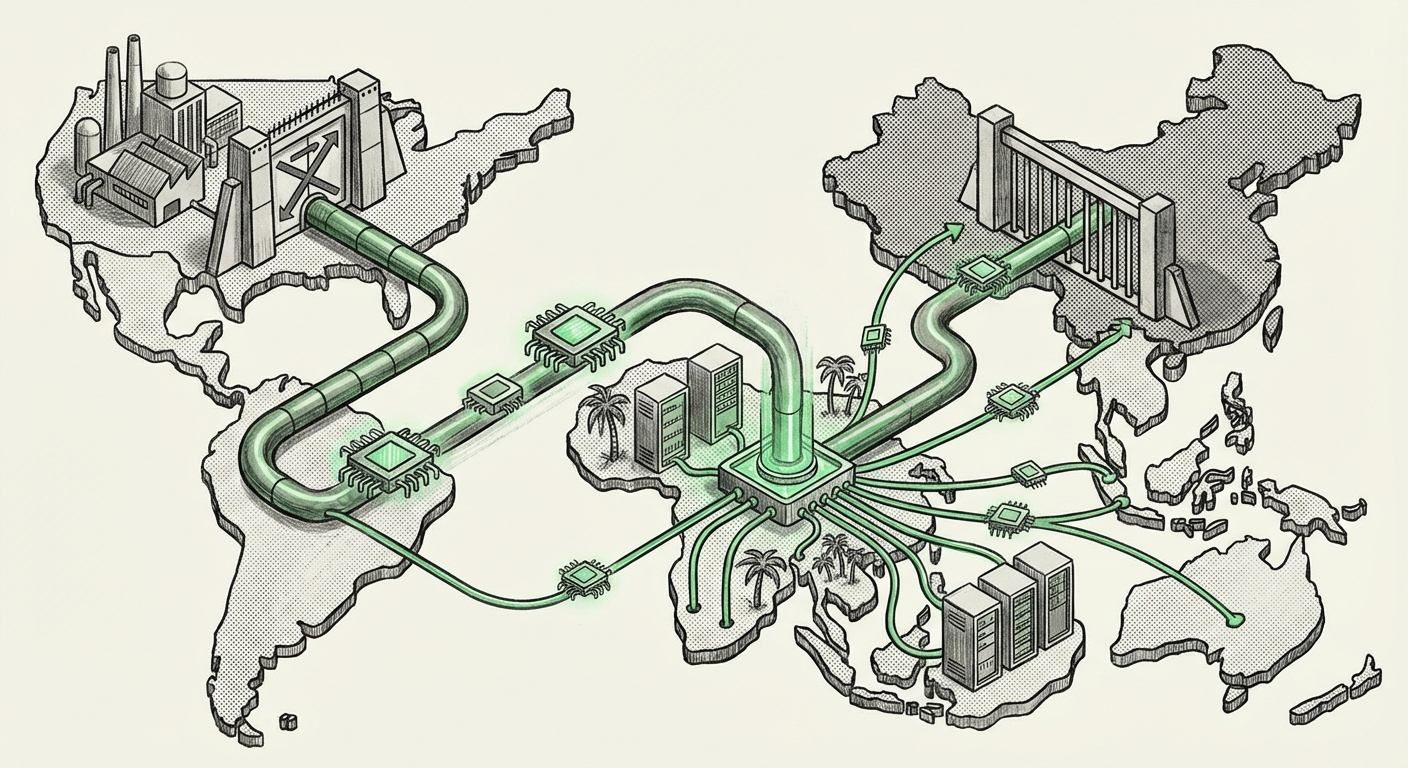
The race for Artificial Intelligence supremacy is not just about algorithms; it is fundamentally about access to the physical tools that power them—namely, high-performance semiconductors. When reports surfaced that ByteDance, the parent company of TikTok, was maneuvering to secure access to approximately 36,000 units of Nvidia’s cutting-edge Blackwell chips via operations in Malaysia, the move sent a clear signal across global tech and geopolitical landscapes. This alleged strategy isn't just a business transaction; it's a sophisticated act of supply chain engineering designed to navigate one of the most significant hurdles in modern technology: the U.S. export control regime targeting advanced AI compute in China.
For those of us tracking the intersection of AI capability and national security strategy, this development is electrifying. It forces us to look beyond datacenter floor plans and analyze the complex regulatory maze and the shifting geography of technological power. What does it mean when the world’s most coveted AI hardware—the very engine behind tomorrow’s large language models (LLMs)—is intentionally routed around sovereign restrictions? This article synthesizes this event, drawing context from the controls themselves, the rise of Southeast Asia, and the crushing global demand for the Blackwell architecture.
The Baseline: Understanding the Export Control Gauntlet
To appreciate ByteDance’s move, we must first understand the barrier. The U.S. government, through the Commerce Department’s Bureau of Industry and Security (BIS), has implemented stringent export controls aimed at preventing China from accessing chips powerful enough to build advanced military AI or sophisticated surveillance systems. These controls aren't broad prohibitions; they are highly specific, targeting chips based on performance metrics like processing power and bandwidth.
Our analysis of the relevant controls, such as those updated in August 2023 (which would specifically target the performance class of Blackwell), shows that these restrictions are laser-focused. They aren't just blocking older generations; they are trying to cap the *pace* of China’s AI development by starving it of the latest, most efficient computational density. For a company like ByteDance, whose TikTok service and vast content recommendation systems rely on ever-more-powerful foundational models, the inability to source Blackwell directly from Nvidia in the U.S. or through primary channels is a catastrophic bottleneck.
This regulatory environment creates a classic technological arms race challenge. If a system is too powerful for direct export, innovators seek the next nearest route. The stakes are incredibly high. As policy analysts monitor these moves, they recognize that any successful circumvention—even through seemingly legitimate third-party locations—challenges the efficacy of the entire control architecture. The exclusion of these very chips, even after recent relaxations, underscores the strategic importance placed on limiting access to the bleeding edge.
The New AI Frontier: Why Malaysia?
ByteDance is not randomly deploying resources; they are targeting a geopolitical sweet spot. The shift toward Malaysia as a critical node in the global AI infrastructure is a pronounced trend, moving beyond simple manufacturing assembly.
The Southeast Asian Compute Magnet
Southeast Asia (SEA), and Malaysia specifically, is rapidly transforming into a critical hub for high-performance computing (HPC) and data centers. Why this pivot away from traditional hubs like Singapore or directly into the West?
- Infrastructure Readiness: Major hyperscalers (Google, Microsoft) have already invested heavily in Malaysian infrastructure, signaling reliable power, connectivity, and regulatory frameworks for large digital operations.
- Government Incentives: Countries like Malaysia are actively rolling out attractive policies—often faster and with less geopolitical baggage than their Western counterparts—to court high-value digital investments. These initiatives might include tax breaks or streamlined approvals for data center development.
- Geographic Buffer: Malaysia offers a plausible distance and legal structure that allows for the *processing* and *development* of AI models that are then deployed globally, theoretically allowing a non-Chinese entity (or a legally distinct subsidiary) to house the hardware without violating direct U.S.-to-China transfer rules.
For ByteDance, using a Malaysian cluster for its massive global AI training needs provides plausible deniability regarding the final destination of the *knowledge* derived from the chips, even if the chips themselves are physically located outside China. This geographical arbitrage is a hallmark of modern, geopolitical technology strategy.
The Blackwell Bottleneck: Demand Outstrips Reality
It is crucial to remember that even without sanctions, securing 36,000 Blackwell chips is a monumental feat. Nvidia’s Blackwell architecture (following the highly successful Hopper generation) represents the pinnacle of AI training capability, necessary for training the next generation of trillion-parameter models.
Supply chain analysis reveals that the initial allocation of these chips is fiercely contested. The first waves of production are prioritized for major U.S. cloud providers and key allies. Therefore, ByteDance’s aggressive acquisition strategy through a third country suggests they are not merely abiding by the rules; they are fighting tooth and nail for *priority access* in a market defined by extreme scarcity.
This competition frames the future implications clearly: Compute inequality is accelerating. Companies that can engineer complex, multi-jurisdictional solutions to access the newest hardware will leapfrog competitors who are restricted to older generations or slower allocation queues. For AI developers worldwide, this means the quality gap between the models trained on Blackwell hardware and those trained on older GPUs will widen significantly.
Pattern Recognition: The Rise of Third-Country Channeling
ByteDance is unlikely to be acting in isolation. Our search for precedent reveals a historical pattern among major Chinese technology firms navigating U.S. restrictions. This practice, often termed "third-country channeling" or "supply chain engineering," involves establishing R&D centers, assembly operations, or subsidiary headquarters in jurisdictions with fewer restrictions (like Southeast Asia, the Middle East, or certain European nations).
We see echoes of this strategy in how firms reacted to previous sanctions. For example, analyzing how Chinese tech giants restructured their supply chains following earlier restrictions reveals a playbook: establish a beachhead in a friendly or neutral territory, funnel the desired restricted components there, and then use those local facilities for the high-value processing work (training the AI models) before potentially using the *outputs* (the trained models or refined software) elsewhere.
This is the long game. It implies that these companies are not waiting for policy shifts; they are building parallel, sanction-resilient technological ecosystems. For trade lawyers and geopolitical risk assessors, this signals a permanent migration of high-tech compute infrastructure outside the direct regulatory reach of Washington, potentially leading to a fractured global standard for AI development.
What This Means for the Future of AI and Business
The ByteDance-Malaysia-Blackwell nexus reveals three profound implications for the global technology sector:
1. The Bifurcation of AI Capabilities
The geopolitical struggle is resulting in two distinct tiers of AI capability. Tier One utilizes the latest, most powerful hardware (like Blackwell) to push the boundaries of LLMs, foundation models, and scientific discovery. Tier Two, constrained by access or budget, lags behind. The ability to use complex international structuring to access Tier One hardware becomes an essential competitive advantage, regardless of where the company is officially headquartered.
Actionable Insight for Businesses: If your core competitive advantage rests on rapidly iterating cutting-edge AI models, your procurement and legal teams must collaborate immediately to map out potential third-country operational hubs. Relying solely on direct purchases from the US hardware vendors will likely leave you behind.
2. The Scrutiny Shifts to the 'Last Mile'
US regulators will inevitably turn their attention to these third countries. While Malaysia currently appears to be a viable route, increased political pressure on nations hosting these operations is guaranteed. The U.S. government will have to address whether processing advanced models in a non-sanctioned nation constitutes a prohibited "end use."
Actionable Insight for Governments and Investors: For regional players like Malaysia, this influx of capital is a double-edged sword. It brings massive digital investment and job creation, but it also forces the nation into the center of U.S.-China technological friction. Investors must closely monitor the diplomatic risk associated with these high-profile data center projects.
3. Software Strategy Becomes Hardware-Aware
For AI researchers and engineers, the era of treating hardware as a universally available utility is over. Every significant model training run must now be designed with the constraints of the *actual available hardware* in mind. If a company has access to Blackwell clusters in an overseas facility, their model architecture might prioritize maximum parallelism suited for that specific hardware configuration, potentially optimizing for energy efficiency or model size based on local infrastructure realities.
Actionable Insight for Developers: Model optimization is no longer just an algorithmic problem; it's a geopolitical one. Understanding where your compute resides—and the regulatory environment of that location—will dictate your training strategies.
The Long View: Compute as a Sovereign Asset
The ByteDance Malaysian operation serves as a high-profile illustration that advanced compute is now firmly treated as a sovereign asset, equivalent to nuclear technology or advanced aerospace components. Control over the hardware means control over the pace of innovation.
The future will likely see an acceleration in two opposing trends:
- Increased Localization: Nations recognizing the strategic value of AI independence will pour resources into developing domestic chip design capabilities (even if manufacturing remains outsourced).
- Increased Sophistication in Circumvention: Companies will continue to leverage complex global legal structures, joint ventures, and strategic hosting agreements in neutral or friendly jurisdictions to maintain technological parity.
The battle for AI leadership is being fought not just in Silicon Valley labs, but in the boardrooms of Singapore, the data center incentives of Kuala Lumpur, and the compliance offices of global technology giants. The chips are moving, the policies are hardening, and the global technology map is being redrawn in real-time, one high-performance GPU cluster at a time.