The Great AI Pivot: Why Tech Giants Are Firing to Fund the $600B Future of Artificial Intelligence
The technology landscape is undergoing a seismic shift, one where the cost of progress is being paid not just in quarterly earnings, but in human capital. Recent reports suggesting that Meta Platforms is planning workforce reductions—potentially cutting up to 20% of its staff—are not merely a sign of corporate belt-tightening. They are the clearest signal yet of a **strategic capital reallocation** driven by the immense financial demands of the Artificial Intelligence race.
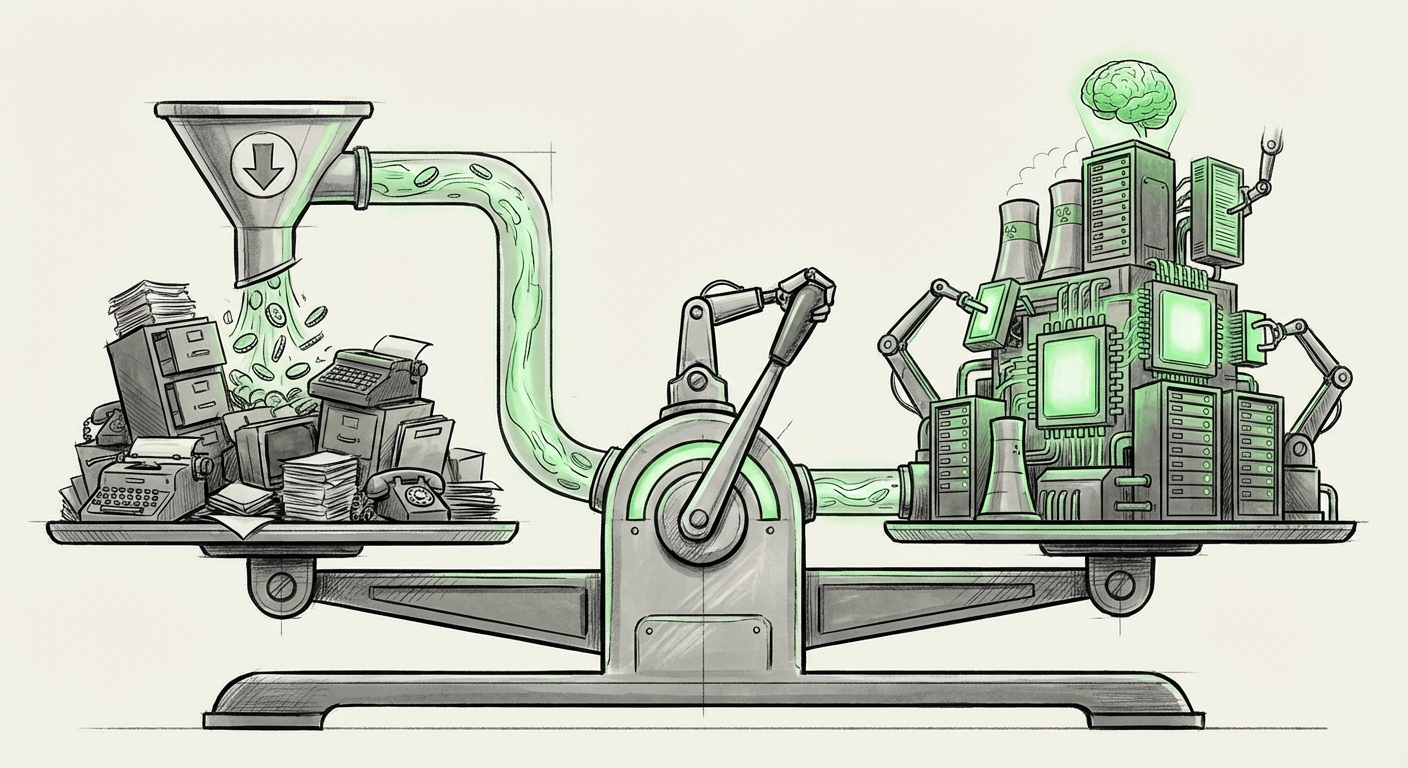
This narrative—Massive AI Spending $\rightarrow$ Need for Cost Reduction $\rightarrow$ Workforce Reduction $\rightarrow$ Strategic Pivot—is becoming the defining story of Big Tech in the mid-2020s. Meta’s reported long-term AI commitment, potentially reaching $\$600$ billion, underscores that dominating the next computing paradigm requires spending sums that dwarf previous investments in mobile or social networking.
The Price of Intelligence: Benchmarking the AI Arms Race
To understand why layoffs are linked to AI investment, we must first grasp the sheer cost of building foundational models. Training leading-edge Large Language Models (LLMs) requires clusters of thousands of specialized, cutting-edge Graphical Processing Units (GPUs)—hardware that is both scarce and staggeringly expensive. We are moving from building software applications to building planetary-scale computational resources.
When we query the industry spending landscape—looking at reports on "total industry spending on large language models and infrastructure 2024"—the data confirms a spending spree that necessitates extreme fiscal discipline elsewhere. Investment banks and research firms project CAPEX across the sector soaring into the hundreds of billions to secure the necessary silicon from suppliers like NVIDIA.
For Meta, which has already invested heavily in Reality Labs (the Metaverse), this new AI imperative cannot be absorbed easily. The choice becomes stark: either slow down the AI buildout and risk obsolescence, or aggressively shed legacy operational costs to feed the hungry AI engine. The reported layoff strategy clearly favors the latter. This is not about efficiency alone; it is about funding survival in the age of generative AI.
What This Means for the Future of AI Infrastructure
The future of AI will be defined by who can afford the most compute. This necessitates a consolidation of resources toward core AI development teams and infrastructure teams. Roles deemed less critical to immediate AI model development or necessary infrastructure maintenance are being pruned to free up billions for hardware acquisition and specialized researcher salaries.
The Industry-Wide Contagion: Layoffs as a Funding Mechanism
Meta’s move is not an anomaly; it is a leading indicator of industry-wide restructuring. By searching for "tech company layoffs driven by ai pivot," we find a pattern emerging across Silicon Valley. Microsoft is aggressively reallocating staff toward its Azure AI division following its partnership with OpenAI. Alphabet (Google) has also undergone significant internal reorganizations, often resulting in targeted cuts even as hiring in AI research remains fierce.
This trend suggests that AI is acting as a powerful gravity well, pulling talent and capital toward its center. Any division or project not directly contributing to AI advancement—whether in foundational models, infrastructure, or application integration—is being scrutinized under the harsh light of financial necessity.
For the average tech employee, this is a clear message: relevance in the coming decade is tied directly to skills that complement or build AI systems. If your role is primarily focused on maintaining older systems or processes that generative AI can automate or render redundant, your position becomes fiscally vulnerable.
The Dual Role of AI: Efficiency Versus Investment
A nuanced view requires looking beyond simple cost offsets. We must investigate the "impact of generative ai on operational efficiency and headcount planning." While the immediate need to fund billions in GPUs is paramount, there is a secondary, powerful effect taking place: AI is beginning to automate white-collar tasks.
Meta, like many others, is likely operating on two tracks simultaneously:
- Funding Track: Cutting headcount in non-core or redundant areas to free up capital for server farms and research talent.
- Efficiency Track: Implementing the very AI tools they are developing to reduce the need for future hiring in areas like content moderation, customer service, coding assistance, and internal documentation.
This dual strategy offers significant leverage. By cutting staff now, companies create space for AI efficiencies later. Think of it like preparing a massive foundation for a skyscraper: you must first clear the existing, smaller buildings (legacy roles) before you can pour the concrete for the new structure (AI operations).
Practical Implications for Business Strategy
For business leaders outside of Big Tech, this serves as a critical benchmark. If the firms with the deepest pockets are undergoing painful structural realignment to fund AI, smaller or mid-sized businesses must approach AI integration with urgency. Ignoring the need to pivot resources away from legacy operational maintenance toward AI adoption is a recipe for competitive failure.
Meta’s Hardware Imperative: Fueling the Brain
The financial scrutiny is directly traceable to the physical requirements of AI. Querying reports on "Meta's capital expenditure for AI hardware roadmap" reveals the scale of physical asset acquisition necessary. These aren't standard servers; these are high-density, power-hungry computational clusters.
Meta is not just building software; it is building digital brains. These brains require immense power, cooling, and, crucially, chips from manufacturers like NVIDIA. The cost of acquiring tens of thousands of these specialized accelerators runs into the tens of billions annually. This monumental hardware expenditure is the non-negotiable cost of entry into the top tier of AI development. When a company commits $\$600$ billion over a decade, the vast majority of that capital is earmarked for compute power—the raw material of modern AI.
This hardware dependency creates a significant economic bottleneck. Companies must secure supply lines and pay premium prices, making every saved dollar from operational cuts that much more vital for securing the next shipment of GPUs.
Actionable Insights: Navigating the AI Reorganization Era
This period of forced restructuring offers clear lessons for technologists, executives, and individuals alike:
1. For Executives: The "AI Tax" is Real
If your company’s strategic plan does not explicitly account for a significant reallocation of budget and personnel toward AI research, integration, or infrastructure within the next 18 months, you are likely under-budgeting for the future. View AI spending not as an optional overhead, but as a mandatory operating expense—an "AI Tax"—required to maintain market relevance.
2. For Technologists: Upskill or Face Obsolescence
The technical skills valued today are those that build, manage, or integrate large-scale AI systems (MLOps, prompt engineering, distributed computing, model fine-tuning). Roles focused purely on standardized, repeatable digital tasks are the most susceptible to both layoffs (to fund AI) and eventual automation (by implemented AI). Focus your professional development on areas that leverage AI capabilities rather than those that compete directly with them.
3. For Business Leaders: Optimize for Agility, Not Scale
The traditional model of scaling headcounts to meet market demand is breaking. Future growth must be achieved through technological augmentation. Businesses must restructure to be lean and agile, ready to absorb new, powerful AI tools without immediately bloating administrative overhead. Operational excellence is now defined by maximizing output per highly specialized human input, supported by AI infrastructure.
Conclusion: The Leaner, Smarter Future
Meta’s reported strategy epitomizes the trade-offs defining the current technological age. The pursuit of artificial general intelligence (or even just state-of-the-art domain-specific AI) is the single most capital-intensive endeavor in corporate history. To fund this future, established giants are making difficult, present-day sacrifices.
The implication for the future of AI is clear: the next wave of breakthroughs will be backed by unprecedented computational muscle, fueled by cost savings extracted from legacy structures. We are witnessing the necessary pruning of the industrial age organization to make way for the computational age enterprise. While painful for those directly affected, this massive reallocation confirms the industry consensus: AI is not just another feature; it is the new operating system for the global economy, and only those willing to pay the steep price of admission will write the code for tomorrow.