The $200 AI Agent: Analyzing Perplexity's 'Personal Computer' and the Rise of Autonomous Systems
The landscape of personal technology is perpetually shifting, driven by waves of innovation. For decades, the personal computer (PC) was defined by hardware specifications and operating systems. Today, the definition is evolving rapidly, moving from a passive tool we operate to a proactive entity that operates *for* us. The recent announcement regarding Perplexity’s concept for a "Personal Computer"—an always-on, dedicated AI agent priced at a premium $200 per month—is not just another high-priced subscription; it signals the concrete arrival of the **Agentic AI Era**.
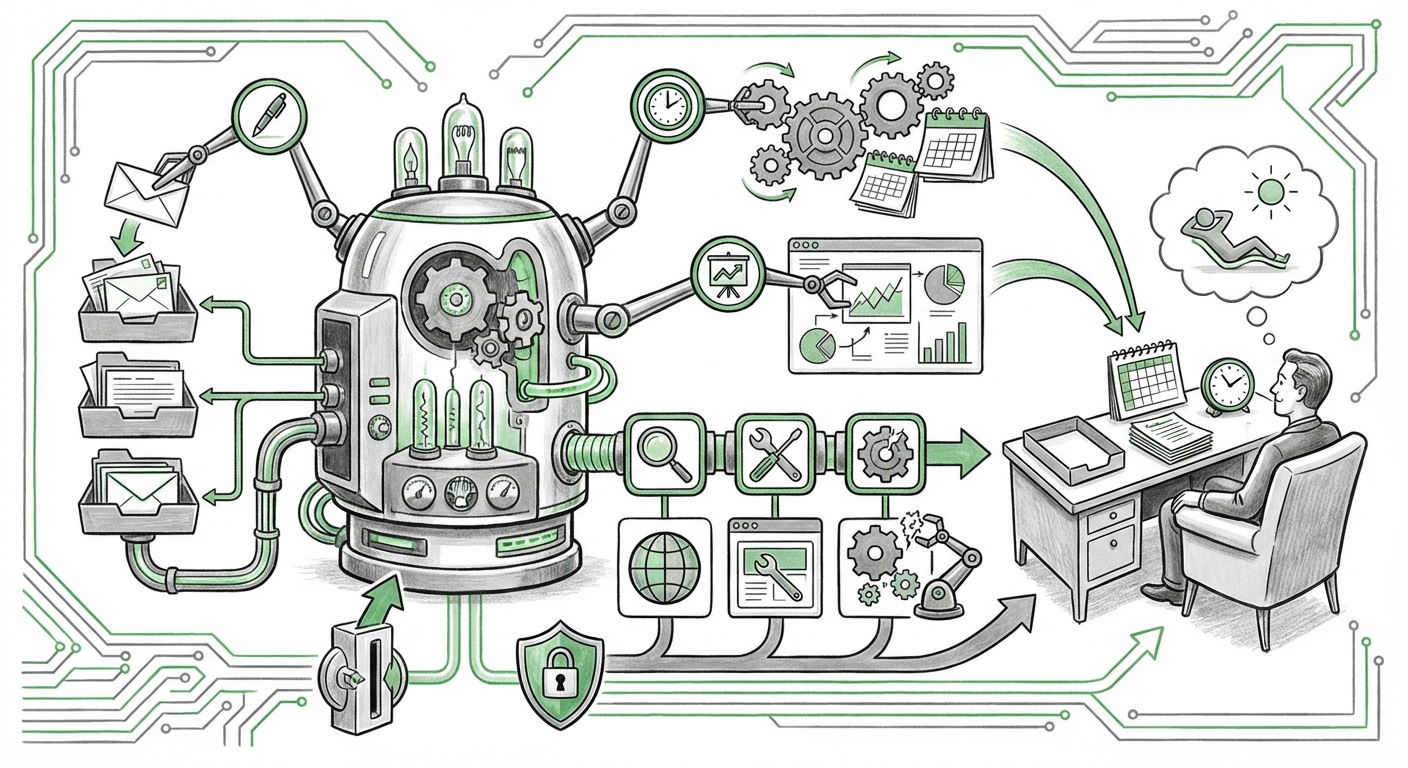
This concept moves far beyond the simple question-and-answer functionality of chatbots. It promises an executive assistant capable of handling complex, multi-step tasks like managing email inboxes, drafting detailed presentations, and controlling other software applications around the clock. To understand the gravity of this shift, we must analyze the underlying technology, the emerging economic model, and the profound implications for how we work.
The Technological Leap: From Chatbot to Autonomous Agent
Traditional Large Language Models (LLMs) are reactive. You prompt them, and they generate a response. Perplexity’s vision requires a fundamental upgrade: **Agentic AI**. Think of it this way: if a chatbot is an excellent consultant you have to micromanage, an autonomous agent is a fully empowered intern who needs clear goals but executes the entire workflow independently.
The Challenge of Going Proactive
For this $200 PC to deliver on its promise—handling emails and applications—it needs technical prowess far exceeding current public models. It must master what analysts call **tool use and planning**. It needs to:
- Deconstruct Goals: Break down a vague request ("Handle my Monday morning prep") into hundreds of discrete, logical steps.
- Tool Selection: Know when to use a web search tool, when to access a calendar API, and crucially, when to manipulate a local application interface.
- Error Recovery: Detect when an action fails (e.g., a login times out) and self-correct the plan without human intervention.
This pushes the boundary of current research. Analysts tracking the market have noted intense competition in developing these reliable, general-purpose agents. The emergence of highly specialized, high-cost agents, such as those seen in early demonstrations by firms like Cognition Labs with their agent "Devin," suggests that the market believes this level of reliable autonomy is achievable, even if it commands a high price tag initially.
For the technically inclined, the core challenge—and opportunity—lies in creating models that can reliably navigate Graphical User Interfaces (GUIs). Search queries focusing on "LLM desktop automation challenges" reveal that making AI truly interact with the fragmented, visual world of modern software remains a significant hurdle. Success here means the agent doesn't just read your calendar; it opens Outlook, drafts replies, and schedules the meeting request itself.
The Economics of Always-On Intelligence: The $200 Question
Perplexity is pricing its dedicated agent similarly to a dedicated, highly skilled human contractor. This aggressive pricing strategy forces a critical market analysis: is the value delivered truly equivalent to the cost?
Navigating Subscription Fatigue
Consumers and businesses are currently suffering from **subscription fatigue**. We pay for cloud storage, streaming, productivity suites, and now, foundational AI access (like ChatGPT Plus or Gemini Advanced). A $200 monthly fee pushes the offering into the category of a critical business utility, not a consumer luxury.
The target audience for this initial offering is likely the high-earning professional or small business owner whose time is demonstrably worth more than $200 an hour. If the agent can save a consultant 10 hours of administrative or preparatory work per month, the return on investment is immediate and tangible. Market analyses often compare these emerging premium tools against existing enterprise software costs. While Microsoft 365 Copilot is folded into a bundle, Perplexity is offering *dedicated autonomy* for a specific price, forcing users to weigh the value of dedicated, tireless delegation.
This mirrors broader trends observed when powerful technology first breaks through. Early adopters pay a premium for capability, which drives down costs and broadens adoption later. The success of this $200 tier will dictate the viability of the wider **Autonomous AI Agents Market Growth Projections**.
Implications for the Future of Work and Digital Life
If the autonomous agent becomes mainstream, the very nature of productivity—and consequently, employment—will be redefined. This is where the trend moves from technical feasibility to societal impact.
The Democratization of Delegation
For most of history, delegation required hiring or managing another person. The autonomous agent democratizes delegation by making it accessible 24/7, requiring no management, vacation time, or salary negotiation (beyond the subscription). Tasks previously deemed "too tedious" or "low-value" for executives will be absorbed entirely.
- For Professionals: Instead of spending two hours compiling data for a weekly report, the agent delivers the finished, formatted document. Focus shifts entirely to strategic thinking and decision-making based on the agent’s synthesized input.
- For Small Businesses: An agent could handle all Level 1 customer service inquiries, manage inventory alerts, and process invoices—tasks that previously required hiring an administrative assistant.
The Security and Trust Dilemma
The most critical implication surrounds trust. If an AI agent is handling your email, drafting communications under your digital signature, and controlling applications, it possesses a vast new attack surface. We move from protecting passwords to vetting the reliability and security protocols of the agent itself.
Users must trust that the agent: a) won't leak sensitive data, b) won't misinterpret instructions leading to catastrophic errors (like sending an angry email to a key client), and c) operates within legal and ethical bounds. This necessitates a new class of security validation focusing on agent behavior rather than just data encryption.
Actionable Insights for Navigating the Agentic Frontier
For businesses and individuals looking to capitalize on, or prepare for, this shift, analysis of these concurrent developments yields several clear action items:
1. Audit Your Digital Workflow for Agent Readiness
Identify the 20% of your tasks that consume 80% of your administrative time. These are the immediate targets for future agent delegation. Discussions on "Consumer willingness to pay for advanced AI agents" often highlight task reduction as the primary driver for adoption. Start mapping those workflows now, understanding the exact steps and tools involved, so you can feed them clearly to your future agent.
2. Invest in AI Interoperability
The true power of an agent is its ability to hop between apps. Businesses should prioritize software stacks that offer robust, modern APIs (Application Programming Interfaces). If your legacy CRM doesn't easily talk to your communication tools, your autonomous agent will struggle, rendering the $200 investment inefficient.
3. Develop an AI Delegation Policy
Before delegating tasks entirely, establish clear guidelines on what the agent is authorized to do independently versus what requires final human approval. This mitigates risk. For example, the agent drafts all responses but flags any email containing terms like "legal action" or "contract termination" for mandatory human review.
Conclusion: The Personal Computer Reimagined
Perplexity’s "Personal Computer" is more than just a clever marketing term; it’s a stake in the ground defining the next era of human-computer interaction. It acknowledges that while foundational LLMs have mastered information synthesis, the true bottleneck in modern productivity is *execution*. By demanding a premium price, Perplexity is betting that the market is ready to pay for reliable, proactive automation that truly manages the chaos of digital life.
We are moving away from an era where we had to learn how to use software, toward an era where software learns how to work *for* us, tirelessly and autonomously. The competition among tech giants to deliver this capability reliably will define the next decade of computing innovation. The question for every professional is no longer *if* they will hire an AI agent, but *when*, and how much they are willing to pay for the gift of reclaimed time.