The End of Real-World Data Collection? How Pure Simulation is Revolutionizing Robotics AI
For decades, the physical world has been the ultimate gatekeeper for artificial intelligence in robotics. If you wanted a robot to learn how to grasp a complex object, open a door, or navigate a chaotic warehouse, it needed to practice—thousands, sometimes millions, of times—in the real environment. This process is agonizingly slow, requires constant human supervision, and costs vast amounts of money. It has been the single greatest bottleneck holding back the mass deployment of intelligent robots.
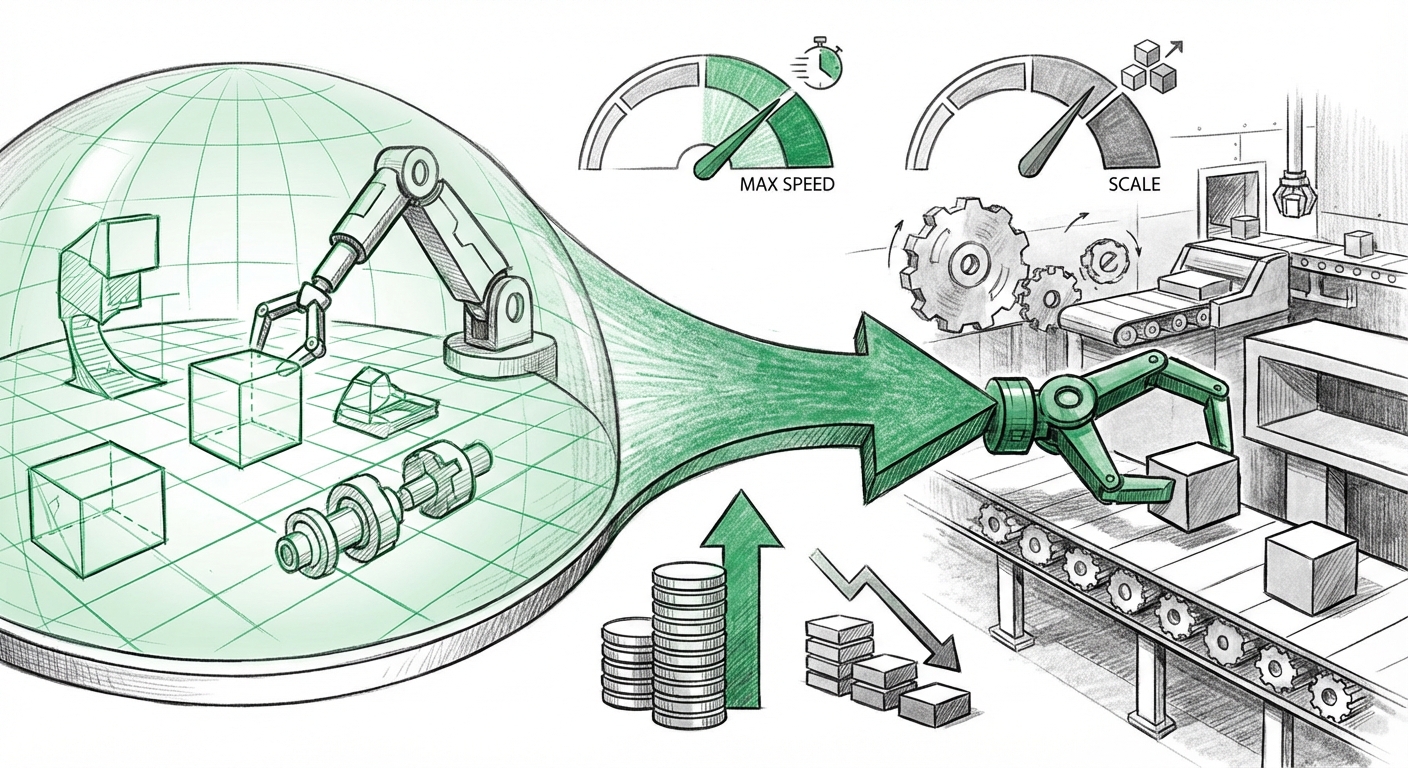
However, recent breakthroughs, notably demonstrated by the Allen Institute for AI (Ai2), suggest a seismic shift is underway. The capability to train powerful new robotics models entirely in a virtual world and have them perform reliably in reality is moving from science fiction to production reality. This is the promise of **Sim2Real transfer**, and it spells the beginning of a new era for embodied AI.
The Bottleneck Broken: Understanding Sim2Real Transfer
Imagine teaching a child to ride a bicycle. You could explain physics, draw diagrams, and show videos (simulation), but eventually, the child must get on the bike and wobble in the real world. Traditional robotics training followed this path: Train in software, deploy in reality, crash, debug, repeat. The gap between the perfect, predictable digital world and the messy, imperfect real world is known as the **Sim2Real gap**.
The goal of Sim2Real research is to teach the AI agent in the simulation so well that when it steps into the real world, it operates almost flawlessly on the first try. This bypasses the need for expensive, time-consuming physical data collection.
The Technical Edge: Mastering Domain Randomization
How do researchers like those at Ai2 manage to leap this gap? The secret lies in making the simulation *less* perfect. If a simulation is a perfect mirror of reality, the slightest real-world difference (a slightly different light reflection, a texture change, a small friction variance) causes the trained model to fail spectacularly. The key technique driving this success is Domain Randomization.
Instead of training the robot model on one perfect digital world, researchers deliberately throw chaos at it within the simulation. They randomize everything:
- Visuals: Changing textures, lighting angles, camera noise, and colors.
- Physics: Varying gravitational constants, object masses, and surface friction coefficients.
- Sensor Noise: Injecting simulated errors into the robot's virtual sensors to mimic real-world limitations.
By forcing the AI to learn robust strategies that work across millions of slightly different virtual environments, the resulting model gains a level of generalization that makes it inherently resilient to the minor imperfections found in physical reality. When the model encounters the real world—which is essentially just one more variation in the massive distribution of randomized worlds—it performs successfully.
This corroborates the idea that the challenge isn't just creating simulations, but creating smartly varied simulations. As technical analyses of Sim2Real advancements show, success hinges on finding the right balance of randomization that teaches flexibility without overwhelming the learning process.
The Commercial Revolution: Who Is Investing in the Virtual Foundry?
While academic research lights the path, commercial adoption validates the technology’s viability. The implications of successful, pure simulation training for industry are staggering, particularly in sectors where physical iteration is costly, such as logistics, manufacturing, and autonomous driving.
Industry Adoption: Beyond the Garage
The shift toward simulation-first training is accelerating across major industrial players. Companies deploying large fleets of robots, whether for sorting packages in a fulfillment center or assembling sensitive electronics, are realizing that the cost of downtime for real-world retraining is immense. This is why we see heavy investment from tech giants and specialized startups alike:
- Digital Twins: Major logistics companies are creating "digital twins"—highly accurate virtual replicas of their entire warehouses. Robots are trained entirely within these twins before the physical robot even arrives on site.
- GPU Power: The success relies on companies like NVIDIA, whose platforms (like Isaac Sim) are specifically designed to handle the massive computational load required to run millions of physics-based simulations in parallel. These platforms make the creation of high-fidelity, randomized digital worlds accessible.
When we look at the commercial landscape, the trend is clear: the competitive advantage will belong to those who can deploy robots faster. If Company A takes six months to train a new gripping routine by gathering physical data, and Company B can achieve the same result in two weeks using simulation, Company B gains a massive lead in deployment speed and scalability. This competitive pressure drives the urgency behind the Ai2-style breakthroughs.
The Economic Earthquake: Dismantling the Data Moat
Perhaps the most profound implication of pure simulation training is its impact on the economics of AI development. Historically, collecting massive, proprietary real-world datasets was the ultimate defense mechanism—the "data moat"—that protected established players.
Quantifying the Cost of Reality
Consider autonomous vehicles. Training a self-driving system requires billions of miles driven under real-world conditions, logging every shadow, every unexpected pedestrian jaywalk, and every icy patch of road. The capital investment required for the sensors, fleets, and safety drivers makes this prohibitively expensive for newcomers. Finding data on the sheer cost of real-world robot data collection confirms this expense.
Simulation, however, offers near-zero marginal cost data generation. Once the physics engine and environment are built:
- Speed: A simulation can run 1,000 times faster than real-time.
- Scale: A single high-powered GPU cluster can generate the equivalent of decades of real-world driving or grasping experience in a single day.
- Safety: Robots can practice catastrophic failures (crashing, dropping hazardous materials) without consequence or cost.
This democratization of data generation is a leveler. It significantly lowers the barrier to entry for developing specialized, high-performing robotic systems. Startups and smaller research labs can now compete on algorithmic ingenuity rather than sheer financial muscle for data acquisition.
Future Implications: What Happens Next?
If the Sim2Real gap continues to shrink, we are moving toward an environment where software deployment cycles in robotics resemble those in cloud computing. Instead of long hardware development phases, we move toward rapid, iterative software updates driven by synthetic data.
1. Hyper-Personalized Automation
Today, robots are generally trained for one task in one environment (e.g., stacking blue boxes in Warehouse X). With simulation, we can quickly retrain a generalist model for a highly specific, short-term task—like handling a new type of oddly shaped packaging during the holiday rush—and deploy the update overnight.
2. The Rise of Synthetic Data Providers
We will likely see the emergence of specialized companies whose entire business model is creating and selling highly realistic, vast synthetic environments and pre-trained simulation-ready models. These companies will not sell physical robots; they will sell the brains, validated in the digital realm.
3. Ethical and Safety Validation
While simulation removes cost barriers, it introduces new verification challenges. How do we certify that a model trained entirely in a simulated physics engine is safe enough for the real world? Future regulations and industry standards will need to adapt to validate the quality of the simulation as much as the quality of the resulting physical performance. This requires rigorous testing across a spectrum of randomized edge cases to ensure real-world reliability.
Actionable Insights for Leaders
For any organization considering integrating physical automation or developing AI-driven hardware, the message is clear: Your simulation strategy is now a core component of your AI strategy.
- Invest in Simulation Tools: If you are still relying on collecting physical data, you are already falling behind. Prioritize internal or external investments in high-fidelity simulation platforms capable of advanced domain randomization.
- Hire for Synthesis Skills: The most valuable engineers in the next five years won't just be machine learning experts; they will be experts in building environments, defining physics parameters, and closing the Sim2Real gap.
- Prepare for Scale: Because simulation training drastically lowers the marginal cost of creating new skills, prepare for a future where you might deploy 100,000 specialized robots, not just 100 standardized ones. Your infrastructure must handle massive updates and varied deployments.
The research from Ai2 signals that we are crossing a threshold. We are moving away from robots that need to crawl before they can walk, toward robots that are born street-smart, having mastered the foundational laws of physics and interaction in the digital sandbox. This changes everything about how quickly, cheaply, and effectively we can automate the physical world.