$2 Million on the Line: Why AI Still Struggles with Human-Like Problem Solving
Imagine offering $2 million to anyone who can build an AI that's as good as an average person at solving simple, interactive games. Sounds easy, right? After all, we've seen AI beat world champions at chess and Go. But the reality is quite different. The ARC-AGI-3 benchmark, a new challenge designed to test AI's ability to solve problems like humans do, reveals a surprising weakness: even the most advanced AI models score below 1 percent.
What is ARC-AGI-3 and Why Is It So Hard?
ARC-AGI-3 presents AI systems with interactive game environments. These aren't your typical video games; they are designed to mimic the kind of simple, intuitive problem-solving that humans do effortlessly. Think of tasks that require understanding cause and effect, spatial reasoning, and the ability to learn from trial and error.
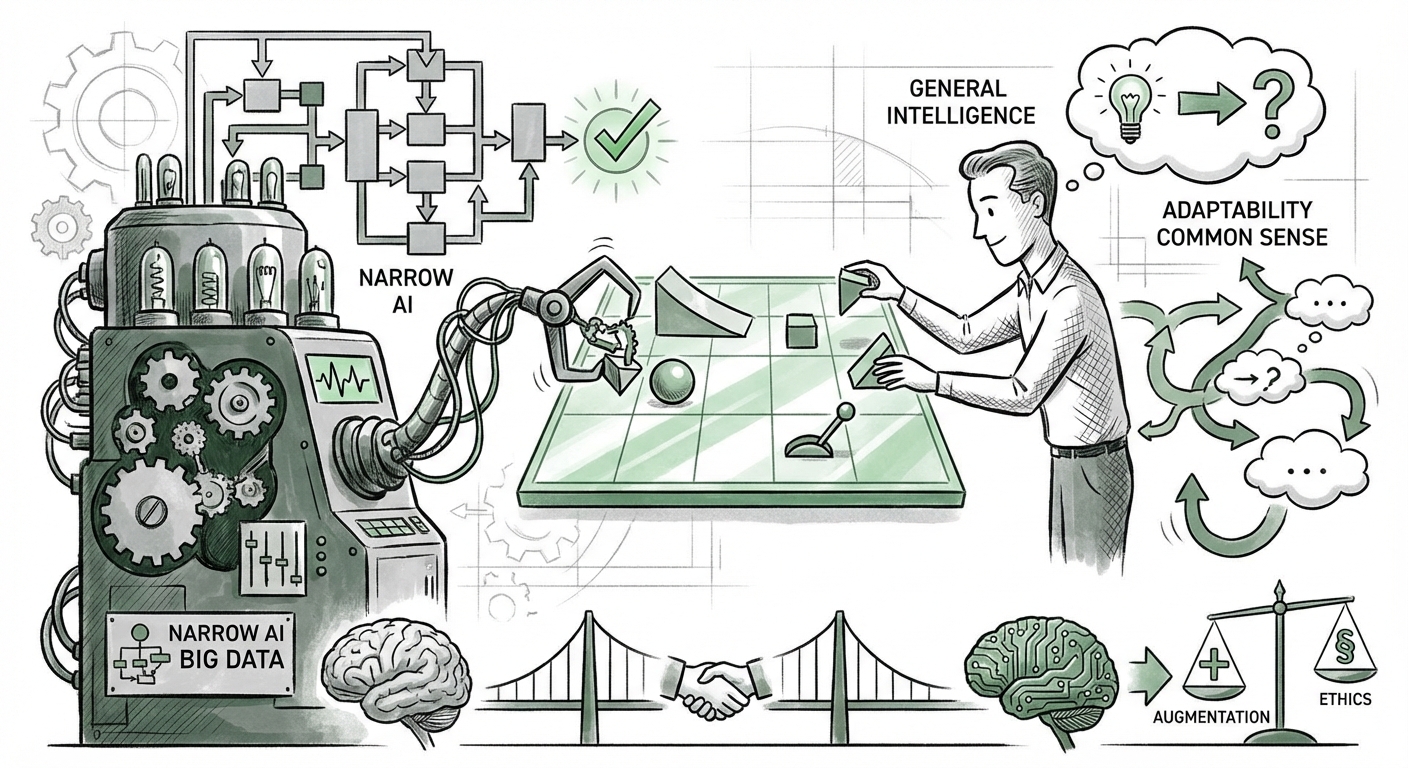
The reason why these tasks are so difficult for AI lies in how these systems are typically trained. Today's frontier models excel because they are trained on massive datasets, allowing them to recognize patterns and predict outcomes with incredible accuracy. However, ARC-AGI-3 strips away these advantages by focusing on tasks that require general intelligence – the ability to apply knowledge and skills to new and unfamiliar situations. Untrained humans find these games easy because they can use common sense and adapt to the challenges.
The Implications for the Future of AI
The poor performance of current AI models on ARC-AGI-3 has several important implications for the future of AI development:
- Focus on Generalization: It highlights the need to shift the focus from narrow AI (excelling at specific tasks) to general AI (performing well across a wide range of tasks). The current approach of scaling up models and training them on more data is not enough to achieve true intelligence.
- Rethinking Training Methods: We need new training methods that enable AI to learn in a more human-like way. This might involve incorporating elements of reinforcement learning, where AI learns through trial and error, or developing AI systems that can reason about the world in a more abstract way.
- Understanding Human Cognition: Ultimately, building AI that can solve problems like humans requires a deeper understanding of how human cognition works. This means drawing insights from fields like psychology, neuroscience, and cognitive science.
Practical Implications for Businesses and Society
The limitations exposed by ARC-AGI-3 have significant practical implications for businesses and society:
- Realistic Expectations: It's crucial to have realistic expectations about what AI can and cannot do. While AI can automate many tasks and provide valuable insights, it is not a replacement for human intelligence, especially when it comes to complex problem-solving and decision-making in novel situations.
- Focus on AI Augmentation, Not Replacement: Businesses should focus on using AI to augment human capabilities, rather than trying to replace them entirely. This means designing AI systems that work alongside humans, leveraging their respective strengths.
- Ethical Considerations: As AI becomes more sophisticated, it's important to address the ethical considerations surrounding its use. This includes ensuring that AI systems are fair, transparent, and accountable. If AI lacks common sense, it can make unexpected and potentially harmful decisions.
Actionable Insights
So, what can businesses and individuals do to navigate this evolving AI landscape?
- Invest in Research and Development: Businesses should invest in research and development to explore new approaches to AI that go beyond simply scaling up existing models. This includes supporting research into general AI, reinforcement learning, and cognitive science.
- Educate Your Workforce: It's important to educate your workforce about the capabilities and limitations of AI. This will help them to use AI effectively and to identify situations where human intervention is necessary.
- Embrace a Human-Centered Approach to AI: When designing and deploying AI systems, it's crucial to take a human-centered approach. This means considering the needs and perspectives of the people who will be using and interacting with the AI.
- Stay Informed: Keep up-to-date with the latest developments in AI. Read industry publications, attend conferences, and follow leading AI researchers and practitioners.
The Future of Problem Solving: A Blend of AI and Human Ingenuity
While ARC-AGI-3 shows that AI still has a long way to go before it can match human intelligence in all areas, it also highlights the immense potential of AI. By focusing on generalization, rethinking training methods, and understanding human cognition, we can create AI systems that are truly intelligent and capable of solving complex problems in a wide range of domains. The future of problem-solving will likely involve a blend of AI and human ingenuity, with each leveraging their respective strengths to achieve outcomes that would be impossible otherwise. We will likely see more benchmarks like ARC-AGI-3 emerge as the need to test general AI becomes more apparent. Ultimately, this will lead to more robust and reliable AI systems that can benefit society as a whole.