Apple's Secret Weapon: How Google's Gemini is Shrinking AI for Your iPhone
In a groundbreaking move that's reshaping the AI landscape, Apple is partnering with Google to bring powerful AI capabilities directly to your devices. Forget slow cloud-based processing – the future is about AI that lives on your phone, and Apple's new strategy is making that a reality. This isn't just about making Siri a little smarter; it's a fundamental shift in how we interact with technology.
Understanding On-Device AI: The Next Big Thing
For years, AI has primarily lived in the cloud. When you ask Siri a question or use Google Translate, your request is sent to a remote server, processed, and then sent back to your device. This works, but it has limitations: it requires an internet connection, it can be slow, and it raises privacy concerns. On-device AI, on the other hand, processes data directly on your smartphone, tablet, or computer. This means:
- Faster Response Times: No more waiting for data to travel to and from a server.
- Enhanced Privacy: Your data stays on your device, reducing the risk of it being intercepted or stored elsewhere.
- Offline Functionality: AI features work even without an internet connection.
Apple's Strategy: Gemini and Distillation
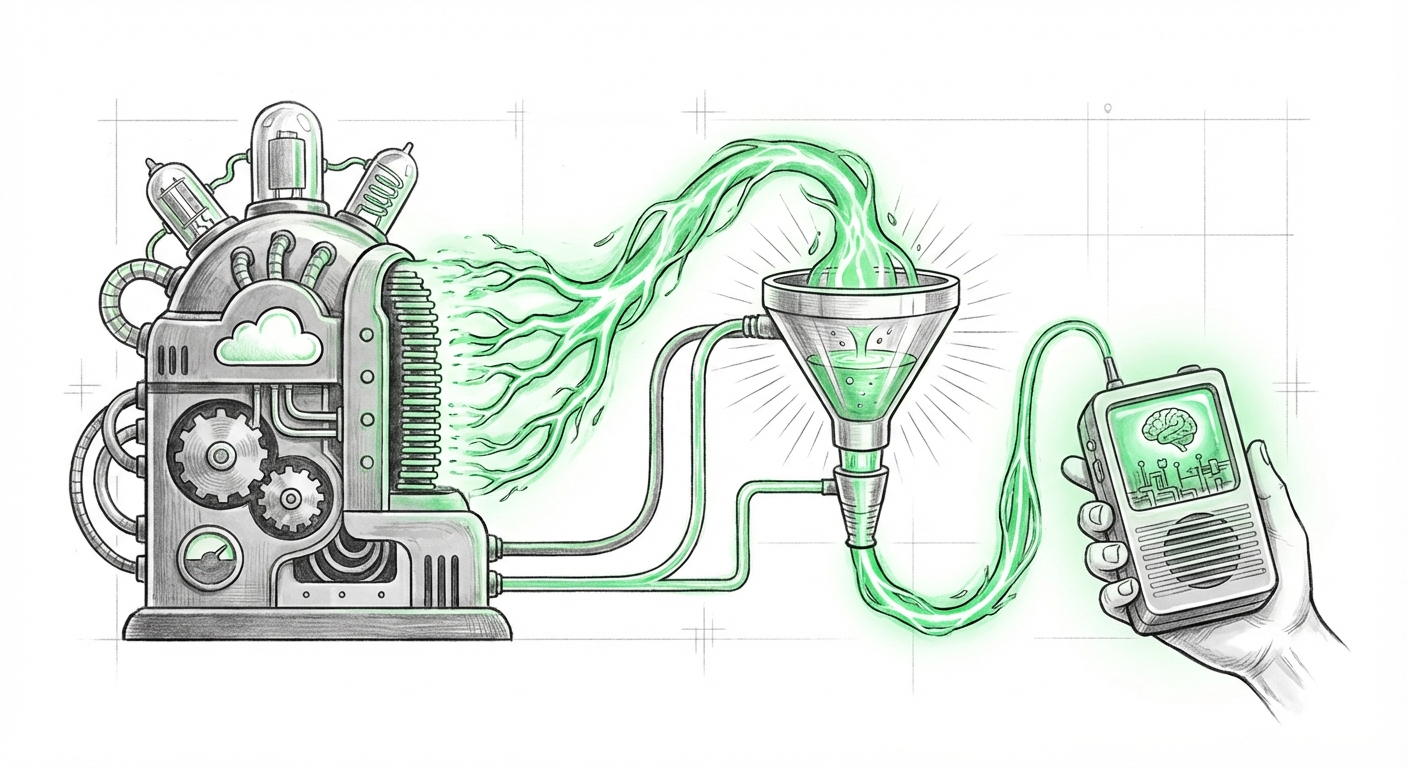
So how is Apple achieving this on-device AI dream? The answer lies in a clever combination of partnerships and technical innovation. According to recent reports, Apple is leveraging Google's powerful Gemini AI model, but not in its full, cloud-based form. Instead, they are using a technique called distillation.
Think of distillation like this: imagine you have a brilliant professor (Gemini) who knows everything about a subject. Instead of trying to clone the professor, you ask them to train a smaller, more focused student (Apple's on-device AI) on the most essential information. This smaller AI model retains the core knowledge but is much more efficient and can run on a device without needing massive computing power.
This approach allows Apple to tap into the vast knowledge and capabilities of Gemini while creating lightweight AI models that can be seamlessly integrated into Siri and other device functions. It's a win-win: Apple gets cutting-edge AI, and Google expands the reach of Gemini's influence.
The Implications for the Future of AI
Apple's move has significant implications for the future of AI:
1. Democratization of AI:
On-device AI makes powerful AI tools accessible to everyone, regardless of their internet connection or access to cloud services. This can be particularly beneficial in areas with limited internet infrastructure.
2. Shift in AI Development:
The focus is shifting from building ever-larger AI models to creating efficient, specialized models that can run on a variety of devices. This requires new skills and techniques in AI development, such as model distillation, quantization, and pruning.
3. Increased Competition:
Apple's partnership with Google could spur other tech companies to develop their own on-device AI solutions. This could lead to a surge of innovation and competition in the AI space.
4. Ethical Considerations:
As AI becomes more pervasive, it's crucial to address ethical concerns such as bias, fairness, and transparency. On-device AI raises unique challenges in this regard, as it can be more difficult to monitor and control than cloud-based AI.
Practical Implications for Businesses and Society
The rise of on-device AI will have a profound impact on businesses and society:
For Businesses:
- New Product Opportunities: Companies can develop new products and services that leverage on-device AI, such as smart home devices, personalized health trackers, and autonomous vehicles.
- Improved Efficiency: On-device AI can automate tasks, improve decision-making, and enhance customer service.
- Enhanced Security: On-device AI can improve security by detecting fraud, preventing cyberattacks, and protecting sensitive data.
For Society:
- Better Healthcare: On-device AI can enable personalized medicine, remote monitoring, and faster diagnosis.
- Improved Education: On-device AI can provide personalized learning experiences, adaptive tutoring, and language translation.
- Safer Transportation: On-device AI can power autonomous vehicles, improve traffic flow, and reduce accidents.
Actionable Insights: Preparing for the On-Device AI Revolution
So, how can businesses and individuals prepare for the on-device AI revolution?
For Businesses:
- Invest in AI Talent: Hire AI experts with skills in model distillation, optimization, and edge computing.
- Explore On-Device AI Solutions: Experiment with different on-device AI platforms and tools.
- Develop a Data Privacy Strategy: Ensure that your AI systems comply with data privacy regulations and protect user data.
For Individuals:
- Learn About AI: Take online courses, read articles, and attend workshops to learn about the basics of AI.
- Experiment with AI Apps: Try out different AI-powered apps and services to see how they can improve your life.
- Stay Informed: Keep up-to-date on the latest developments in AI and their potential impact on society.
Conclusion: A New Era of Intelligent Devices
Apple's strategic use of Google's Gemini to power on-device AI marks a pivotal moment in the evolution of artificial intelligence. By embracing model distillation, Apple is not only enhancing the capabilities of its devices but also paving the way for a future where AI is more accessible, private, and efficient. This is not just about smarter smartphones; it's about a new era of intelligent devices that can seamlessly integrate into our lives and empower us in ways we never thought possible. The future of AI is here, and it's running on your phone.