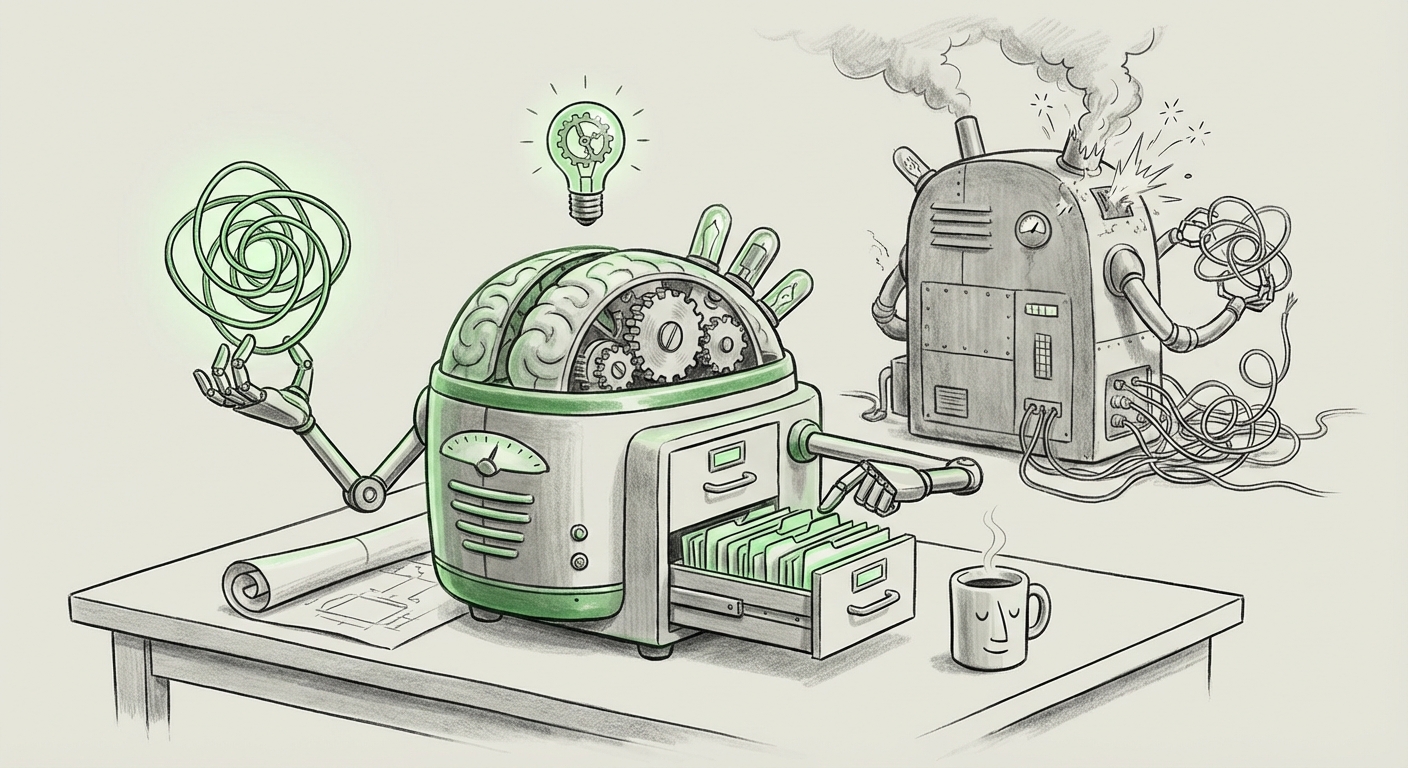
Smarter AI: How "Thinking Time" and Memory are Revolutionizing Transformers
Imagine an AI that not only remembers a vast amount of information but also knows when to slow down and really think about a problem. That's the promise of a new advancement in Transformer architecture, a type of AI model that's already powering many of the technologies we use every day. A research team in Germany has developed a way to give these models both "thinking time" and better memory, leading to impressive results, especially in solving complex math problems.
The Problem with Current AI
Current AI models, especially large language models, are amazing at tasks like writing articles, translating languages, and even generating code. They achieve this by learning patterns from massive amounts of data. However, they often struggle with tasks that require deeper reasoning or step-by-step problem-solving, such as complex math. They can also be inefficient, requiring enormous computing power and energy to operate.
One of the key limitations is that these models process information in a single pass. They don't have a mechanism to deliberately "think" about a problem multiple times, refining their understanding and arriving at a more accurate solution. It's like trying to solve a Rubik's Cube without being able to rotate it and consider different moves.
Introducing "Thinking Time" for AI
The German research team's innovation addresses this limitation by allowing Transformer models to decide how many times they want to "think" about a problem. This means the model can iterate on its solution, refining it over multiple passes. It's similar to how a human might approach a difficult math problem: reading it, trying a solution, checking the work, and then revising the approach if needed.
This "thinking time" is crucial for tasks that require step-by-step reasoning. By giving the model the ability to reflect and refine, the researchers have significantly improved its performance on these types of problems.
The Power of Memory
In addition to "thinking time," the researchers also incorporated improved memory capabilities into their Transformer architecture. This allows the model to store and retrieve relevant information more effectively, which is essential for tasks that require drawing on a large knowledge base. Think of it like having a well-organized notebook filled with important facts and formulas that you can quickly access when needed.
The combination of "thinking time" and enhanced memory allows the model to not only process information more effectively but also to learn and retain knowledge more efficiently.
Outperforming Larger Models
The results of this research are impressive. The new Transformer architecture, equipped with both "thinking time" and memory, outperformed much larger models on math problems. This is a significant achievement because it suggests that we can achieve better AI performance not just by scaling up the size of the models but also by making them smarter and more efficient.
This has major implications for the future of AI development. It suggests that the focus should shift from simply building bigger models to designing more intelligent architectures that can learn and reason more effectively.
What This Means for the Future of AI
The development of Transformer models with "thinking time" and memory opens up a range of possibilities for the future of AI. Here are some potential implications:
- More Efficient AI: By allowing models to "think" and remember more effectively, we can create AI systems that require less computing power and energy. This is crucial for making AI more accessible and sustainable.
- Improved Problem-Solving: AI systems with "thinking time" will be better at solving complex problems that require step-by-step reasoning, such as scientific research, engineering design, and financial analysis.
- Enhanced Learning: The ability to remember and recall information more effectively will allow AI models to learn from their experiences and improve their performance over time.
- More Human-Like AI: By mimicking the human ability to reflect and reason, we can create AI systems that are more intuitive and easier to interact with.
Practical Implications for Businesses and Society
The advancements in Transformer architecture have significant practical implications for businesses and society. Here are a few examples:
- Improved Customer Service: AI-powered chatbots with "thinking time" can handle more complex customer inquiries and provide more accurate and helpful responses.
- More Effective Medical Diagnosis: AI systems can analyze medical images and patient data with greater accuracy, leading to earlier and more effective diagnoses.
- Better Financial Analysis: AI models can identify patterns and trends in financial data more effectively, helping businesses make better investment decisions.
- Enhanced Education: AI-powered tutoring systems can provide personalized learning experiences for students, adapting to their individual needs and learning styles.
Actionable Insights
For businesses and individuals looking to leverage these advancements in AI, here are some actionable insights:
- Invest in AI Research and Development: Support research efforts focused on developing more efficient and intelligent AI architectures.
- Explore AI-Powered Solutions: Identify areas where AI can be used to improve efficiency, reduce costs, and enhance decision-making.
- Focus on Data Quality: Ensure that the data used to train AI models is accurate, complete, and relevant.
- Promote AI Literacy: Educate employees and the public about the potential benefits and risks of AI.