Sleep While it Computes: Exploring the Future with Karpathy's AutoResearch
Imagine a world where AI doesn't just perform tasks, but actively designs and improves itself. This idea, once the stuff of science fiction, is rapidly becoming a reality thanks to innovations like Andrej Karpathy's AutoResearch. In this article, we'll break down what AutoResearch is, why it matters, and what it could mean for the future of artificial intelligence.
What is AutoResearch?
AutoResearch, as the name suggests, is about automating the research process itself. Traditionally, AI research is driven by human scientists and engineers. They come up with ideas, write code, run experiments, analyze the results, and then use those results to refine their ideas. This process is time-consuming and requires a lot of human expertise.
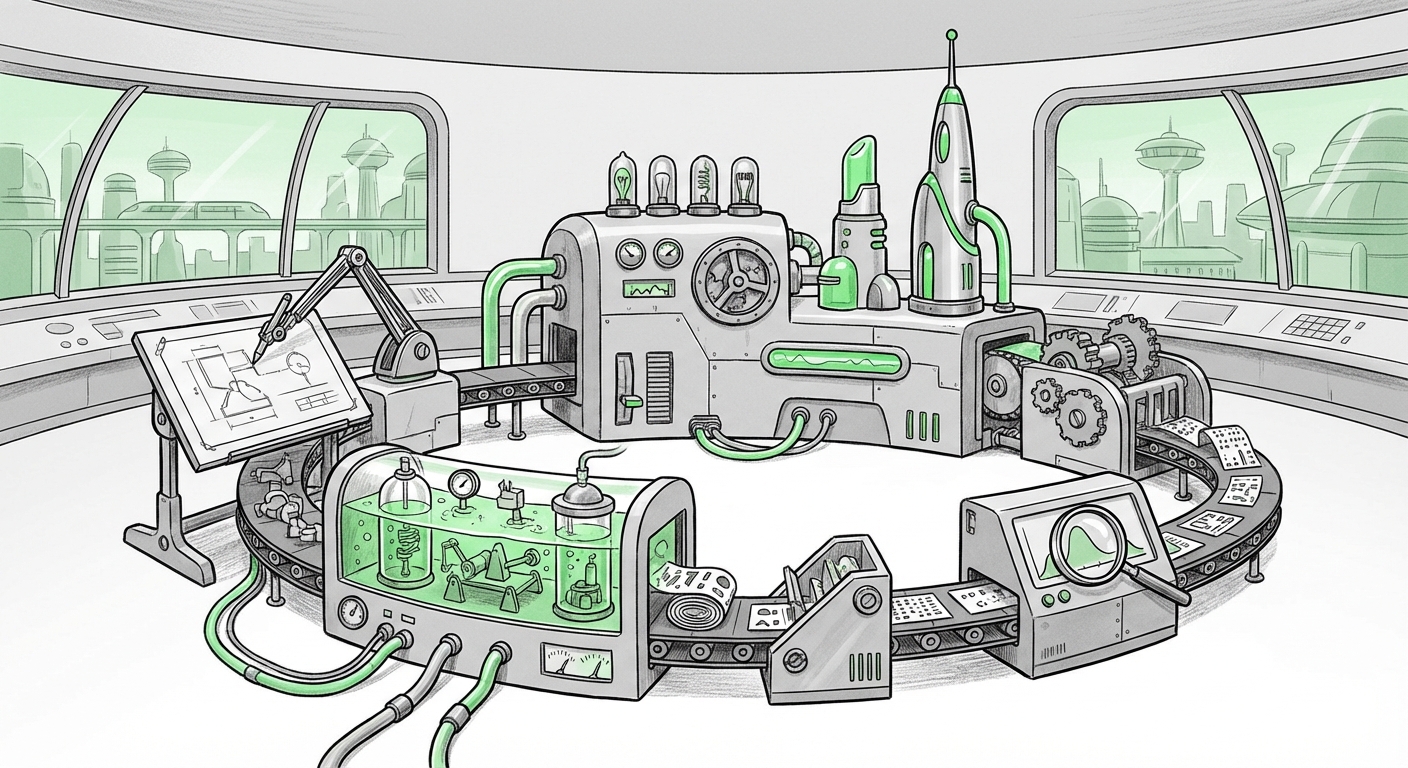
AutoResearch aims to change this by using AI to handle many of these steps. Think of it as an AI that can:
- Generate hypotheses: Come up with new ideas for how to improve AI models.
- Design experiments: Figure out how to test these ideas in a rigorous way.
- Run simulations: Use computers to execute the experiments and gather data.
- Analyze results: Look at the data and draw conclusions about whether the ideas worked.
- Iterate and improve: Use the conclusions to generate even better ideas and repeat the process.
In essence, AutoResearch is about creating AI that can "think" for itself and drive its own development.
Why is AutoResearch Important?
AutoResearch has the potential to dramatically accelerate the pace of AI innovation for several key reasons:
Speed and Efficiency
AI can run experiments and analyze data much faster than humans. This means that AutoResearch could allow us to explore a much larger number of ideas in a shorter amount of time, leading to quicker breakthroughs.
Overcoming Human Bias
Human researchers often have biases that can limit their thinking. AutoResearch systems, on the other hand, can be designed to explore a wider range of possibilities, including those that humans might overlook.
Tackling Complexity
As AI models become more complex, it becomes increasingly difficult for humans to understand how they work and how to improve them. AutoResearch could help us to navigate this complexity by automatically identifying and optimizing key aspects of these models.
Practical Implications for Businesses and Society
The development of AutoResearch will have far-reaching implications for businesses and society as a whole:
Accelerated Product Development
Companies could use AutoResearch to quickly develop and refine new AI-powered products and services. Imagine a company using AutoResearch to design a better self-driving car or to create a more effective medical diagnosis system. The possibilities are endless.
Scientific Discovery
AutoResearch could also be applied to other scientific fields, helping researchers to make new discoveries in areas like medicine, materials science, and climate change.
Economic Growth
By accelerating innovation and driving the development of new technologies, AutoResearch could contribute to significant economic growth.
Ethical Considerations
However, it's also important to consider the ethical implications of AutoResearch. As AI becomes more autonomous, we need to ensure that it is aligned with human values and that it is used in a responsible way. This includes addressing issues such as bias, transparency, and accountability.
What This Means for the Future of AI and How It Will Be Used
The emergence of AutoResearch signifies a paradigm shift in how we approach AI development. Here’s what it could mean for the future:
AI Designing AI
We could see a future where AI systems are largely responsible for designing and improving themselves. This could lead to a rapid acceleration in the capabilities of AI, far beyond what humans could achieve on their own.
Democratization of AI Research
AutoResearch could make AI research more accessible to a wider range of people. By automating many of the technical aspects of research, it could lower the barrier to entry and allow more individuals and organizations to participate in the development of AI.
New AI Architectures
AutoResearch could lead to the discovery of entirely new AI architectures that we haven't even conceived of yet. By exploring a wider range of possibilities, AI could uncover solutions that humans would never have thought of.
Personalized AI
AutoResearch could be used to create AI systems that are tailored to the specific needs and preferences of individual users. Imagine having an AI assistant that is constantly learning and adapting to your unique work style and personal habits.
Actionable Insights
So, what can businesses and individuals do to prepare for the age of AutoResearch?
- Invest in AI Education: It's crucial to develop a workforce that understands the fundamentals of AI and can work alongside these advanced systems.
- Embrace Experimentation: Encourage a culture of experimentation and be willing to try new approaches to AI development.
- Focus on Ethics: Prioritize ethical considerations in all AI projects.
- Stay Informed: Keep up-to-date with the latest developments in AutoResearch and related fields.
AutoResearch represents a major step towards creating truly intelligent machines. By automating the research process, it has the potential to unlock new levels of AI capability and transform industries. While challenges remain, the potential benefits are enormous.