Fixing AI Vision: How Alibaba's Qwen Team Built HopChain for Smarter Reasoning
Imagine showing a computer a picture and asking it several questions about what it sees. Sounds easy, right? But for AI vision models, this can be surprisingly tricky, especially when the questions require multiple steps of reasoning. Alibaba's Qwen team has been hard at work tackling this problem and has come up with a clever solution called HopChain.
The Challenge: Multi-Step Reasoning in AI Vision
AI vision models are great at identifying objects in images. They can tell you if there's a cat, a dog, or a car in a picture. However, when you ask more complex questions that require connecting different pieces of information, these models often struggle. This is because they tend to "fall apart" during multi-step reasoning.
Think of it like this: if you ask an AI, "Is the object to the left of the blue car larger than the object to the right of the red car?" the AI needs to first identify the blue and red cars, then locate the objects to their left and right, and finally compare their sizes. Each of these steps introduces a chance for error, and these errors can accumulate, leading to a wrong answer.
HopChain: A Step Forward in AI Reasoning
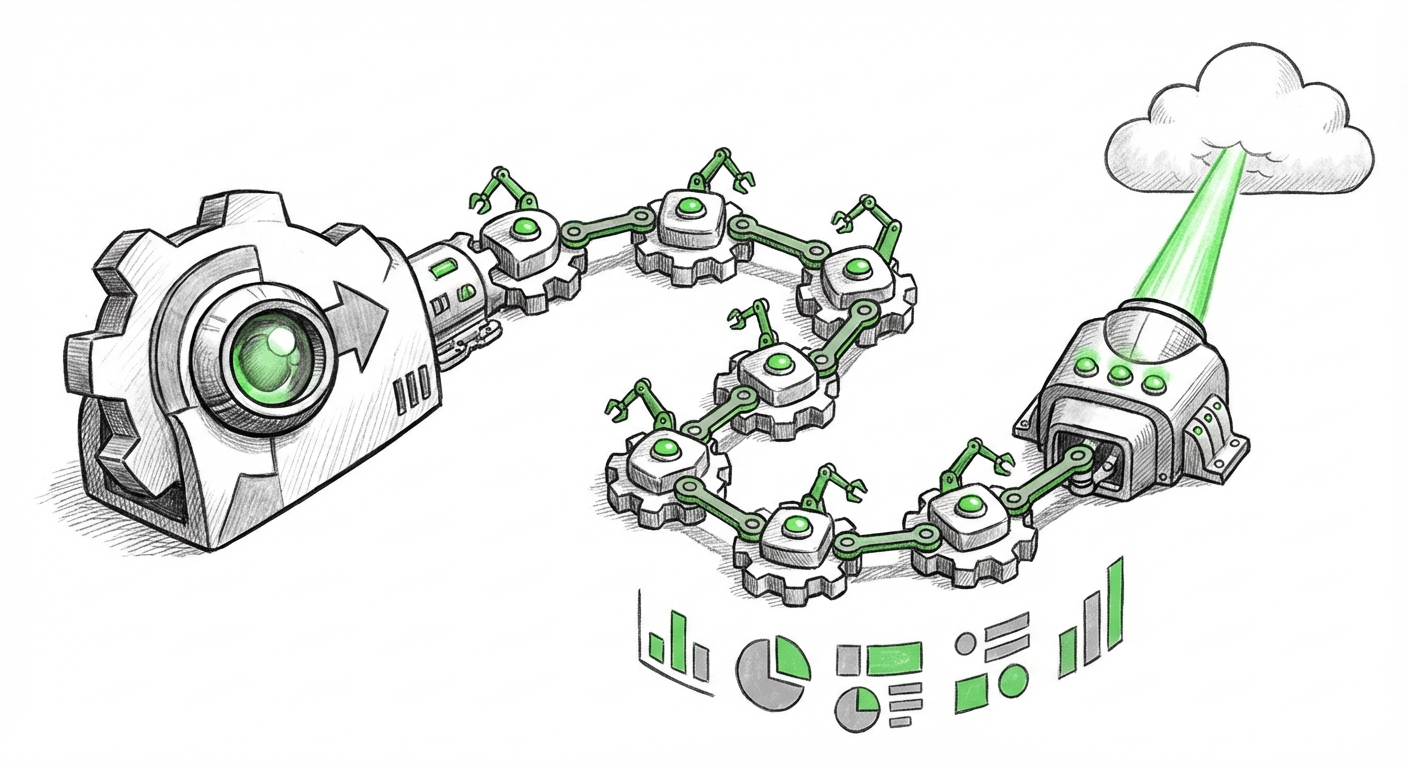
The Qwen team at Alibaba recognized this weakness and developed HopChain to address it. HopChain is designed to improve the ability of AI vision models to perform complex reasoning tasks by breaking them down into smaller, more manageable steps.
Here's how HopChain works:
- Decomposition: HopChain breaks down a complex question into a series of simpler sub-questions or "hops."
- Execution: The AI vision model answers each of these sub-questions individually.
- Aggregation: HopChain then combines the answers to the sub-questions to arrive at the final answer to the original, complex question.
By breaking down the problem, HopChain reduces the likelihood of errors accumulating. It's like solving a puzzle one piece at a time instead of trying to fit all the pieces together at once.
What This Means for the Future of AI
The development of HopChain is a significant step forward for AI vision and has several important implications for the future:
1. More Reliable AI Systems
HopChain makes AI vision models more reliable and accurate, especially in tasks that require complex reasoning. This increased reliability is crucial for applications where accuracy is paramount, such as medical image analysis or autonomous driving.
2. Enhanced Understanding of Visual Data
By enabling AI to reason more effectively about visual data, HopChain paves the way for a deeper understanding of images and videos. This could lead to new insights in fields like scientific research, security, and entertainment.
3. Improved Human-Computer Interaction
With HopChain, AI systems can better understand and respond to complex human queries about visual information. This can make human-computer interaction more natural and intuitive.
Practical Implications for Businesses and Society
The advancements made by HopChain have wide-ranging practical implications for businesses and society:
1. Retail and E-commerce
Imagine an AI system that can analyze product images and answer complex questions about their features, materials, or compatibility with other products. This could revolutionize online shopping by providing customers with more detailed information and personalized recommendations.
2. Healthcare
In healthcare, HopChain could be used to analyze medical images like X-rays or MRIs to identify subtle anomalies or patterns that might be missed by human doctors. This could lead to earlier and more accurate diagnoses.
3. Security and Surveillance
HopChain could enhance security systems by enabling them to analyze surveillance footage and identify suspicious activities or objects with greater accuracy. For example, an AI system could be trained to detect unattended bags in public places or identify individuals who are behaving erratically.
4. Autonomous Vehicles
For self-driving cars, HopChain could improve the vehicle's ability to understand complex traffic scenarios and make safe driving decisions. For example, it could help the car determine the intentions of pedestrians or anticipate the actions of other vehicles.
Actionable Insights
So, what can businesses and individuals do to take advantage of these advancements?
- Stay Informed: Keep up-to-date with the latest developments in AI vision and reasoning. Follow research publications and industry news to understand the potential applications of technologies like HopChain.
- Experiment: Explore how AI vision models can be applied to your specific business needs. Try using existing AI platforms and tools to analyze visual data and identify opportunities for improvement.
- Invest in Training: Invest in training your employees to work with AI systems and interpret their results. This will ensure that you can effectively leverage AI to make better decisions.
- Collaborate: Partner with AI researchers and developers to create custom solutions that address your unique challenges. Collaboration can help you stay ahead of the curve and unlock new possibilities.
Conclusion: A Brighter Future for AI Vision
Alibaba's Qwen team's development of HopChain represents a significant leap forward in AI vision. By addressing the challenges of multi-step reasoning, HopChain is making AI systems more reliable, accurate, and capable of understanding the visual world around us. As AI vision continues to evolve, we can expect to see even more innovative applications that transform businesses, improve lives, and shape the future of society.