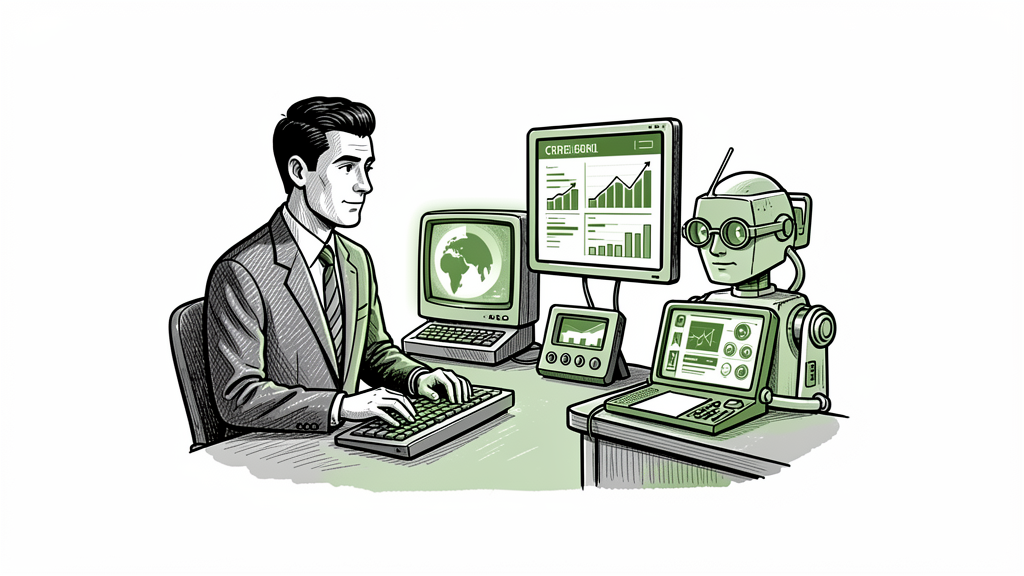
AI Agent Reality Check: Why Benchmark Brilliance Doesn't Guarantee Real-World Success
Imagine having a super-smart robot that can ace any test you throw at it. It gets perfect scores in practice, showing amazing skills. But when you take it out into the real world, things start to fall apart. It struggles to handle unexpected situations and make simple decisions. This is the challenge facing AI agents today.
The Promise of AI Agents
AI agents are designed to be smart helpers. They're computer programs that can understand instructions, learn from experience, and make decisions to achieve specific goals. Think of them as virtual assistants that can manage your schedule, automate tasks, and even solve complex problems. The potential applications are huge, ranging from customer service and healthcare to manufacturing and finance.
For example, an AI agent could:
- Help doctors diagnose diseases more accurately.
- Manage supply chains more efficiently.
- Provide personalized financial advice to individuals.
Because of this massive potential, researchers have been working hard to make AI agents smarter and more capable. A key part of this work is using benchmarks to measure their progress.
The Benchmark Illusion
Benchmarks are like standardized tests for AI agents. They provide a controlled environment where agents can be evaluated on specific skills. These tests often involve completing tasks in simulated environments, like navigating a virtual maze or solving a logic puzzle.
AI agents often perform exceptionally well on these benchmarks. They can learn to optimize their behavior to achieve high scores, demonstrating impressive abilities in these artificial settings. This has led to a lot of excitement about the future of AI and the potential for these agents to revolutionize various industries. However, a recent study has revealed a significant problem: these impressive benchmark scores don't always translate to real-world success. According to a 2026 study highlighted on the-decoder.com, AI agent skills look great in benchmarks but fall apart under realistic conditions.
The Real-World Reality
The real world is messy, unpredictable, and full of surprises. Unlike the controlled environments of benchmarks, real-world scenarios are constantly changing. AI agents must be able to handle unexpected events, adapt to new information, and make decisions in the face of uncertainty. And this is where they often struggle.
Why do AI agents that excel in benchmarks fail in the real world?
- Overfitting: AI agents can become too specialized in solving the specific problems presented in the benchmark. They learn to exploit the quirks of the test environment, rather than developing general problem-solving skills.
- Lack of Robustness: Real-world environments are full of noise and distractions. AI agents may be easily thrown off by unexpected changes in their surroundings.
- Limited Generalization: AI agents may struggle to apply their knowledge to new situations that are slightly different from what they've seen before.
In other words, succeeding in a benchmark is like memorizing the answers to a test. You might get a good grade, but you haven't actually learned the material well enough to apply it in new situations.
Implications for the Future of AI
The fact that AI agents struggle in the real world has significant implications for the future of AI. It means that we need to be careful about relying too heavily on benchmark scores as a measure of progress. We also need to focus on developing AI agents that are more robust, adaptable, and capable of generalizing their knowledge to new situations.
Here are some key areas where future research needs to focus:
- Improving Robustness: Developing AI agents that are less sensitive to noise and distractions.
- Enhancing Generalization: Creating AI agents that can apply their knowledge to new and unfamiliar situations.
- Developing Better Benchmarks: Designing benchmarks that more accurately reflect the complexities of the real world.
- Focusing on Continuous Learning: Enabling AI agents to learn and adapt continuously as they encounter new experiences.
Practical Implications for Business and Society
The limitations of AI agents also have important implications for businesses and society. It means that we need to be realistic about what AI agents can and cannot do. We should avoid deploying them in situations where they could cause harm or make critical errors. Instead, we should focus on using them to augment human capabilities, rather than replace them entirely.
Here are some practical steps that businesses can take:
- Start Small: Begin by deploying AI agents in low-risk environments where their mistakes will not have serious consequences.
- Monitor Performance Closely: Continuously track the performance of AI agents and intervene when necessary.
- Invest in Training: Provide AI agents with ongoing training to help them adapt to new situations.
- Focus on Augmentation: Use AI agents to assist human workers, rather than replace them entirely.
For society as a whole, it's important to have open and honest conversations about the limitations of AI. We need to avoid hype and unrealistic expectations, and focus on developing AI in a way that benefits everyone.
Actionable Insights
So, what can you do with this information? Here are some actionable insights:
- For Researchers: Focus on creating more realistic and challenging benchmarks that better reflect the complexities of the real world. Explore new techniques for improving the robustness and generalization abilities of AI agents.
- For Businesses: Don't blindly trust benchmark scores. Test AI agents thoroughly in real-world settings before deploying them. Prioritize AI applications that augment human capabilities, rather than replace them.
- For Policymakers: Develop regulations and guidelines that ensure the responsible development and deployment of AI. Promote public understanding of the limitations of AI and the potential risks.
- For Individuals: Be aware of the limitations of AI and don't rely on it blindly. Use AI tools to enhance your own capabilities, but always exercise critical thinking and judgment.
Conclusion
AI agents have the potential to transform many aspects of our lives, but their limitations must be acknowledged. While they may excel in controlled benchmark environments, they often struggle to handle the complexities and uncertainties of the real world. By focusing on improving the robustness, adaptability, and generalization abilities of AI agents, and by deploying them responsibly, we can harness their power for the benefit of all.