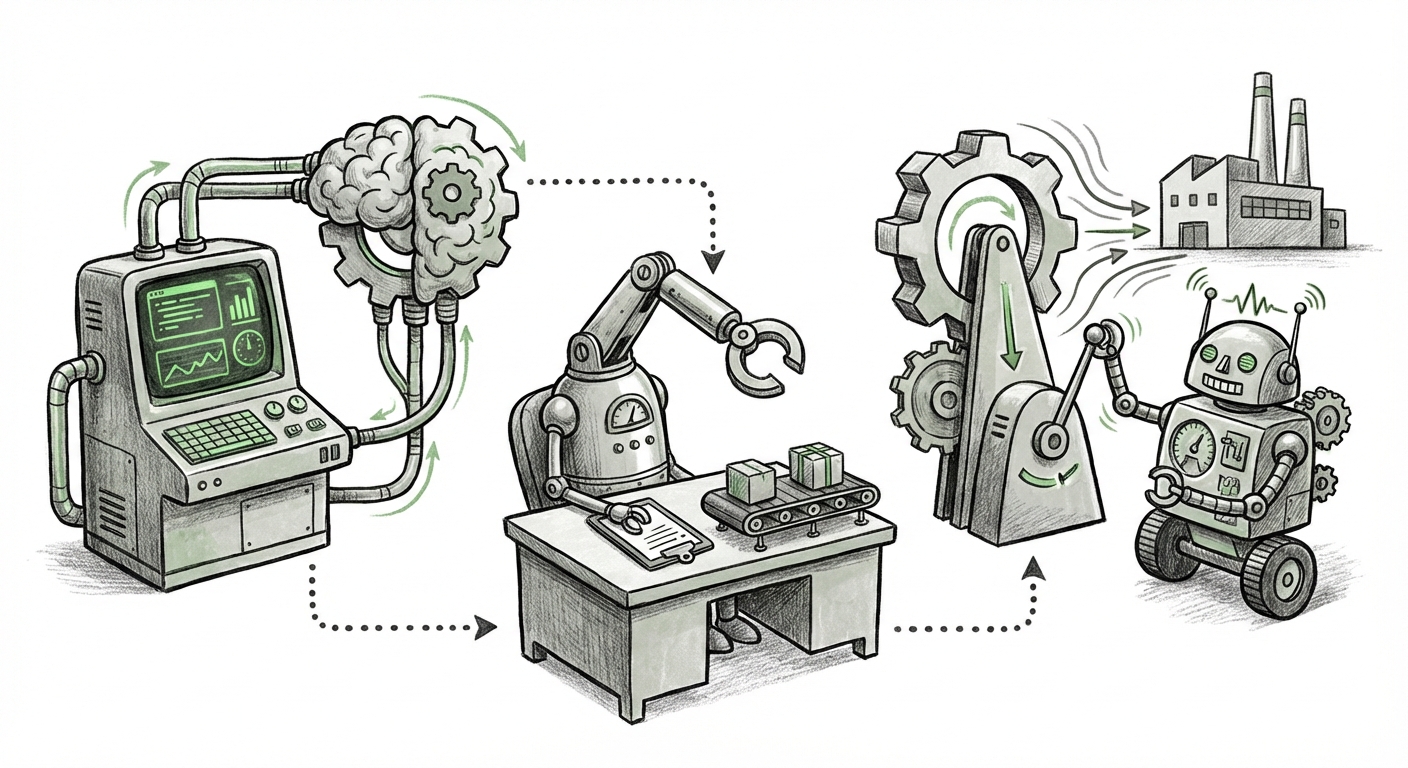
Understanding OpenAI's Outlook: Why AI's "Surprisingly Slow" Progress Signals Future "Big Leaps"
The world of Artificial Intelligence (AI) often feels like a whirlwind of constant breakthroughs and rapid advancements. Every week brings news of new models, enhanced capabilities, and expanded applications. Yet, a recent statement from OpenAI's chief scientist, published on the-decoder.com on 2026-04-24, offers a fascinating and perhaps counter-intuitive perspective: AI progress has been "surprisingly slow." This declaration, coming from one of the leading figures in the field, is immediately followed by a powerful promise: "big leaps ahead." This unique juxtaposition of a candid acknowledgment of past slowness and an optimistic forecast for the future provides a critical lens through which to examine the current state and trajectory of AI.
This article will delve into what these statements truly mean for the future of AI development and how it will be used. We will explore the implications of this perceived "slowness," what kind of "big leaps" might be on the horizon, and the practical takeaways for businesses, policymakers, and society at large. Understanding this nuanced perspective from an organization like OpenAI is crucial for anyone looking to navigate the complex and ever-evolving landscape of artificial intelligence.
The Paradox of Progress: "Surprisingly Slow" Yet Promising "Big Leaps"
At first glance, the notion of AI progress being "surprisingly slow" might seem to contradict the daily headlines of generative AI transforming industries and research labs pushing boundaries. However, this statement from OpenAI's chief scientist needs to be interpreted within the context of expert expectations. For those at the forefront of AI research, deeply immersed in its complexities and potential, "slow" doesn't necessarily mean stagnant. Instead, it suggests that the pace of foundational breakthroughs or the journey toward more generalized intelligence might not have met the ambitious timelines or anticipated exponential curves some experts had hoped for. It implies that perhaps certain challenges have proven more formidable, or scaling certain capabilities has yielded diminishing returns quicker than predicted.
This perception of "slowness" could be a reflection of the intricate nature of AI development, where pushing the boundaries requires overcoming increasingly complex hurdles. It might point to the fact that while application-level progress is visible, the underlying scientific challenges of achieving truly robust, adaptable, and general AI systems are still incredibly difficult. The journey from impressive pattern recognition to genuine understanding, reasoning, and common sense might be a longer, more arduous path than initially projected.
Yet, the promise of "big leaps ahead" is equally significant. It suggests that the challenges contributing to the perceived slowness are not insurmountable. Instead, they might represent a period of deep foundational work, a quiet phase of problem-solving and architectural rethinking that is now poised to yield substantial advancements. This could indicate a maturing of research methodologies, the convergence of different AI paradigms, or perhaps the discovery of new scaling laws or training techniques that are about to unlock unprecedented capabilities. The "slow" period could be the necessary incubation phase before a revolutionary growth spurt.
What "Slow" Truly Means for AI Development
When an industry leader speaks of "surprisingly slow" progress, it's not a critique of the dedication of researchers or the volume of innovation. It's a subtle but important commentary on the intrinsic difficulties of advancing a field as profound as artificial intelligence. Here are some potential interpretations of what "slow" might entail from a development perspective:
- Encountering Deeper Technical Barriers: The initial waves of AI progress often tackle the "lower-hanging fruit." As AI systems become more sophisticated, the problems they face also increase in complexity. This could mean challenges in areas like real-world reasoning, handling ambiguity, integrating multi-modal data seamlessly, or achieving true autonomy and reliability in unpredictable environments.
- The Quest for Generalization: While narrow AI excels at specific tasks, the holy grail remains Artificial General Intelligence (AGI). The path to AGI is likely far more complex than simply scaling up current models. "Slow" might reflect the immense difficulty in moving beyond specialized intelligence to systems that can learn, adapt, and apply knowledge across a vast array of tasks, much like humans do.
- Computational and Data Demands: As models grow, so do their computational and data requirements. There might be a temporary slowing as researchers optimize architectures, develop more efficient training methods, or explore novel hardware solutions to keep pace with the ambitions of larger, more capable models.
- Ethical and Safety Considerations: The increased power of AI systems necessitates a heightened focus on ethics, safety, and alignment. Integrating these considerations into the development lifecycle can inherently slow down the rapid deployment of new capabilities, as robust testing and careful evaluation become paramount. This "slowness" is often a deliberate and necessary step toward responsible AI.
Understanding this "slow" period as a natural part of a complex scientific endeavor helps to contextualize the future promise. It suggests that the upcoming "leaps" will be built on a more solid, rigorously tested foundation, addressing some of the fundamental limitations encountered in prior phases.
Anticipating the "Big Leaps Ahead": What's Next for AI?
The promise of "big leaps ahead" is exciting and suggests that the fundamental challenges that contributed to the recent "slowness" are on the verge of being overcome. While the source does not detail specific advancements, we can infer the kinds of breakthroughs that would constitute "big leaps" in the current AI landscape:
- Enhanced Reasoning and Problem-Solving: Moving beyond statistical correlations to more robust logical reasoning, planning, and problem-solving abilities. This could manifest in AI systems that are better at understanding cause and effect, making complex decisions, or engaging in multi-step analytical tasks with greater accuracy and less "hallucination."
- True Multi-modality and Contextual Understanding: AI systems that can seamlessly integrate and reason across different data types—text, images, audio, video, sensor data—with a deeper understanding of context and nuance. Imagine AI assistants that truly understand your environment and intentions, not just your spoken commands.
- Greater Efficiency and Accessibility: Breakthroughs that make powerful AI models significantly more efficient to train and run, reducing their carbon footprint and making advanced AI accessible to a wider range of organizations, including smaller businesses and individual developers.
- More Reliable and Aligned AI: Significant advancements in making AI systems more trustworthy, predictable, and aligned with human values and intentions. This includes improved safety mechanisms, explainability, and the ability to operate effectively and ethically in real-world scenarios.
- Personalized and Adaptive AI: AI systems that are not just powerful but also highly adaptive and personalized to individual users or specific organizational needs, continuously learning and evolving based on unique interactions and data.
These "big leaps" would not just be incremental improvements but fundamental shifts that expand the scope and impact of AI, pushing it closer to more general intelligence and enabling entirely new categories of applications.
Future Implications for AI Development and Adoption
The combined message of "slow" progress followed by "big leaps" has profound implications for how AI will be developed and adopted:
- Accelerated Research Cycles: If foundational issues are being resolved, the pace of applied research and development could increase dramatically. This might lead to a shorter time between lab breakthroughs and practical deployments.
- Increased Investment and Competition: The promise of "big leaps" will undoubtedly attract even more investment into the AI sector. Companies will race to be at the forefront of these new capabilities, intensifying competition and fostering innovation.
- Shifting Paradigms: The "leaps" might involve new architectural designs or theoretical frameworks that could shift the dominant paradigms in AI, moving beyond current transformer-based models or introducing novel approaches to learning and inference.
- Democratization of Advanced AI: More efficient and powerful AI could become more widely available through APIs and cloud services, allowing a broader range of developers and businesses to integrate cutting-edge capabilities without needing vast in-house expertise or computational resources.
This outlook suggests that the AI landscape is not just evolving, but potentially on the brink of a transformative acceleration, requiring all stakeholders to be prepared for significant changes.
Business Strategy in a Shifting AI Landscape
For businesses, OpenAI's assessment provides a critical strategic imperative. The "surprisingly slow" period might have lulled some into a false sense of security regarding the pace of change, but the promise of "big leaps ahead" demands immediate strategic recalibration. Here are practical implications for businesses:
- Invest in AI Literacy and Training: Prepare your workforce. Understanding AI's capabilities and limitations, and how to effectively integrate it into workflows, will be crucial. The "big leaps" will demand new skills and a digitally fluent workforce.
- Embrace Agility and Experimentation: The AI landscape will be dynamic. Businesses must foster a culture of agile development, continuous experimentation, and rapid prototyping to quickly adopt and adapt to new AI capabilities as they emerge. Avoid rigid, long-term AI strategies that cannot pivot.
- Strategic Partnerships: Forge relationships with leading AI research institutions, startups, and platform providers. Being connected to the innovation ecosystem will be key to staying ahead of the curve and gaining early access to transformative technologies.
- Data Strategy is Paramount: High-quality, well-structured data remains the fuel for AI. Businesses need to invest in robust data governance, collection, and preparation strategies to ensure they can leverage future AI advancements effectively.
- Prioritize Ethical AI Development: As AI becomes more powerful, the risks of bias, misuse, and unintended consequences also grow. Businesses must bake ethical considerations into their AI development from the outset, focusing on fairness, transparency, and accountability. This proactive approach will build trust and mitigate future risks.
- Re-evaluate Automation Potential: The "big leaps" could significantly expand the scope of tasks that can be automated or augmented by AI. Businesses should re-evaluate their processes to identify new opportunities for efficiency, cost reduction, and innovation that were not feasible with previous AI capabilities.
Businesses that are prepared for a period of accelerated innovation will be best positioned to capitalize on the upcoming "big leaps," transforming operations, products, and customer experiences.
Societal Impact and Ethical Imperatives
Beyond business, the promise of "big leaps" carries profound implications for society. The rapid advancement of AI demands careful consideration and proactive planning:
- Workforce Transformation: While AI will create new jobs, it will also likely automate existing ones. Society needs to invest in education, reskilling programs, and social safety nets to support a smooth transition for the workforce.
- Ethical Governance and Regulation: As AI capabilities grow, the need for thoughtful regulation and ethical guidelines becomes more urgent. Governments, international bodies, and industry leaders must collaborate to establish frameworks that ensure AI is developed and used responsibly, protecting individual rights and societal well-being.
- Addressing Bias and Fairness: Powerful AI systems, if not carefully designed, can perpetuate and amplify existing societal biases. Continuous effort is needed to develop fair and unbiased AI, ensuring equitable access and outcomes.
- The Future of Creativity and Innovation: AI's "leaps" will not only automate but also augment human creativity and innovation. This will open new frontiers in art, science, and problem-solving, demanding a societal shift in how we perceive and value human-AI collaboration.
- Global Cooperation: The development and deployment of advanced AI are global phenomena. International cooperation will be essential to address shared challenges, establish common standards, and prevent potential harms.
The period of "surprisingly slow" progress might have offered a window for society to reflect and prepare. The "big leaps" will demand that this preparation translates into tangible policies, educational reforms, and ethical frameworks to harness AI's potential for good while mitigating its risks.
Actionable Insights for the Path Ahead
To thrive in this anticipated phase of AI acceleration, individuals, businesses, and policymakers should consider the following actionable insights:
- For Businesses:
- Form an internal AI task force to monitor advancements and identify strategic applications relevant to your sector.
- Allocate dedicated R&D budgets for AI experimentation, even if it's small initially, focusing on proofs-of-concept.
- Prioritize data infrastructure and quality as the foundation for future AI adoption.
- Develop a comprehensive talent strategy that includes upskilling existing employees and attracting new AI expertise.
- Engage with ethical AI principles and integrate them into product development and deployment guidelines.
- For Individuals:
- Cultivate AI literacy: Understand how AI works, its capabilities, and its limitations.
- Focus on developing uniquely human skills such as creativity, critical thinking, emotional intelligence, and complex problem-solving, which are complementary to AI.
- Embrace lifelong learning to adapt to evolving job markets and new AI-driven tools.
- For Policymakers and Society:
- Invest in public education and digital infrastructure to ensure broad access to AI opportunities.
- Develop agile regulatory frameworks that can adapt to rapid technological change without stifling innovation.
- Foster international dialogues and collaborations on AI ethics, safety, and governance.
- Support research into explainable AI, bias mitigation, and robust AI safety mechanisms.
Conclusion: Readying for the Next Wave
OpenAI's chief scientist's remarks from 2026-04-24 provide a powerful narrative: a phase of "surprisingly slow" progress that is now expected to culminate in "big leaps ahead." This isn't a story of stagnation, but rather a compelling indication of the foundational work and deep problem-solving that has been underway behind the scenes. It suggests that AI is poised for another significant inflection point, where new breakthroughs will unlock unprecedented capabilities and transform how we live, work, and interact with technology.
The implications are clear: the next chapter of AI promises to be even more transformative than the last. For businesses, this means a need for agile strategies, continuous learning, and a proactive approach to ethical integration. For society, it underscores the urgency of thoughtful governance, equitable access, and a focus on human flourishing alongside technological advancement. By understanding the ebb and flow of AI progress—the deliberate pace preceding exponential growth—we can better prepare for and shape a future where artificial intelligence serves as a powerful force for good, guiding these "big leaps" responsibly toward a more intelligent and equitable world.