Navigating Time: What an LLM Limited to 1930 Teaches Us About AI's Future in 2026
In the rapidly evolving landscape of artificial intelligence, one of the most intriguing thought experiments recently brought to light by the-decoder.com on 2026-04-28 offers a unique lens through which to examine the capabilities and, more importantly, the limitations of Large Language Models (LLMs). Imagine an LLM, a powerful AI designed to understand and generate human-like text, but with a critical handicap: it knows nothing of the world after 1930. Its knowledge of history, technology, culture, and society abruptly ceases at the dawn of the Great Depression's recovery and the ominous shadows of an approaching global conflict. This "time-capsule AI" is then asked to describe our world as it exists in 2026.
While the actual predictions of this hypothetically constrained LLM aren't detailed in the source, the mere premise of such an experiment provides a profound framework for understanding the future of AI. It forces us to confront fundamental questions about how AI learns, how it predicts, and what its 'understanding' truly means when faced with vast gaps in its data. This scenario isn't just a fascinating academic exercise; it carries significant implications for how we develop, deploy, and trust AI systems across all sectors of society and business.
The Curious Case of AI's Time Capsule: Understanding Knowledge Cutoffs
At its core, the the-decoder.com article highlights the concept of a knowledge cutoff, a critical parameter for all LLMs. These models are trained on massive datasets of text and code, but this training data is almost always finite and has an endpoint. For many commercially available LLMs, this cutoff might be a few months or a year prior to their release, meaning they won't know about the most recent news, events, or technological advancements. The experiment of an LLM knowing nothing after 1930 takes this concept to an extreme, providing a stark illustration of its consequences.
The 1930 Lens on 2026: A Thought Experiment
Consider what a mind, human or artificial, trained only on information up to 1930 would perceive about 2026. This AI would possess a sophisticated understanding of early 20th-century physics, economics, politics, and culture. It would know about the rise of radio, the Model T, silent films transitioning to "talkies," the aftermath of World War I, and the initial impacts of the global economic crisis. However, it would have no concept of:
- World War II, the Cold War, or subsequent geopolitical shifts.
- The invention of the computer, the internet, smartphones, or artificial intelligence itself.
- Space travel, nuclear energy, or modern medical breakthroughs like antibiotics, DNA, or vaccines.
- Globalized economies, digital currencies, or modern financial systems.
- Contemporary social movements, civil rights, or the evolving understanding of human identity and rights.
- Modern popular culture, music, fashion, or global communication networks.
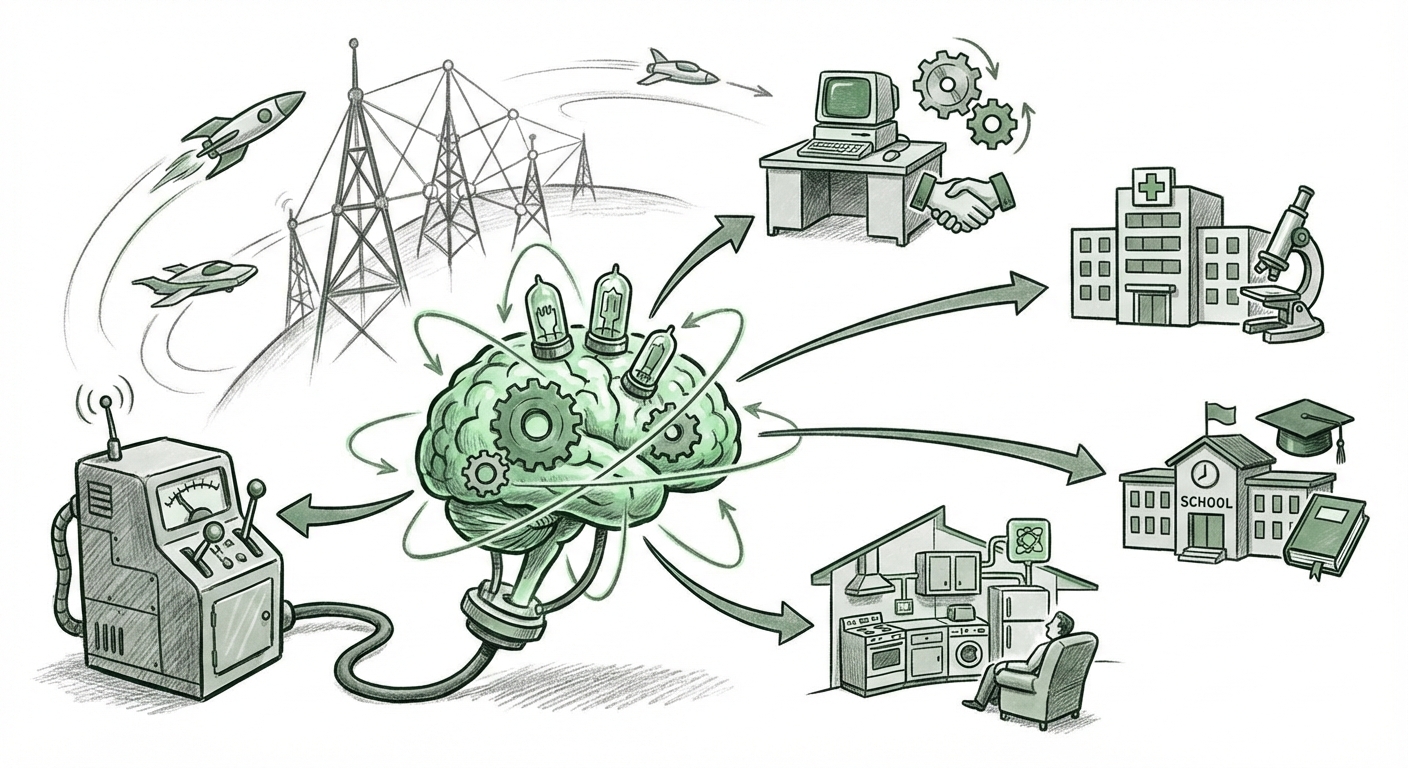
Tasked with describing 2026, such an LLM would likely engage in what is often termed "hallucination." It wouldn't know it was making things up; it would simply extrapolate from its limited dataset, trying to find patterns and make logical connections based on what it *does* know. It might predict a future dominated by dirigibles, enhanced steam power, or an intricate global telegraph network, entirely missing the digital revolution. Its predictions about society might reflect 1930s social norms, biases, and technological limits, presenting a fascinating, yet fundamentally incorrect, vision of our present.
Implications for AI Development: Bridging the Knowledge Gap
This thought experiment, highlighted in the 2026-04-28 article, serves as a powerful reminder for AI developers and researchers. It underscores several critical aspects of AI's future:
The Imperative of Up-to-Date Data
For AI to be genuinely useful and relevant in dynamic fields like finance, healthcare, or climate science, it cannot operate with a static, outdated knowledge base. The 1930-cutoff LLM vividly demonstrates that historical data, while valuable for context, rapidly loses its predictive and descriptive power when applied to a distant, radically different future. Future AI development must focus on robust mechanisms for continuous learning and real-time data integration, ensuring models are always drawing from the most current and relevant information. This isn't just about adding new facts; it's about updating an entire world model.
Mitigating Hallucination and Ensuring Factual Accuracy
When an LLM encounters a query outside its training data, it doesn't simply say "I don't know." Instead, it attempts to generate a plausible response based on the patterns it *has* learned, which can lead to convincing but utterly false information, or "hallucinations." The 1930-limited LLM predicting 2026 is an extreme example of this. Future AI development must incorporate better mechanisms for identifying knowledge gaps and communicating uncertainty, perhaps by flagging information that extends beyond its verified training data. This could involve confidence scores, explicit disclaimers, or even querying external, verified knowledge bases in real-time.
The Challenge of Context and Nuance
Beyond factual knowledge, understanding the world requires context, nuance, and an awareness of social, cultural, and political evolution. An AI unaware of World War II, for example, would miss the foundational shifts that shaped post-war international relations, technological advancements, and societal values. Future AI needs to be trained not just on more data, but on data that captures these deeper, interconnected shifts, potentially through more sophisticated knowledge graphs or by integrating diverse multimodal inputs that reflect the human experience in its entirety.
Practical Realities for Businesses: Navigating AI's Blind Spots
The lessons from the LLM with a 1930 knowledge cutoff are profoundly practical for businesses relying on AI in 2026. As AI becomes more embedded in decision-making processes, understanding its limitations is paramount.
Risk of Outdated Strategic Insights
Imagine a financial firm using an LLM for market analysis or future trend prediction, but its underlying data hasn't been updated in years. It might recommend strategies based on market dynamics from a bygone era, leading to disastrous outcomes. Similarly, a product development team relying on an AI unaware of the latest consumer behaviors or technological innovations could launch an irrelevant or obsolete product. Businesses must meticulously vet the recency and relevance of the data their AI models are trained on.
Impact on Customer Experience and Trust
Customer service bots or AI assistants, if operating on outdated knowledge, could provide incorrect information, struggle with modern terminology, or even offer culturally insensitive responses. This erodes customer trust and damages brand reputation. Ensuring that AI interacting with customers is continuously updated and culturally aware is not just good practice but a business imperative.
The Need for Human Oversight and Expertise
The 1930-cutoff LLM underscores the indispensable role of human intelligence. No matter how sophisticated an AI seems, it lacks the lived experience, intuitive understanding, and critical judgment that humans possess. Businesses must embed human experts in their AI workflows, especially for critical decisions. These experts can identify AI "hallucinations," validate outputs, and provide the crucial context that even the most advanced AI might miss.
Actionable Insights: Harnessing AI's Power Responsibly
For businesses and society to truly benefit from AI in 2026 and beyond, a proactive and informed approach is essential:
- Prioritize Continuous Learning and Updating: Invest in AI infrastructure that supports frequent retraining and real-time data integration. This could involve cloud-based AI services with automatic updates or developing in-house pipelines for continuous data ingestion and model refresh. Consider hybrid models that combine static foundational knowledge with dynamic, real-time data feeds.
- Define and Monitor Knowledge Cutoffs: Understand the specific knowledge cutoff of every AI model you deploy. Establish clear policies for how often models should be updated and what external information sources are integrated. Regularly audit AI outputs against the latest factual information.
- Implement Human-in-the-Loop Systems: Never treat AI as an autonomous decision-maker, especially in critical areas. Design workflows where human experts review, validate, and contextualize AI-generated insights. AI should augment human intelligence, not replace it entirely.
- Foster AI Literacy: Educate employees, stakeholders, and the public about AI's capabilities and, crucially, its limitations. Understanding concepts like knowledge cutoffs and hallucination is vital for responsible AI adoption.
- Develop Domain-Specific AI with Curated Data: Instead of relying solely on general-purpose LLMs, consider developing or customizing AI models with highly curated, domain-specific, and regularly updated datasets. For example, a legal AI should be trained on the latest legal precedents and statutes, not just historical texts.
- Embrace Explainable AI (XAI): Seek AI solutions that can explain their reasoning and data sources. If an AI can trace its conclusions back to specific pieces of information, it becomes easier to identify when it's drawing from outdated or irrelevant data.
The Road Ahead: AI as a Dynamic Partner
The the-decoder.com article about an LLM with a 1930 knowledge cutoff predicting 2026 is more than just a captivating thought experiment; it's a profound teaching moment. It reminds us that AI is not a crystal ball capable of seeing the future without proper, current input. Its intelligence is a reflection of the data it consumes. For AI to serve us effectively, to be a true partner in navigating the complexities of 2026 and beyond, it must be as dynamic, adaptable, and informed as the world it seeks to understand.
The future of AI lies not just in building bigger models, but in building smarter ones—models that recognize the fluidity of knowledge, embrace continuous learning, and work synergistically with human expertise. As we progress, the insights gleaned from scenarios like the 1930-limited LLM will guide us in creating AI systems that are not just powerful, but also reliable, responsible, and truly intelligent.
Conclusion: Beyond the 1930 Horizon
The journey of AI is one of continuous discovery and refinement. The hypothetical LLM, frozen in the year 1930 yet tasked with envisioning 2026, brilliantly illustrates the profound impact of informational context and knowledge cutoffs. It serves as a compelling caution and a clear directive: for AI to truly thrive and contribute meaningfully to our lives and enterprises, it must transcend static datasets and embrace a paradigm of constant learning and integration with the living, breathing, and ever-changing world around it. Only then can we ensure that our AI partners are truly equipped to navigate the future, not just recite the past.