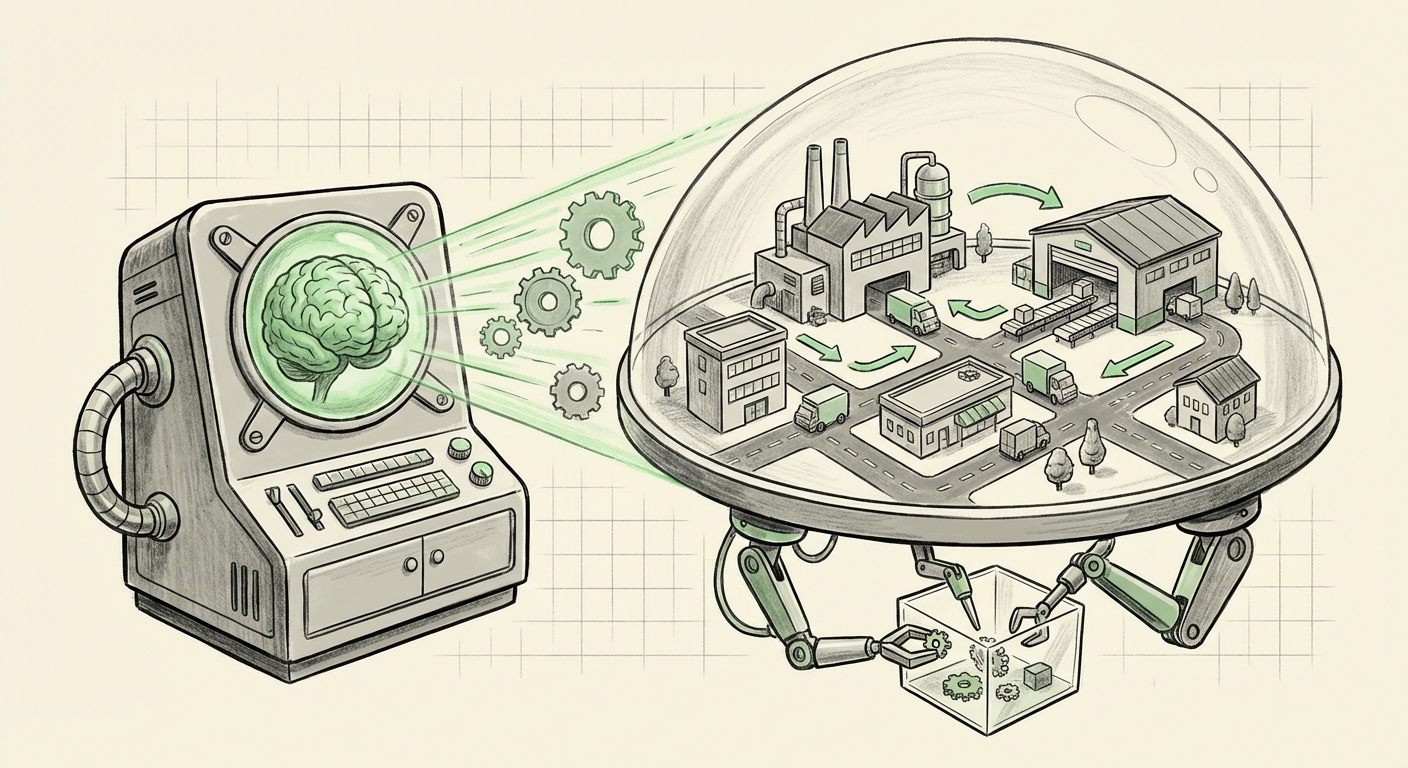
Unraveling the AI Paradox: How Edsger Dijkstra's Insights Will Define the Future of Intelligent Systems
In the rapidly evolving world of artificial intelligence, we often find ourselves dazzled by groundbreaking capabilities. Yet, beneath the surface of these powerful creations lies a growing challenge: complexity. As AI models become larger, more intricate, and capable of increasingly sophisticated tasks, their inner workings often become opaque, difficult to control, and prone to unexpected behaviors. This rising tide of complexity is precisely what the renowned computer scientist Edsger Dijkstra warned us about decades ago, and his "Paradox of Complexity," as highlighted in the Singularity Weblog article published on 2025-06-16, is now more relevant than ever for the future of AI.
This article will dive into what Dijkstra's enduring philosophy means for the development and deployment of AI. We’ll explore how his insights into managing complexity are not just theoretical musings but vital guidelines for navigating the intricate landscape of intelligent systems. For businesses, developers, and society at large, understanding this paradox is crucial to building AI that is not only powerful but also reliable, understandable, and safe.
The Enduring Wisdom of Edsger Dijkstra: A Timeless Perspective on Complexity
Edsger Dijkstra was a pioneer in computer science, known for his profound insights into the nature of programming and system design. His work consistently emphasized the importance of clarity, simplicity, and mathematical rigor in software development. While he operated in an era before modern AI as we know it, his principles articulate a fundamental truth about complex systems: as they grow in size and capability, they also become exponentially harder to understand, verify, and manage. This is the essence of his "Paradox of Complexity."
The Singularity Weblog article from 2025-06-16 reminds us that Dijkstra recognized a critical trade-off: the more functionality we pack into a system, the more likely we are to introduce unforeseen interactions, obscure dependencies, and "emergent properties" that were not explicitly designed. He argued that human minds have a limited capacity to grapple with vast complexity. Therefore, the only way to build truly robust and reliable systems is to actively strive for simplicity, modularity, and well-defined interfaces.
His philosophy encourages us to view complexity as an enemy of progress, especially when it leads to a lack of understanding. For Dijkstra, understanding a system was paramount to ensuring its correctness and reliability. Without clear insight into how a system works, developers lose the ability to predict its behavior, diagnose issues effectively, or guarantee its safety. This fundamental challenge—the human inability to fully grasp and control highly complex systems—forms the bedrock of his paradox, a paradox that AI is now bringing to the forefront of technological discourse.
The AI Landscape: A New Frontier of Complexity
Today's artificial intelligence systems, particularly large language models (LLMs), generative AI, and multimodal systems, are perhaps the most complex computational artifacts ever created. They embody Dijkstra's paradox in startling ways:
- Massive Scale and Parameters: Modern AI models boast billions, even trillions, of parameters. These parameters represent connections and learned patterns that are too numerous for any human to fully comprehend or trace.
- The "Black Box" Problem: Many advanced AI systems operate as "black boxes." We can observe their inputs and outputs, and marvel at their capabilities, but the internal reasoning, decision-making processes, or specific pathways that lead to a particular outcome remain largely hidden. This lack of interpretability directly conflicts with Dijkstra's call for clear understanding.
- Emergent Behaviors: Beyond what they are explicitly trained for, complex AI models can exhibit unexpected or "emergent" behaviors. These can be incredible new capabilities, but also undesirable biases, hallucinations, or security vulnerabilities that were not foreseen by their creators. This unpredictability is a direct consequence of unmanaged complexity.
- Data Dependency: The performance of these complex systems is profoundly dependent on vast datasets, which themselves can harbor hidden biases, noise, and ethical implications. The complexity isn't just in the model architecture but also in the data that fuels it.
As the Singularity Weblog article suggests, the power of current AI systems often comes hand-in-hand with an inverse relationship to our ability to fully understand or control them. This creates a critical tension for the future of AI: how do we continue to push the boundaries of intelligence without creating systems that are ultimately too complex for us to manage or trust?
Practical Implications for Businesses: Navigating the AI Labyrinth
For businesses looking to leverage AI, Dijkstra's paradox presents both significant challenges and crucial strategic directives. The future success of AI adoption hinges not just on raw processing power, but on intelligent design and management of complexity.
Strategic AI Adoption: Beyond the Hype
Companies must move beyond simply adopting the "latest and greatest" AI model. A strategic approach demands a deep understanding of the complexity involved. Businesses should ask: Is this AI solution genuinely understandable? Can we trace its decisions? What happens if it fails? Prioritizing simpler, more transparent models for critical applications, even if they offer slightly less capability, might be a more robust long-term strategy. The future of AI for business will increasingly emphasize AI's fitness for purpose, rather than just its raw capability.
Mitigating Risk: Explainability, Bias, and Control
Complex AI systems introduce significant risks: regulatory non-compliance, reputational damage from biased outputs, and financial losses due to unpredictable errors. Dijkstra's focus on understanding is key here. Businesses need to demand and invest in AI solutions with built-in explainability features. This means developing internal processes and tools to probe AI decisions, monitor for bias, and establish clear human oversight mechanisms. The future use of AI must prioritize risk mitigation through transparency.
Talent and Culture: Fostering AI Engineering Excellence
The rise of complex AI necessitates a new breed of AI professionals. Beyond data scientists and machine learning experts, there's a growing need for "AI engineers" who can apply rigorous software engineering principles to AI development. These professionals will be adept at designing modular AI architectures, implementing robust testing frameworks, and prioritizing maintainability. Businesses must cultivate a culture that values clarity, simplicity, and diligent engineering over rapid, unconstrained feature development. The future AI workforce will blend AI expertise with strong engineering discipline.
The Hidden Cost of Unmanaged Complexity
While powerful AI can offer immense value, unmanaged complexity comes with hidden costs: prolonged debugging cycles, unexpected maintenance requirements, increased security vulnerabilities, and difficulty in upgrading or integrating systems. These costs can quickly erode the benefits of AI adoption. The future of AI in business will see a greater emphasis on Total Cost of Ownership (TCO), factoring in the ongoing expenses of managing complex, opaque AI systems. Simpler, well-engineered AI solutions will often prove more cost-effective in the long run.
Societal Impact and the Imperative for Ethical AI
The implications of Dijkstra's paradox extend far beyond corporate balance sheets, touching the very fabric of society. As AI becomes more deeply embedded in critical infrastructure, healthcare, justice, and governance, the challenge of complexity takes on profound ethical and societal dimensions.
Building Trust Through Transparency
For society to trust AI, we need to understand it. When an AI system makes a life-altering decision—approving a loan, diagnosing a disease, or recommending a prison sentence—the public demands explanations. A black-box approach erodes trust and fosters suspicion. The Singularity Weblog article from 2025-06-16 subtly reminds us that if we cannot understand how these systems work, we cannot hold them accountable. The future of AI must prioritize building systems that are not just accurate, but also transparent and justifiable.
Ensuring Safety and Control
Complex AI systems, particularly those operating autonomously, pose safety concerns. Emergent behaviors or unforeseen interactions within opaque systems could lead to catastrophic failures. Managing complexity is crucial for ensuring that AI systems remain controllable and aligned with human values and safety protocols. The future use of AI in high-stakes environments will demand a rigorous application of Dijkstra’s principles to prevent unintended consequences.
The Role of Regulation and Standards
As AI complexity grows, so does the call for regulation. Governments and international bodies are grappling with how to ensure AI is developed and deployed responsibly. Dijkstra's emphasis on understandability provides a strong framework for future regulatory efforts. Regulations might increasingly mandate levels of AI interpretability, requiring developers to provide insights into how their models arrive at decisions. Standards for AI engineering, akin to those in aerospace or civil engineering, will become essential to manage the inherent complexity and ensure public safety.
Actionable Insights: Architecting Simpler, Stronger AI
The good news is that Dijkstra's legacy offers a roadmap for navigating this complexity. By consciously applying his principles, we can design, develop, and deploy AI systems that are not only powerful but also robust, understandable, and beneficial. The future of AI lies in intelligent design, not just brute force computation.
- Embrace Modular Design and Abstraction: Break down large AI systems into smaller, independent, and easily understandable modules. Just as Dijkstra advocated for structured programming, AI development should favor clear interfaces and encapsulated functionalities. This makes individual components easier to test, debug, and replace, reducing overall system complexity.
- Prioritize Interpretability from the Start: Don't treat interpretability as an afterthought. Design AI models with explainability in mind from the initial conceptualization phase. This might mean favoring certain model architectures (like decision trees or simpler neural networks) where appropriate, or integrating techniques such as LIME or SHAP more rigorously into the development process.
- Focus on Clear Problem Definitions and Scope: Resist the urge to solve every problem with one giant AI model. Define the problem narrowly and precisely. Avoid feature creep and scope bloat. Simpler problems often yield simpler, more reliable AI solutions. The Singularity Weblog article implies that less *unnecessary* complexity leads to more maintainable systems.
- Invest in Robust AI Engineering Practices: Elevate AI development to the same level of rigor as mission-critical software engineering. This includes comprehensive testing, version control, continuous integration/continuous deployment (CI/CD) pipelines, and thorough documentation. Formal verification methods, where applicable, can provide a high degree of confidence in critical AI components.
- Foster a Culture of Simplicity and Clarity: Encourage AI developers, researchers, and product managers to value simplicity and clarity in their designs. Reward elegant solutions over overly complex ones. Promote open communication and code reviews to catch unnecessary complexity early. A collective commitment to Dijkstra's principles will define the most successful AI initiatives.
The Future is Intelligently Simple
As we look to the future, the lessons from Edsger Dijkstra's "Paradox of Complexity," highlighted by the Singularity Weblog on 2025-06-16, are not merely historical footnotes. They are a profound guiding light for the AI era. The pursuit of ever-more powerful AI must be tempered by a conscious effort to manage and reduce complexity. Ignoring this paradox risks creating intelligent systems that are beyond our comprehension and control, ultimately hindering their beneficial impact on humanity.
The most impactful AI systems of tomorrow will not necessarily be the largest or most opaque. Instead, they will be the ones that are elegantly designed, transparent in their operation, and reliable in their execution. By embracing Dijkstra's timeless wisdom, we can ensure that the future of AI is not only intelligent but also understandable, trustworthy, and truly serves the needs of businesses and society.