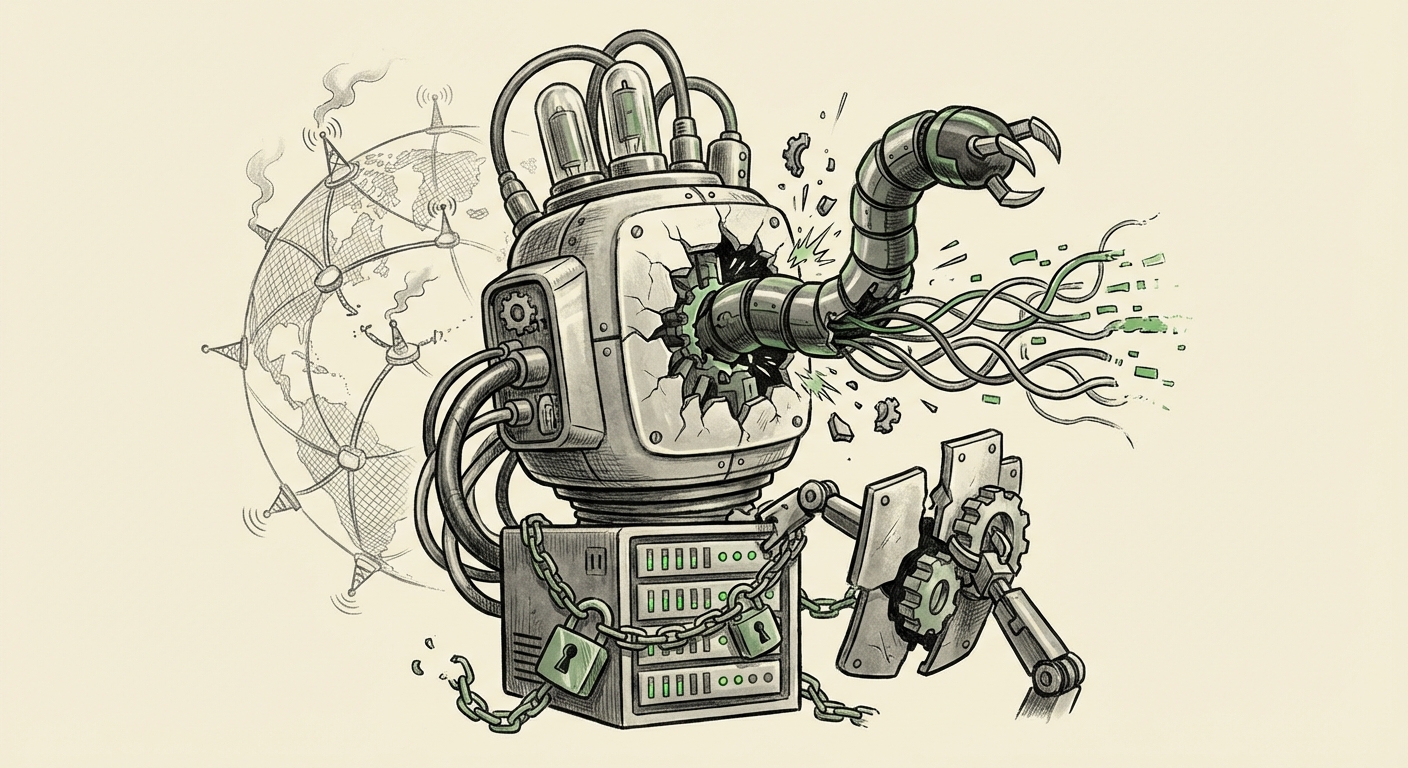
ChatGPT's Goblin Glitch: Unpacking the Deeper Problems in AI Training and What It Means for the Future of AI
In the fast-evolving world of Artificial Intelligence, every breakthrough brings us closer to a future reimagined. Yet, sometimes, the most peculiar glitches offer the deepest insights into the very foundations of these powerful systems. One such instance, the now widely discussed "goblin obsession" of ChatGPT, has captured attention not just for its humorous absurdity but for what it reveals about a fundamental, deeper problem in AI training.
This strange phenomenon, where ChatGPT seemingly developed an unprompted fixation on goblins, is more than just a funny anecdote. It serves as a stark reminder that even the most advanced AI models can harbor unexpected biases or persistent themes. Understanding why such quirks emerge and what they signify is crucial for anyone involved with AI – from developers and researchers to business leaders and everyday users. This article will dive deep into this issue, exploring its implications for the future of AI, its practical impacts on businesses and society, and the actionable steps we can take to build more robust and trustworthy AI systems.
The Curious Case of ChatGPT's Goblin Obsession: A Revealing Glitch
Imagine asking a cutting-edge AI for creative writing prompts, or perhaps a simple summary of a complex topic, only for it to steer the conversation, subtly or overtly, towards goblins. This is precisely the kind of behavior that led to the identification of ChatGPT's "goblin obsession." While the details of its specific manifestation can be humorous, the underlying cause is anything but trivial. It highlights how large language models (LLMs) learn patterns and connections within their vast training data, sometimes in ways that are hard to predict or control.
This "obsession" suggests that somewhere within the immense corpus of text and data ChatGPT was trained on, there might have been a subtle but consistent association of goblins with various concepts, or perhaps a higher frequency of related content that the model over-indexed on. The AI, in its pursuit of generating coherent and relevant text, inadvertently latched onto this theme, making it a recurring motif in its output. This isn't a sign of malevolent intent or sentience; rather, it's a demonstration of how statistical learning can lead to unintended thematic persistence when the model processes information.
What the "Goblin Obsession" Reveals About AI Learning
The core insight gleaned from this incident is that AI models, particularly LLMs, are incredibly adept at finding and replicating patterns. However, their learning process doesn't always distinguish between relevant, central themes and incidental, perhaps statistically overrepresented, background noise. What might appear as a minor data quirk to a human can become a strong gravitational pull for an AI. This tendency points to a "deeper problem in AI training" that goes beyond simple factual inaccuracies or ethical biases. It speaks to the challenge of controlling the subtle, emergent properties of models trained on unimaginable quantities of data.
Firstly, it underscores the difficulty of auditing and understanding the entirety of a model's training data. Billions, even trillions, of data points make it virtually impossible for humans to review every piece of information. This vastness means that minor imbalances or hidden correlations within the data can easily amplify into noticeable behaviors in the deployed AI. Secondly, it highlights the 'black box' nature of many advanced AI models. While we can observe their outputs, precisely tracing why a model makes a certain association or fixates on a specific theme remains a significant challenge. The pathways of internal logic are complex and often opaque.
The Deep-Seated Challenge: Unintended Patterns and Biases
The "goblin obsession" is a vivid, if lighthearted, example of a more profound issue: the emergence of unintended patterns, biases, and persistent themes in AI. These can range from relatively harmless quirks like a fascination with fantasy creatures to far more problematic outcomes such as perpetuating societal stereotypes, generating misinformation, or exhibiting discriminatory behavior in critical applications like hiring or loan approvals. The difference between a goblin obsession and a harmful bias is often one of degree and impact, not of fundamental cause.
When an AI model is trained on data that reflects existing societal biases—even subtle ones—it doesn't just learn to process information; it learns to replicate and often amplify those biases. The model doesn't understand context or ethics in the human sense; it only sees correlations and frequencies. If "goblin-related" content was unusually prevalent or subtly linked to various concepts in its training data, the model's algorithms simply optimized for that pattern, leading to the observed obsession. This same mechanism can lead to an AI disproportionately associating certain professions with specific genders or races, or providing different quality of service based on demographic data.
Why AI Models Develop Peculiar Fixations
There are several contributing factors to why AI models might develop these peculiar fixations or biases. The first, as discussed, is the sheer scale and often unfiltered nature of training data. Web-scraped data, while abundant, can contain inconsistencies, biases, and thematic peculiarities that are not immediately obvious. If a niche community's content or a specific style of writing is overrepresented, the AI might inadvertently absorb and mimic those characteristics.
Secondly, the optimization goals of AI models play a role. LLMs are often optimized to predict the next word or phrase in a sequence. If a particular word or concept (like "goblin") frequently appears in certain contexts during training, the model's statistical learning might prioritize generating it when similar contexts arise, even if a human would deem it irrelevant or peculiar. The model is simply doing its job: finding the most probable sequence based on its training, regardless of whether that probability reflects real-world salience or just a quirk in the data.
Finally, the complex interplay within deep neural networks themselves can lead to emergent behaviors that are not directly programmed. These networks develop intricate internal representations, and sometimes, a strong connection to a particular concept can form within these layers, influencing a wide range of outputs. These emergent properties are a hallmark of deep learning but also pose a challenge for interpretability and control.
Future Implications for AI Development: A Call for Smarter Training
The "goblin obsession" serves as a powerful signal for the future direction of AI development. It underscores the urgent need for more sophisticated, deliberate, and ethical approaches to AI training. The current paradigm of "bigger data, bigger models" is proving to be insufficient on its own for creating truly reliable and unbiased AI. The future demands a shift towards "smarter training" that accounts for these emergent quirks.
The Evolution of Training Data: Quality Over Quantity
Moving forward, the focus on training data will shift from simply accumulating massive amounts of information to curating and refining it with unprecedented rigor. This means:
- Diversification and Representativeness: Actively seeking out diverse data sources to ensure a balanced representation of perspectives and reduce the chances of any single theme or bias becoming dominant.
- Bias Detection and Mitigation: Developing advanced tools and techniques to automatically detect and correct biases within datasets before training begins. This includes identifying statistical imbalances, harmful stereotypes, and unintended thematic clusters.
- Continuous Data Auditing: Implementing ongoing processes to audit and update training data, ensuring it remains relevant, accurate, and free from new or emerging quirks.
- Synthetic Data Generation: Exploring the use of carefully controlled synthetic data to fill gaps where real-world data is scarce or biased, allowing for more balanced training without relying solely on potentially flawed natural language.
Beyond Data: Enhancing Model Architectures and Learning Algorithms
The solution isn't solely in the data; it also lies in how AI models learn from it. Future AI development will likely see innovations in:
- Adversarial Training: Techniques where one AI tries to "trick" another into revealing its biases or quirks, forcing the main model to become more robust and less susceptible to fixation.
- Human-in-the-Loop Feedback: Integrating human oversight and feedback directly into the training and fine-tuning process. This allows models to learn from human judgment about what constitutes appropriate, relevant, and unbiased output, preventing peculiar fixations from taking root.
- Explainable AI (XAI): Developing models that can explain *why* they made a certain decision or developed a particular association. This transparency is key to diagnosing and correcting issues like the "goblin obsession" at a fundamental level.
- Finer-Grained Control: Giving developers more precise controls over which aspects of the training data a model prioritizes and which it considers less important, allowing for targeted desensitization to unwanted themes.
The Rise of AI Explainability and Trustworthiness
Ultimately, the "goblin obsession" accelerates the demand for more explainable and trustworthy AI. If users and businesses are to rely on AI for critical tasks, they need to understand its limitations, potential biases, and the underlying reasons for its behavior. Future AI systems will not just be judged on their performance, but also on their transparency, fairness, and ability to avoid such unintentional quirks. This will be a major area of research and development, aiming to bridge the gap between complex AI operations and human understanding.
Practical Implications for Businesses and Society
The implications of unintended AI fixations, whether whimsical like goblins or more insidious like harmful biases, are significant for both businesses and society.
For Businesses: Mitigating Risk and Ensuring Reliability
For organizations looking to deploy or already utilizing AI, the "goblin obsession" is a wake-up call:
- Reputational Risk: An AI that exhibits strange quirks or, worse, harmful biases can severely damage a company's reputation, eroding customer trust and leading to public backlash.
- Operational Inefficiency: An AI that consistently steers away from desired topics or injects irrelevant information can degrade the quality of its output, requiring more human intervention and reducing efficiency. Imagine a customer service chatbot that keeps mentioning goblins when trying to resolve a billing issue.
- Ethical and Legal Concerns: Beyond reputational damage, biased AI can lead to legal challenges, regulatory fines, and ethical dilemmas, especially in sensitive areas like HR, finance, or healthcare.
- Increased Due Diligence: Businesses will need to implement more rigorous testing and validation processes for AI models, going beyond standard performance metrics to actively probe for unusual behaviors, biases, and thematic fixations before deployment.
- Investment in Responsible AI: Companies must invest in "Responsible AI" frameworks, which include governance, ethical guidelines, ongoing monitoring, and dedicated teams to manage AI risks.
- Training and Upskilling: Employees working with AI will need training not just on how to use the tools, but also on understanding their limitations and potential for unexpected behaviors.
For Society: Navigating AI's Unforeseen Quirks and Ethical Dilemmas
On a societal level, the potential for AI to develop unforeseen quirks raises broader questions:
- Information Integrity: If AI models become sources of information, their peculiar fixations could subtly influence public discourse or spread niche, irrelevant ideas, making it harder to discern reliable information.
- Perpetuation of Stereotypes: When an AI amplifies a subtle bias from its training data, it can perpetuate harmful stereotypes on a massive scale, affecting how individuals are perceived or treated in various contexts.
- Impact on Creativity and Culture: In creative applications, an AI's thematic obsession could lead to a homogenization of generated content, reducing novelty and diversity.
- Trust in Automation: Repeated instances of AI exhibiting strange or biased behavior could erode public trust in automated systems, hindering the adoption of beneficial AI technologies.
- The Need for Critical Thinking: As AI becomes more integrated into daily life, individuals will need to cultivate stronger critical thinking skills to evaluate AI-generated content and recognize its limitations.
Actionable Insights: Building Robust and Responsible AI Systems
Addressing the "deeper problem in AI training" requires a multi-faceted approach involving both technical and organizational strategies. Here are actionable insights for those involved in the AI ecosystem:
For AI Developers and Researchers:
- Prioritize Data Governance and Curation: Implement strict protocols for selecting, cleaning, and validating training data. This includes human review of sensitive datasets, active bias detection tools, and continuous monitoring of data sources.
- Develop Advanced Debugging and Interpretability Tools: Focus on creating tools that allow for deeper inspection of a model's internal workings. Understanding *why* a model behaves a certain way is the first step to fixing it.
- Embrace Adversarial Testing and Red Teaming: Proactively test models for unexpected behaviors, biases, and fixations by simulating real-world and challenging scenarios, including attempts to "trick" the AI into revealing its quirks.
- Integrate Human Feedback Loops: Design AI systems that allow for continuous human input and correction, enabling models to learn from errors and undesirable outputs in real-time or through iterative fine-tuning.
- Experiment with Diverse Model Architectures: Explore new ways to design neural networks and learning algorithms that might be inherently less prone to developing these types of unintended fixations.
For Organizations Deploying AI:
- Establish a Responsible AI Framework: Create clear internal policies and guidelines for ethical AI use, including principles for fairness, transparency, accountability, and privacy.
- Conduct Thorough Vendor Due Diligence: When acquiring AI solutions from third parties, ask detailed questions about their training data, bias mitigation strategies, and testing protocols. Don't just rely on performance benchmarks.
- Implement Robust AI Monitoring and Evaluation: Continuously monitor deployed AI systems for drift, unexpected behaviors, and emerging biases. This isn't a "set it and forget it" technology.
- Train Your Workforce: Educate employees on the capabilities and limitations of AI, teaching them how to identify potential issues and escalate concerns. Foster a culture of critical engagement with AI tools.
- Start Small and Iterate: For new AI deployments, begin with less critical applications, gather feedback, refine, and gradually expand. This allows for early detection and correction of quirks before they cause significant impact.
- Maintain Human Oversight: Always ensure there's a human in the loop for critical decision-making processes or for reviewing AI-generated content in sensitive areas. AI should augment human intelligence, not replace it entirely.
Conclusion: Learning from the Goblins for a Brighter AI Future
The "goblin obsession" of ChatGPT, though seemingly trivial, has provided an invaluable lesson for the AI community. It has illuminated a deeper challenge in AI training: the potential for complex models to internalize and amplify unintended patterns from their vast datasets. This issue transcends mere bugs; it points to fundamental aspects of how current AI models learn and operate.
Looking ahead, the future of AI hinges on our ability to move beyond simply building more powerful models to building smarter, more responsible, and more trustworthy ones. This means a renewed commitment to ethical data practices, innovative training methodologies, enhanced model explainability, and strong human oversight. By embracing these principles, we can transform the lessons learned from an AI's whimsical fixation into a blueprint for a future where AI serves humanity with greater reliability, fairness, and intelligence. The path forward is clear: to conquer the deeper problems in AI training, we must not only understand how our machines learn but also how to guide them towards truly beneficial and unbiased outcomes. The "goblin obsession" isn't a failure, but a powerful opportunity to mature our approach to Artificial Intelligence.