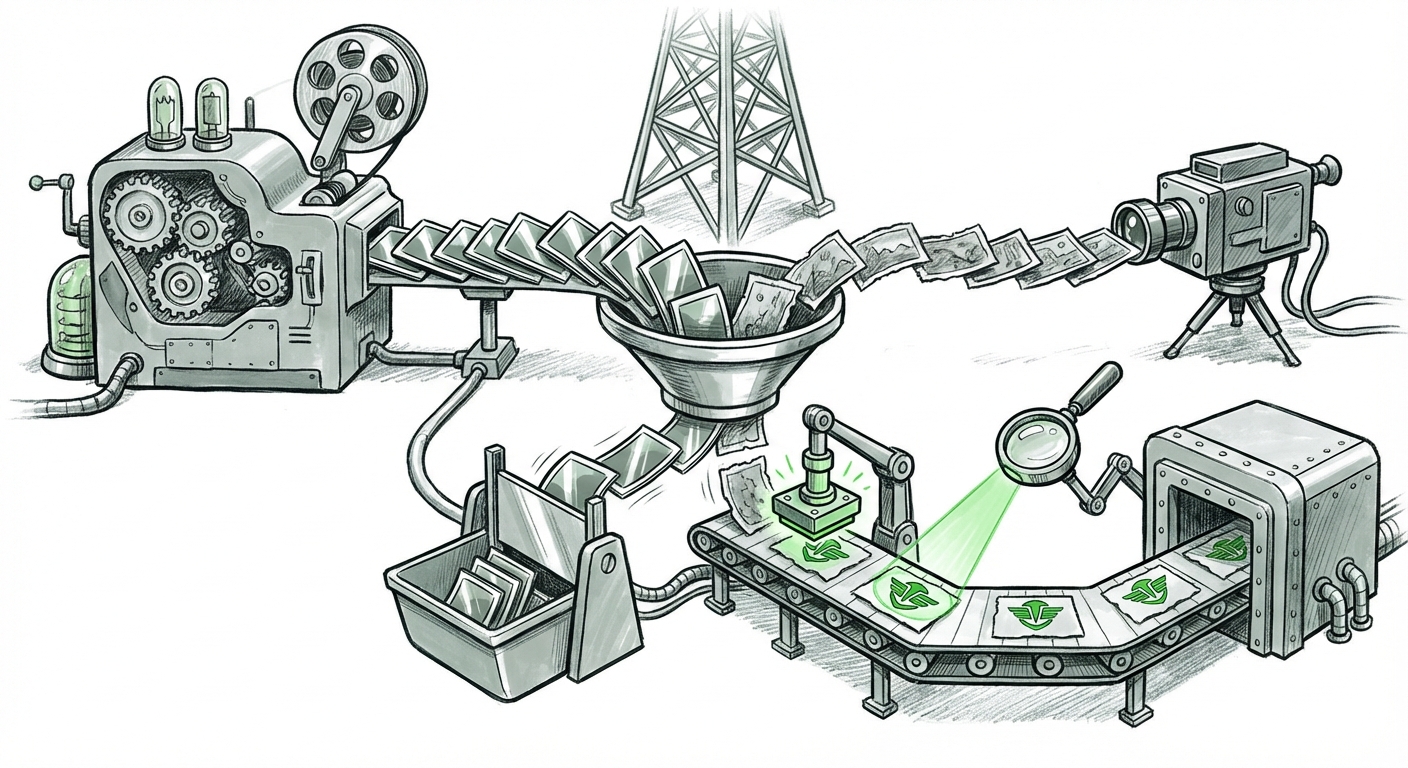
Sapient's HRM-Text: Why "Thinking in Latents" Is the Quiet Rebuke to Chain-of-Thought That Will Transform AI
For the past few years, the AI world has been obsessed with one idea: making machines "think aloud." This approach, known as chain-of-thought reasoning, encourages large language models to break down problems step-by-step, writing out their internal logic like a student showing their work on a math test. It has been wildly successful. Models like GPT-4, Claude, and Gemini now use chain-of-thought to solve complex math problems, answer tricky logic puzzles, and even write code. It has become the gold standard for advanced reasoning.
But what if showing your work is actually slowing you down? What if the most efficient way for a machine to think is not in words, but in something more abstract—something the AI community calls latents?
That is exactly the question being raised by a new AI model from Sapient, called HRM-Text. In a recent analysis published by The Sequence, this model was highlighted as a "quiet rebuke" to the chain-of-thought paradigm. It represents a fundamental shift in how we think about machine reasoning, and it could change the future of AI in profound ways. This article unpacks what HRM-Text is, why it matters, and what it means for the future of AI for businesses and society.
What Is Chain-of-Thought and Why Has It Dominated?
To understand why HRM-Text is a big deal, you first need to understand the current reigning champion: chain-of-thought reasoning. Imagine you ask an AI: "Sarah has three apples. She gives one to John and then buys two more. How many does she have now?" A standard language model might just guess the answer. But a chain-of-thought model will write: "Sarah starts with 3. She gives 1 to John, so she has 2. Then she buys 2 more, so she has 4. The answer is 4."
This explicit, step-by-step writing has been a game-changer. It helps the model keep track of its own logic, correct mistakes mid-stream, and handle multi-step problems that were previously impossible. It is intuitive, easy to debug, and feels almost human. Because of these benefits, chain-of-thought has become the default architecture for almost every major AI system released in the last two years.
But there is a catch: it is incredibly expensive in terms of computing power. Every step in the chain requires the model to generate tokens (words or subwords). The longer the chain, the more tokens, and the more energy and time are needed. For simple tasks, this is like using a sledgehammer to crack a nut. The model is forced to "speak" its thoughts even when it could have just "thought" them silently and instantly.
The Quiet Rebuke: Sapient's HRM-Text
Enter Sapient's HRM-Text. The name stands for something specific—Hierarchical Reasoning in Multiple spaces—but what really matters is how it thinks. The key innovation is that the model does not generate intermediate text. Instead, it performs its internal reasoning in what AI researchers call latent space.
What is latent space? Think of it as the "language of thought" before it gets translated into human words. When a standard AI talks to you, it does so by converting its internal representations into tokens you understand. Chain-of-thought forces it to do that at every reasoning step. HRM-Text, on the other hand, keeps its reasoning inside its own mathematical domain. It does not "speak" until it is ready to give you the final answer. It thinks in compressed, efficient internal patterns rather than in verbose human language.
This is a radical departure. It is like the difference between solving a puzzle in your head versus explaining every step out loud to someone else. You can often solve a problem much faster if you just do it quietly. HRM-Text applies this principle to machine reasoning.
Why "Thinking in Latents" Matters for the Future of AI
If you are a business leader, a developer, or just someone curious about where AI is headed, this shift carries three massive implications.
1. Unprecedented Efficiency Gains
The most immediate impact of HRM-Text's approach is speed and cost. Because the model does not generate intermediate words, it uses far fewer tokens per query. For a typical reasoning task, chain-of-thought might use 10x or 20x the tokens of a direct answer. HRM-Text's latent thinking bypasses that entirely. Early indications suggest this could reduce compute costs by a factor of 5 to 10 for complex reasoning tasks. For companies that run thousands of AI queries per second, this is not just a nice-to-have—it is a transformative cost reduction.
It also means lower latency. In customer service chatbots, for instance, every second of delay reduces customer satisfaction. A model that thinks in latents can respond almost instantly, even to questions that require multi-step logic. This could make AI assistants feel far more natural and responsive.
2. A Path to More Powerful AI
Chain-of-thought is limited by the fact that it has to express everything in human language. But human language is not the most efficient representation for all kinds of reasoning. For example, spatial reasoning, abstract mathematics, or high-dimensional optimization often benefit from representations that don't map neatly to words. By operating in latent space, HRM-Text can represent ideas that are difficult to verbalize. This could unlock entirely new capabilities in fields like drug discovery, materials science, and complex system simulation.
Imagine an AI that designs a new protein structure. Instead of explaining each logical step in English (which might be impossible for a human to follow anyway), it can directly manipulate the geometric and chemical constraints in its latent space. The output is the final design, not a transcript of the process. This is much closer to how expert humans actually work in creative fields—they don't always know why a particular idea is good; they just know it is.
3. Energy and Environmental Impact
Data centers that run large AI models consume enormous amounts of electricity. A single training run for a major model can produce as much carbon emissions as several cars over their lifetimes. But beyond training, the cost of inference (running the model in production) is increasingly the bigger issue. Chain-of-thought reasoning multiplies inference cost dramatically. By reducing token usage by an order of magnitude, HRM-Text's approach could slash the energy footprint of AI systems. For society, this means we can deploy more capable AI without overwhelming power grids. It is a win-win for capability and sustainability.
Practical Implications for Businesses and Society
So what does this mean for you, right now? Here are actionable insights and what to watch for.
For Businesses: Rethink Your AI Cost Strategy
If you are currently using a chain-of-thought-based model (like GPT-4 with reasoning enabled or Claude's "think step by step" mode), you are likely paying a premium for every request that involves complex logic. The HRM-Text approach suggests that cheaper alternatives are coming. Over the next year, we can expect to see more models that offer "thinking in latents" as an option. When they arrive, you should aggressively test them on your use cases. The savings could be dramatic, especially for high-volume applications like customer support, document analysis, and code generation.
But there is a trade-off. Because latent reasoning is not transparent—you can't see the steps—it may be harder to audit and debug. For regulated industries like healthcare or finance, chain-of-thought's transparency might still be necessary. The future likely involves a hybrid approach: use fast latent thinking for routine tasks and fall back to chain-of-thought when you need to verify the logic.
For Developers: New Architectures Are Coming
If you build applications on top of large language models, you should start paying attention to research into latent reasoning. HRM-Text is still early-stage, but it points to a shift in architecture. Developers who understand how to prompt or configure models for latent reasoning will have an advantage. You may also need to adapt your evaluation pipelines. Currently, many benchmarks rely on chain-of-thought outputs to assess correctness. With latent reasoning, you'll need to trust the final answer more and the process less. That requires new testing methodologies.
For Society: The Black Box Debate Heats Up
One of the biggest advantages of chain-of-thought reasoning is that it makes AI more interpretable. You can read the model's "thoughts" and see if it is biased, wrong, or making dangerous assumptions. HRM-Text's approach essentially closes that window. The model thinks in an opaque latent space that even its creators may not fully understand. This reignites the debate about AI transparency. Do we want powerful but inscrutable AI? Or do we prefer slower, more explainable systems? Society will need to grapple with this question as models like HRM-Text become more common. Regulation may end up mandating a minimum level of interpretability, which could limit adoption of pure latent-thinking models in some sectors.
The Bigger Picture: A Return to Efficiency in AI
The rise of chain-of-thought was driven by a simple insight: giving models more space to "think" improves performance. But it also created a culture of computational excess. Every problem was solved by adding more tokens, more parameters, and more compute. HRM-Text represents a counter-movement: a demand for efficiency. Instead of asking "how can we make the model bigger?" it asks "how can we make the model smarter about how it uses its resources?"
This trend is not happening in isolation. Across the AI industry, we are seeing renewed focus on small models, quantization, and efficient architectures. The era of "bigger is always better" is giving way to a more nuanced appreciation for the right tool for the job. Sapient's HRM-Text is a bellwether for that shift. It shows that sometimes, the quietest approach is the most powerful one.
What to Watch Next
- Benchmark results: Look for head-to-head comparisons of HRM-Text against GPT-4 and Claude on reasoning tasks. If it matches or exceeds accuracy at a fraction of the cost, the industry will pivot quickly.
- Open-source versions: If the latent-thinking approach is open-sourced, expect rapid experimentation and adaptation by the developer community.
- Enterprise pilots: Watch for case studies from companies that deploy HRM-Text in production. Real-world cost savings will accelerate adoption.
- Regulatory response: In 2026, governments are increasingly interested in AI transparency. How latent-thinking models fit into emerging laws will shape their future.
Conclusion: A Quiet Revolution
Sapient's HRM-Text is not the loudest AI release of the year. It does not boast about having the highest benchmark score or the largest parameter count. But its quiet approach—thinking in latents rather than in words—challenges one of the most entrenched dogmas in modern AI. Chain-of-thought reasoning is not the only way to achieve deep intelligence. In fact, it may not even be the best way.
For businesses, this means lower costs and faster responses. For society, it means a more sustainable path forward for AI—but also a tougher conversation about transparency. As the model continues to prove itself, we may look back at 2026 as the year AI learned to think in silence. And sometimes, the quietest thinkers are the most brilliant of all.