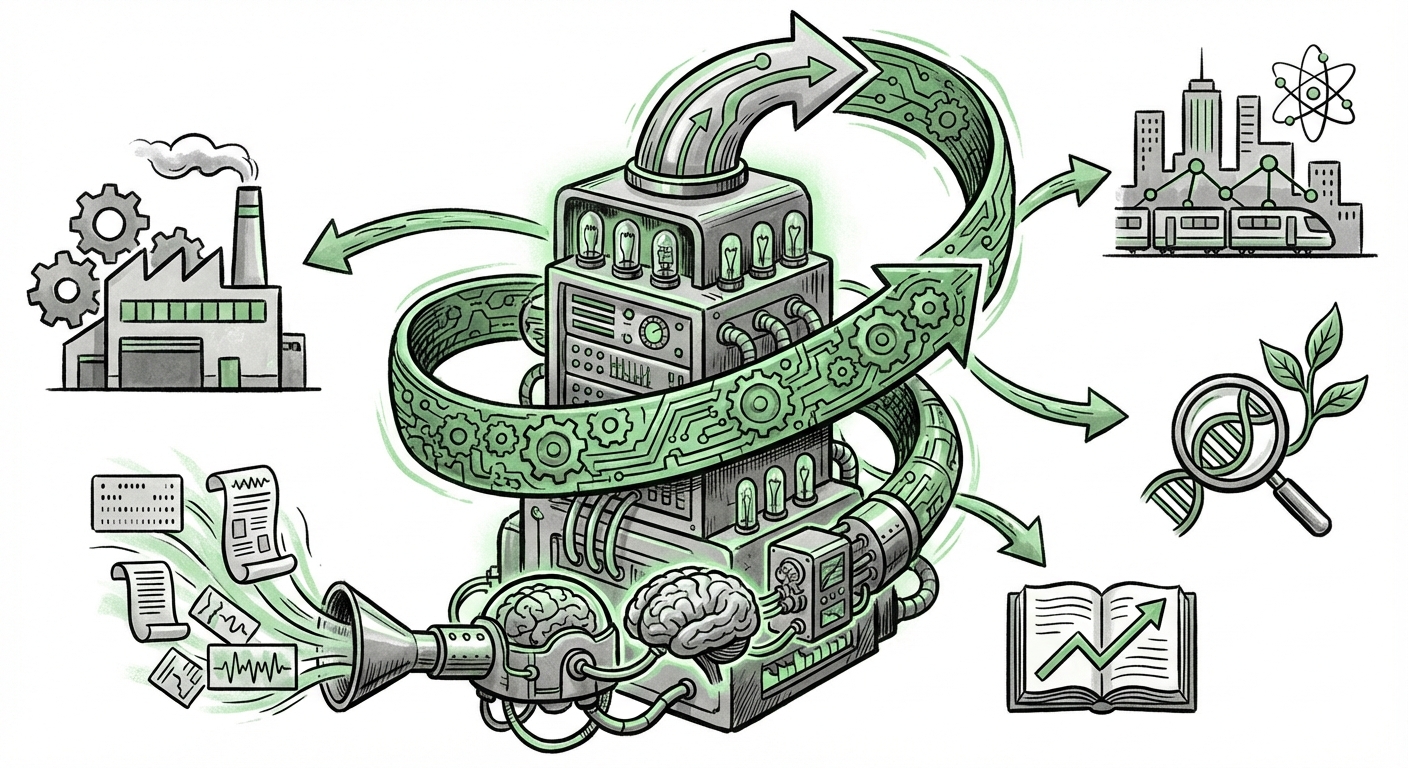
Salesforce AI Agents Slash a 231-Day Migration to Just 13 Days — With Fewer Incidents
What if you could finish a project that normally takes nearly eight months in under two weeks? That is exactly what Salesforce claims its AI agents did for a massive data migration. According to a report from the-decoder.com published on May 30, 2026, Salesforce says its AI agents cut a 231-day migration down to just 13 days — and with fewer incidents along the way.
This is not just a technical curiosity. It is a signal that the future of enterprise work is about to change dramatically. When AI agents can handle one of the most painful, risky IT tasks in existence — moving huge amounts of data between systems — then almost any routine business process is on the table. Let's break down what happened, why it matters, and what it means for the future of AI and how it will be used.
The Migration That Used to Take Eight Months
Data migrations are infamous in the technology world. They are slow, error-prone, and often cause outages or data loss. A typical migration for a large company might involve weeks of planning, manual scripting, testing, and then careful execution with teams standing by to fix problems. The 231-day timeline — about 7.7 months — is not unusual for a complex enterprise environment.
Salesforce says its AI agents took over that process. Instead of humans writing scripts and monitoring every step, the AI agents planned, executed, and validated the migration. The result: 13 days. That is a 94% reduction in time. Even more impressive, the company reported fewer incidents during the move. That means the AI did not just go fast — it went safely.
This is a huge deal because it shows that AI can handle tasks that require careful sequencing, error checking, and adaptation. Historically, automation tools could handle simple, repetitive steps. But a migration involves many interdependent tasks. Moving one database table might break a link to another. An AI agent that can reason about those dependencies and adjust in real time is something new.
What Are AI Agents, Exactly?
You have probably heard the term "AI agent" a lot lately. It is different from a chatbot or a simple automation script. An AI agent is a program that can perceive its environment, make decisions, and take actions to achieve a goal. In this case, the agent understood the structure of the source data, the target system, and the mapping rules. It then executed the transfer, monitored for errors, and fixed issues without human intervention.
Think of it like a very smart, very patient intern who never sleeps and never makes careless mistakes. The agent can break a big project into small steps, check each step, and adjust if something goes wrong. That is exactly what made the 13-day migration possible.
Why This Matters for the Future of AI
This story is a perfect example of a trend that is accelerating fast: autonomous task completion. Until recently, AI was mostly used for generating text, answering questions, or recognizing images. Those are valuable, but they are "assistive" — they help a human do a job faster. AI agents that can independently execute complex multi-step projects are a step toward "replacement" automation. Not replacement of people entirely, but replacement of the repetitive, low-level work that burns out engineers and slows down business.
From Cockpit to Autopilot
We are moving from AI as a co-pilot to AI as an autopilot. A co-pilot helps you fly the plane but you are still in command. An autopilot can fly the plane from takeoff to landing under the right conditions. That is what Salesforce showed. The AI agents did not just suggest steps — they did the work.
This shift will force every company to rethink how they allocate talent. Right now, many IT departments spend a huge chunk of their time on maintenance, migrations, upgrades, and data cleanup. If AI agents can handle those tasks in a fraction of the time, human workers can focus on higher-value work: designing new systems, improving customer experience, and strategic planning.
Practical Implications for Businesses
If you run a business, this is not science fiction. The technology is here now. Here is what you need to start thinking about:
1. Re-Evaluate Your Project Timelines
If a 231-day project can become a 13-day project, then many of the timelines you use for planning are likely outdated. Anything that involves data movement, system integration, or repetitive IT operations might be radically faster with AI agents. That changes budgeting, resource allocation, and competitive positioning. If your competitor can launch a new system in two weeks while you plan for eight months, you lose.
2. Prepare for Fewer Incidents, Not More
One worry people have is that AI will cause chaos — bugs, data corruption, outages. But the Salesforce example shows the opposite: fewer incidents. That makes sense because AI agents do not get tired, do not mistype commands, and can check their own work against rules consistently. When programmed correctly, they are actually safer than humans for highly procedural tasks.
3. Invest in AI Governance and Validation
The catch is that you need good guardrails. The AI agent worked because it had clear goals, clear rules, and validation steps built in. Companies that want to use AI agents need to invest in governance frameworks — what can the agent do? What are the limits? Who approves the final result? Without that, an AI agent might finish a migration in 13 days but migrate the wrong data. The technology requires mature oversight.
4. Retrain Your Workforce
If AI agents handle migrations, what happens to the people who used to do that work? Smart companies will retrain them to manage the agents. Instead of writing migration scripts, they will design agent workflows, monitor exceptions, and handle edge cases the AI cannot solve. The role shifts from "doer" to "supervisor." That requires new skills in prompt engineering, oversight, and AI behavior analysis.
What This Means for Society
Beyond individual businesses, this trend has broader implications. Data migrations are just one example. AI agents will soon handle software updates, security patching, compliance reporting, and many other back-office tasks. That could lead to huge gains in productivity and speed. It could also disrupt jobs that involve rote IT work.
There is also a security angle. If AI agents can migrate data fast and safely, they can also be used to exfiltrate data fast. Companies will need to ensure that their AI agents are locked down and cannot be hijacked by bad actors. The same power that makes them useful also makes them dangerous in the wrong hands.
On the positive side, faster migrations mean businesses can modernize their systems more quickly. Many companies are stuck on old, insecure software because migration is too painful. AI agents could help the entire industry upgrade faster, which improves security and performance for everyone.
Actionable Insights for Leaders
If you are a business leader or a technology manager, here are concrete steps you can take right now:
- Start small. Identify one repetitive, high-risk IT task in your organization — a regular data sync, a quarterly system update, a compliance audit. Try applying an AI agent to that task first. Measure the time and error rate against your current process.
- Build trust through testing. Do not let an AI agent run wild. Give it a sandbox environment with sample data. Run parallel tests where the agent does the work and a human validates. Gradually increase autonomy as confidence grows.
- Train your people. Start teaching your IT staff about agent design, prompt engineering, and AI oversight. The skills that matter are changing. Invest in training programs now.
- Update your governance. Create policies for when an AI agent can act independently and when a human must approve. Include rollback plans and incident response procedures specifically for AI-driven processes.
- Watch for vendor capabilities. Salesforce has shown what is possible. Other cloud providers — Microsoft, Amazon, Google — are likely to offer similar agent capabilities soon. Evaluate them as part of your technology stack.
The Bottom Line: Speed and Safety Are Not Trade-offs Anymore
The old assumption was that if you wanted something done fast, you had to accept more risk. The Salesforce case challenges that. With well-designed AI agents, you can be both faster and safer. That is a powerful combination that will reshape how companies operate.
The future of AI is not just about chatbots that write emails. It is about agents that do real work — migrations, integrations, deployments — in a fraction of the time with fewer errors. The 13-day migration is a proof point. It shows that the era of autonomous enterprise IT is not coming. It is already here.
Companies that embrace this now will have a massive competitive advantage. Those that wait will find themselves struggling to keep up with the speed of AI-driven competitors. The message is clear: start planning for your AI agent workforce today.