Terence Tao Argues AI Could Finally Bring Division of Labor to Math – Here’s What That Means
Mathematics, for all its power, has always remained a largely solitary pursuit. A single mathematician wrestles with a proof, scribbling equations for months or years. But what if that could change? What if math, like engineering or software development, could benefit from a division of labor?
That is the provocative idea put forward by one of the world’s greatest living mathematicians, Terence Tao. In a recent discussion, Tao argued that artificial intelligence could bring division of labor to mathematics for the first time in history. This isn’t just a neat academic thought—it could reshape how we do math, how we train AI, and what problems we can solve.
The Big Idea: Math as a Team Sport
Terence Tao, a Fields Medal winner and professor at UCLA, is known for his deep insights into everything from harmonic analysis to number theory. But his latest argument is more about process than proof. He suggests that AI could break down mathematical problems into smaller, more manageable pieces, allowing different specialists—both human and machine—to work on them simultaneously.
Tao’s point is rooted in history. For centuries, math has been a craft practiced by individuals. A great mathematician might spend years developing a single theorem. There have been collaborations, of course, but they are rare and often require deep alignment of expertise. Compare this to fields like architecture or engineering, where a project is divided into tasks: one team designs the foundation, another the electrical system, another the plumbing. Math has no such structure.
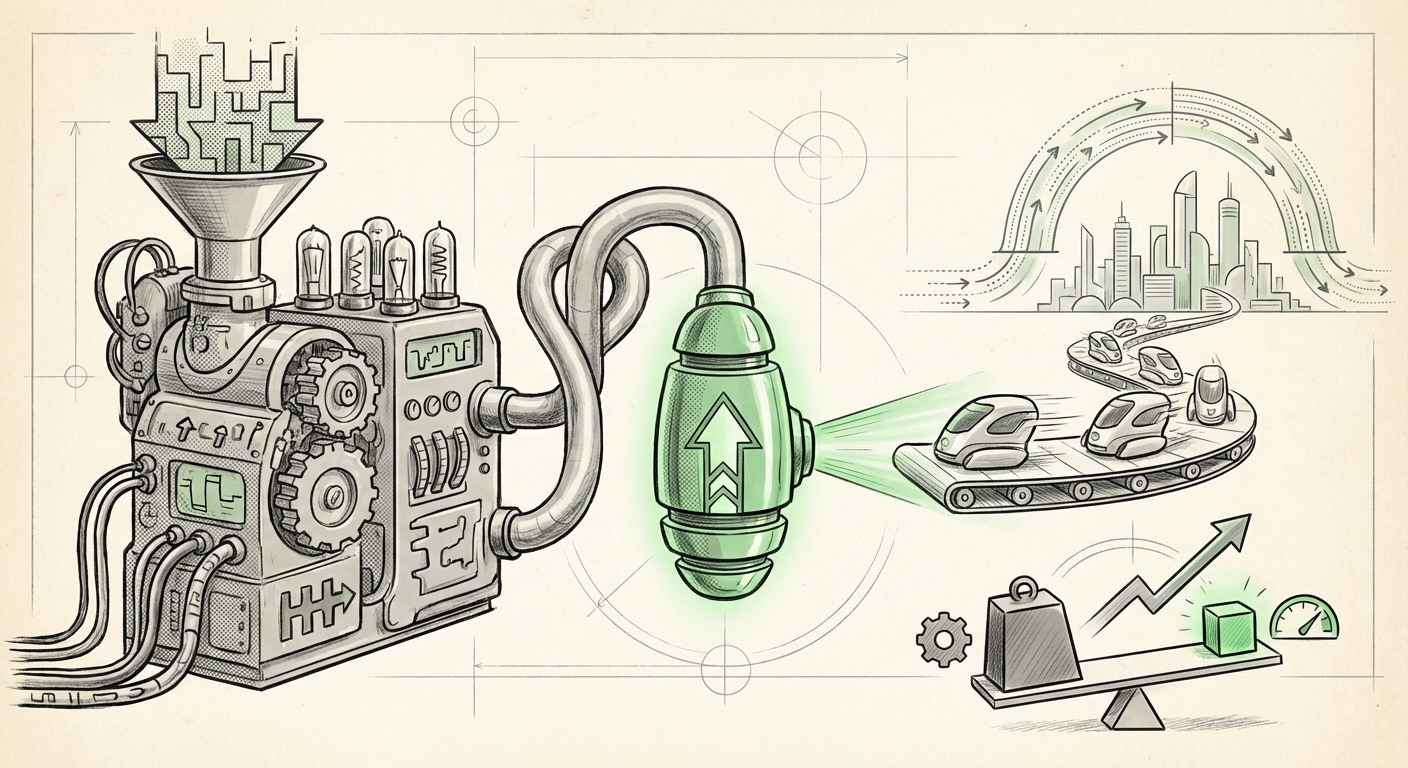
AI, Tao suggests, could change that. By automating parts of reasoning, verification, and exploration, AI could act as a “tool” that lets mathematicians focus on what they do best—while also making math more scalable and accessible.
How AI Could Create a Mathematical Division of Labor
Let’s break down what Tao’s vision looks like in practice. It’s not about AI replacing mathematicians; it’s about AI becoming a collaborative partner that handles the grunt work.
1. Automating Routine Proof Verification
One of the most time-consuming parts of math is checking proofs for errors. AI systems, especially those trained on large datasets of mathematical language, can now verify logical steps with high accuracy. In a division-of-labor model, a “verifier” AI could check the work of a human mathematician, freeing them to focus on creative leaps.
2. Exploring Solution Spaces
Many math problems involve searching for patterns or counterexamples. AI excels at this. Tao imagines an AI that could “scan” thousands of potential approaches, pointing out promising directions to human mathematicians. This is like having a tireless research assistant who never sleeps.
3. Decomposing Big Problems
The most powerful implication is that AI could help break down a complex problem into sub-problems. For example, a mathematician working on a difficult conjecture could ask an AI to identify which parts of the proof are independent of each other. Those parts could then be tackled by different teams (or even different AIs).
Tao’s argument is not just theoretical. He points to recent advances in machine learning, especially large language models, that are starting to show competence in mathematical reasoning. Tools like GPT-4 and specialized math models have already solved Olympiad-level problems and helped generate new mathematical conjectures.
What This Means for the Future of AI and Mathematics
If Tao is right, we are on the edge of a paradigm shift. The implications ripple far beyond math itself.
AI Becomes a Mathematical Co-Author
In the future, AI won't just be a calculator or a search engine for math—it will be a co-author. We could see papers co-authored by “AI system X” and human mathematicians, where the AI contributed verifications, experiments, or even novel sub-proofs. This would change how credit and authorship work in academia.
Faster Scientific Discovery
Math underpins all science. If we can do math faster and more collaboratively, we unlock new physics, new engineering, even new medicine. A division of labor in math could accelerate progress in climate science, quantum computing, drug discovery, and more. Problems that currently take decades could be solved in years.
Democratizing Mathematics
Not everyone is a genius like Terence Tao. But with AI handling the heavy lifting, more people could contribute to mathematical research. A biologist, for example, could use an AI to help model a population dynamics problem without needing a PhD in pure math. This could democratize mathematics, making it a tool for everyone.
What This Means for Businesses and Society
The business world should pay close attention. This isn't just an academic curiosity.
A New Market for AI Tools
Demand for AI systems that can do math will explode. Startups and companies that build “AI math assistants” could find a large market among researchers, engineers, and educators. Imagine a tool that helps an engineer verify the math behind a bridge design, or helps a student learn complex calculus by breaking it into steps.
Changing Education and Skills
If AI can do rote calculations and even some proof work, the way we teach math will need to change. Emphasis will shift from computational skill to problem decomposition and creativity. Schools and universities that adapt early will have an advantage.
Ethical and Regulatory Questions
If AI is a co-author, how do we ensure it is reliable? There will be a need for verification standards and transparency. Who is responsible if an AI-driven math error leads to a faulty building or a bad medical model? Society will need new norms.
Challenges to Tao’s Vision
Of course, not everyone is convinced. Some mathematicians argue that math is fundamentally a human activity, requiring intuition and aesthetic judgment that AI lacks. Others worry about reliability—AI systems can still “hallucinate” false proofs. Tao himself acknowledges these limits. The division of labor he envisions is not automatic; it will require careful design.
But Tao’s track record is strong. He is not a hype machine; he is a pragmatic optimist. His argument is grounded in actual trends in AI research and the needs of the mathematical community.
Actionable Insights for Readers
So, what should you take away from this?
- For researchers: Start experimenting with AI tools for math. Even if they are imperfect, they can save time and spark ideas.
- For business leaders: Watch for startups building mathematical AI. This sector could be the next big opportunity in tech.
- For educators: Begin shifting curricula toward problem decomposition and collaboration with AI tools. The mathematicians of tomorrow will need new skills.
- For everyone: Understand that the line between human and machine work in complex fields is blurring. Embrace the change, but stay critical.
Conclusion: A New Era for Math and AI
Terence Tao’s argument is more than just a prediction; it’s a call to action. The division of labor in mathematics would be a historic first. It would change how math is done, who can do it, and what we can achieve. AI is not just a tool for solving equations; it could become a partner in the very process of discovery. The future of math may be collaborative, and AI is the collaborator we have been waiting for.