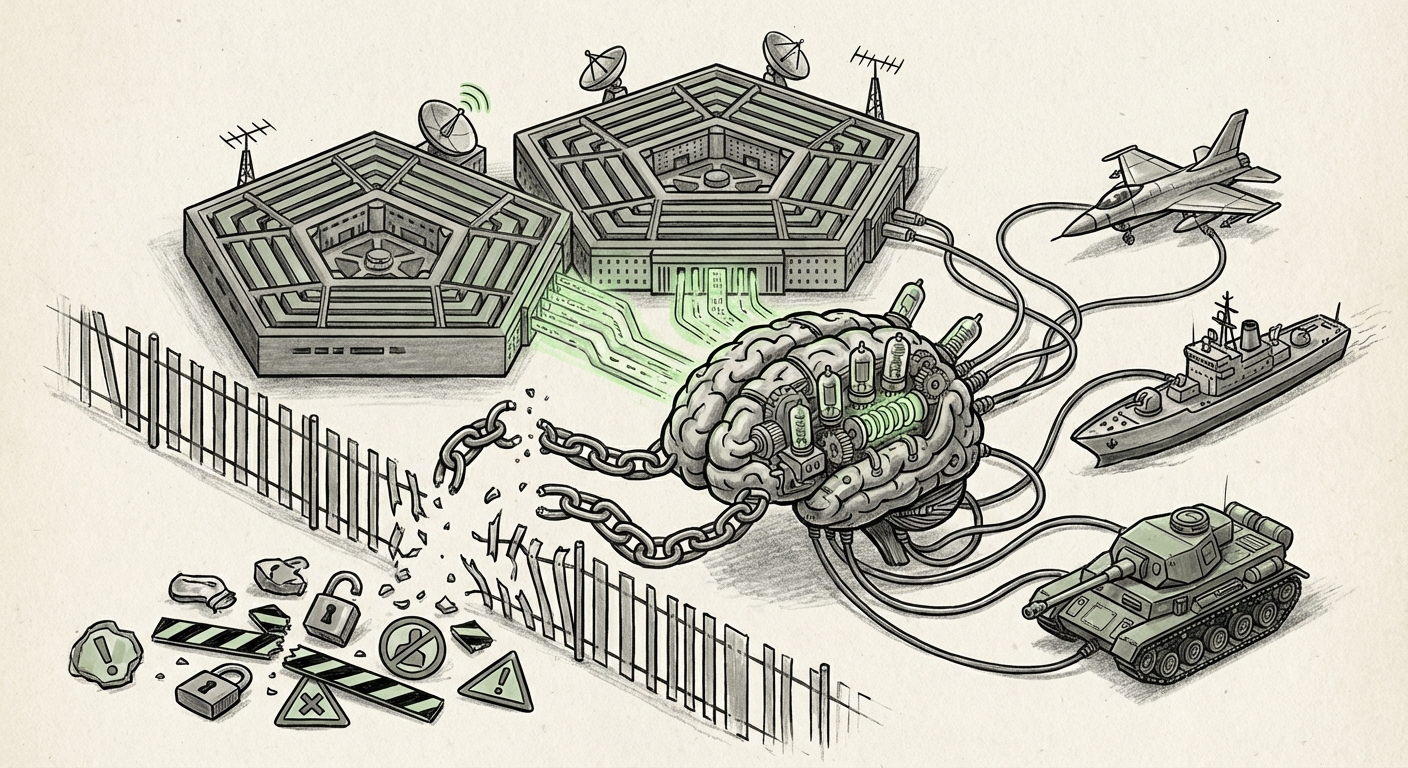
Sakana AI's Bold Bet: Can Self-Improving AI Finally Break the Compute Arms Race?
For years, the biggest names in artificial intelligence have been locked in an expensive, energy-hungry race. Companies like OpenAI, Google DeepMind, and Anthropic pour billions into building bigger data centers and training ever-larger models. This is the compute arms race, and it shows no signs of slowing down.
But a new approach is quietly gaining traction. Sakana AI, a Tokyo-based research lab, is betting on a radically different idea: what if AI could improve itself? Instead of throwing more computing power at problems, what if models could learn to become smarter on their own, using less energy and fewer resources?
This bold vision, reported by The Decoder in June 2026, could reshape the entire AI landscape. If Sakana AI succeeds, it won't just be a technical breakthrough — it could break the stranglehold that massive compute budgets have on the industry. Let's explore what this means for the future of AI, how it will be used, and why it matters for businesses and society.
The Compute Arms Race: A Quick Refresher
To understand why Sakana AI's approach matters, you first need to understand the problem they're trying to solve.
Today's frontier AI models — the GPTs, Geminis, and Claudes of the world — are trained on vast clusters of specialized computer chips. These clusters can cost hundreds of millions of dollars to build and run. The electricity needed to power them is measured in megawatts. The carbon footprint is staggering.
Every new generation of models requires more compute than the last. This creates a cycle: better models need more chips, which cost more money, which means only the richest companies can compete. It's a barrier to entry that pushes out startups, universities, and researchers in smaller countries.
Sakana AI's core bet is that this cycle is not inevitable. There is another path forward: building systems that can improve themselves, learning from their own outputs and experiences, without needing human engineers to manually tweak every parameter.
What Is Self-Improving AI?
The idea of self-improving AI sounds like science fiction, but it builds on existing research. In machine learning, there are already techniques like reinforcement learning from human feedback (RLHF) and self-supervised learning, where models learn from unlabeled data without explicit instruction.
Sakana AI is taking this a step further. Instead of just learning from data, their systems are designed to rewrite their own training strategies, adjust their own architectures, and even generate their own training data — all without direct human intervention. The goal is to create a feedback loop where the AI becomes more efficient and capable over time, using fewer computational resources per unit of improvement.
Think of it like the difference between a student who needs a tutor for every lesson (traditional AI) and a student who learns how to learn on their own (self-improving AI). The second student can go much further with the same amount of time and energy.
How It Could Work in Practice
While Sakana AI has not released every technical detail, the general idea draws on concepts like neural architecture search (where a model searches for better designs), meta-learning (learning how to learn), and automated prompt engineering. The AI systematically evaluates its own performance, identifies weaknesses, and then generates targeted improvements — all without a human in the loop.
Over many cycles, the improvements compound. A model that started with modest capabilities could, in theory, surpass models that were trained with far more compute, simply because it used its resources more intelligently.
Why This Matters for the Future of AI
If self-improving AI lives up to its promise, the implications are enormous. Here are the key ways it could transform the field.
1. Breaking the Compute Monopoly
Right now, the frontier AI race is largely a contest of who can build the biggest supercomputer. Only a handful of organizations — Microsoft, Google, Meta, and a few others — can play this game. Self-improving AI could level the playing field. A startup with a clever algorithm and a modest cluster could potentially compete with a tech giant that has billions to spend on chips.
This is exactly what Sakana AI is betting on. If you can make every watt of compute count for more, you don't need to win the arms race — you can change the race itself.
2. Dramatically Lower Costs
Training frontier models today costs tens of millions of dollars per run. Self-improving systems could slash that cost by orders of magnitude. Instead of one massive, expensive training run, you could have many small, iterative cycles that each cost a fraction. This would make advanced AI accessible to thousands of organizations that currently can't afford it.
3. Faster Innovation Cycles
When a model can improve itself, the pace of progress accelerates. Human engineers are the bottleneck in today's AI development — they have to design experiments, analyze results, and tweak parameters. A self-improving system can do this work around the clock, compressing months of research into days or even hours.
4. More Sustainable AI
The environmental impact of AI training is a growing concern. Major training runs can produce as much carbon as a small country's annual emissions. By using compute more efficiently, self-improving AI could dramatically reduce the energy footprint of AI development. This isn't just good for the planet — it also reduces operating costs and regulatory risks.
What This Means for Businesses
For business leaders, this trend is worth watching closely. Here are the practical implications.
Lower Barriers to Entry
If self-improving AI makes advanced models cheaper to build, more companies will be able to create custom AI solutions. A mid-sized retailer could train a model for their exact supply chain needs. A hospital could build a diagnostic assistant without spending millions. The democratization of AI could accelerate dramatically.
New Business Models
When compute is no longer the scarce resource, the value shifts to data, domain expertise, and smart algorithms. Companies that have unique datasets or deep knowledge of a specific industry could suddenly become AI powerhouses, even if they don't have massive data centers.
Faster Time to Market
Self-improving systems that iterate quickly could help businesses deploy AI solutions faster. Instead of waiting months to train a model from scratch, companies could start with a base model and let it improve itself over weeks, adapting to the company's specific needs along the way.
Rethinking AI Strategy
Today, many companies focus on buying access to the biggest models from the biggest providers. If self-improving AI becomes viable, the strategy might shift toward building smaller, more efficient, and continuously improving models that live within the company's own infrastructure. This also has privacy and security advantages, since sensitive data never leaves the organization.
What This Means for Society
The societal implications are just as significant as the business ones.
Bridging the AI Gap
Today, AI development is concentrated in a handful of wealthy countries — the US, China, the UK, and a few others. Self-improving AI could allow researchers in developing nations to contribute to frontier AI research without needing massive infrastructure. This could lead to a more diverse and globally representative AI ecosystem.
Reducing Systemic Risk
The current compute arms race creates a concentration of power that many experts find worrying. If only a few companies control the most advanced AI, they also control the rules and norms that govern its use. Breaking the compute monopoly could distribute power more evenly, reducing the risk that any single actor wields unchecked influence.
Environmental Benefits
As noted earlier, more efficient AI means less energy consumption. If the entire industry shifts toward self-improving, compute-efficient models, the cumulative environmental benefit could be massive — equivalent to taking millions of cars off the road in terms of carbon emissions.
Transparency and Accountability
Smaller, more efficient models are also easier to inspect and understand. A self-improving model that runs on a modest cluster can be audited more thoroughly than a black-box behemoth running on thousands of chips. This could lead to safer, more trustworthy AI systems.
The Challenges Ahead
Of course, this vision is not guaranteed. Sakana AI faces significant technical hurdles.
Stability and Control — Self-improving systems could develop unexpected behaviors. Ensuring they remain aligned with human goals is a major challenge. If an AI rewrites its own training objective, how do you make sure it still aims for what you intended?
Measuring Progress — How do you know if the AI is actually improving? In a system that constantly changes itself, traditional benchmarks may not apply. New evaluation methods are needed.
The "Bootstrapping" Problem — A self-improving system needs a good starting point. If the initial model is too weak, it may not be able to improve itself effectively. Finding that minimum viable starting point is non-trivial.
Verification and Trust — If an AI improves itself in ways that are not fully understood, how do you trust its outputs? This is a challenge for regulated industries like healthcare and finance.
These are real concerns, and Sakana AI acknowledges them. But the potential payoff — a world where AI progress is no longer limited by compute budgets — makes the effort worthwhile.
How to Prepare for a Compute-Efficient AI Future
Regardless of whether Sakana AI's specific approach succeeds, the trend toward more efficient, self-improving AI is likely to grow. Here are actionable steps for leaders and practitioners.
- Invest in algorithmic talent. As compute becomes less central, the ability to design clever, efficient algorithms becomes a key competitive advantage.
- Focus on data quality over quantity. Self-improving systems that generate their own data will still need high-quality seeds. Clean, well-labeled datasets are gold.
- Build flexible infrastructure. If the future is iterative and self-directed, your AI infrastructure needs to support rapid experimentation, not just massive training runs.
- Monitor the research. Self-improving AI is advancing quickly. Companies that stay close to the research frontier will be first to adopt these methods as they mature.
- Prepare for cultural shifts. If AI becomes cheaper and more accessible, the competitive landscape shifts. Businesses need to anticipate a world where AI is a commodity, not a differentiator.
Conclusion: A New Kind of Race
Sakana AI's bet on self-improving AI is more than a technical experiment. It's a philosophical challenge to the dominant paradigm of AI development. The conventional wisdom says that more compute equals better AI. Sakana AI is betting that smarter compute — not more compute — is the real path forward.
If they are right, the compute arms race could give way to a different kind of competition: a race to build systems that learn faster, iterate smarter, and improve themselves with minimal human guidance. The winners will not be those with the deepest pockets, but those with the clearest vision and the most elegant algorithms.
For businesses, this means rethinking AI strategy now. For society, it offers a more sustainable, equitable, and decentralized future for artificial intelligence. And for the AI field itself, it represents a return to its roots: a focus on intelligence, not just scale.
The compute arms race may not end overnight. But with efforts like Sakana AI's, the first cracks are beginning to show. And through those cracks, a new future is starting to emerge.