Google DiffusionGemma: Text Generation From Noise Changes Everything
Imagine teaching a painter to create a masterpiece by starting with a blank canvas and slowly adding strokes — that's how most AI language models work today, generating text word by word, left to right. Now imagine instead starting with a canvas full of random noise and watching the picture reveal itself all at once. That's exactly what Google's new open model DiffusionGemma does, and it's a shift that could change how we think about AI text generation forever.
Announced on June 10, 2026, and reported by The Decoder, DiffusionGemma represents a bold departure from the autoregressive approach used by nearly every major language model today — including GPT-4, Claude, and even Google's own Gemini models. Instead of predicting the next word in a sequence, DiffusionGemma starts with pure noise and iteratively refines it into coherent text. This is the same fundamental technique behind image generators like Stable Diffusion and DALL·E, now applied to language. And because it's open, developers everywhere can experiment, build, and innovate on top of it.
Let's break down what this really means, why it matters, and how it will likely reshape the AI landscape for businesses, developers, and everyday users.
What Exactly Is DiffusionGemma?
To understand why DiffusionGemma is such a big deal, you first need to understand how most AI text models work today.
Traditional large language models (LLMs) are autoregressive. That means they generate text one token (word or subword) at a time, in order. They start with a prompt, predict the next most likely word, add it to the sequence, then predict the next word, and so on — like completing a sentence one step at a time. This works well, but it has a major downside: it's sequential. You can't generate word 50 until you've generated words 1 through 49. That makes generation slow, especially for long outputs.
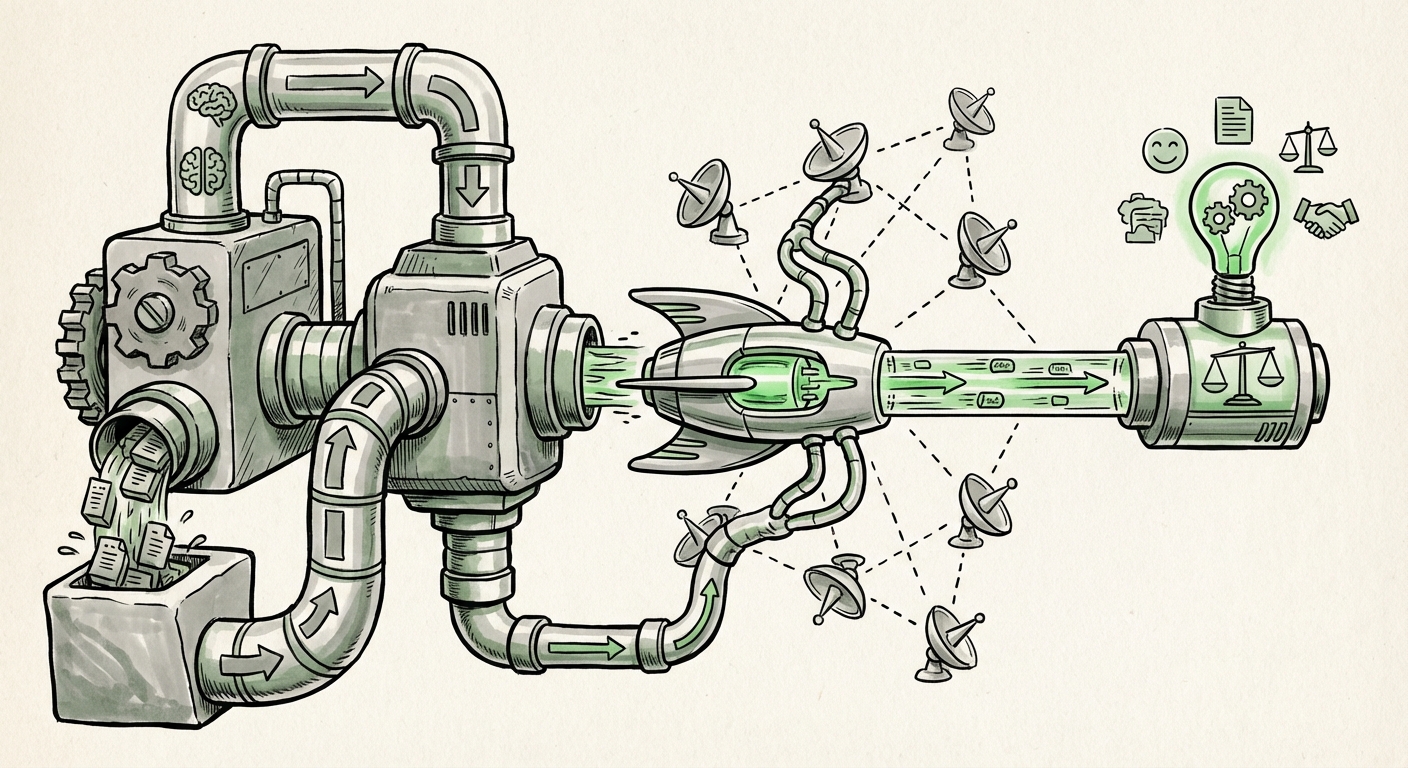
Diffusion models flip this on its head. Instead of building text from left to right, they start with random noise — a jumbled mess of characters and tokens — and then gradually refine it over multiple steps until clear, coherent text emerges. The model learns to "denoise" the input, transforming chaos into meaning. This is the same approach that powers image generation: start with static, end with a picture of a cat. Only now, the output is language.
DiffusionGemma is Google's open implementation of this idea. By releasing it openly, Google is inviting the global research and developer community to explore, modify, and improve the approach. This democratization is a huge deal for the future of AI.
Why "From Noise" Changes the Game
The shift from word-by-word to noise-based generation isn't just a technical curiosity — it has real, practical consequences.
1. Speed and Parallelism
Because diffusion models don't need to generate tokens in order, they can potentially generate entire outputs in parallel. Instead of waiting for each word, the model refines the whole sequence simultaneously. This could lead to dramatically faster generation times for long-form content, real-time applications, and batch processing. For businesses that rely on AI for customer service, content generation, or data analysis, this means lower latency and higher throughput.
2. Different Quality Characteristics
Autoregressive models sometimes produce text that feels "stuck" — they can repeat phrases, lose track of the overall structure, or produce outputs that are locally coherent but globally messy. Diffusion models, by contrast, iterate over the entire output at once. This can lead to better global coherence, more consistent tone, and fewer repetitive patterns. The output may feel more "holistic" because the model sees the whole picture during refinement.
3. Controllability and Editing
One of the most exciting possibilities is incremental editing. With an autoregressive model, if you want to change the middle of a generated paragraph, you often have to regenerate everything after that point. With a diffusion model, you can potentially "denoise" a specific region — change a sentence or a phrase without rewriting the whole output. This opens the door to interactive editing tools where users can refine AI-generated text the way they'd edit a photo: paint over a section and let the model fill it in.
4. New Creative Possibilities
Diffusion models have a different "creative feel." In image generation, diffusion often produces more diverse, surprising outputs compared to autoregressive methods. The same could be true for text. Starting from random noise and refining it means the model can find creative solutions that a left-to-right model might never discover. For brainstorming, storytelling, and creative writing, this could be a powerful tool.
What This Means for the Future of AI
DiffusionGemma is not just a new model — it's a signal about where AI is heading. Here are the key trends and implications.
Trend 1: The End of the "One Token at a Time" Monopoly
For years, autoregressive generation has been the default for language models. DiffusionGemma shows that there is a viable, powerful alternative. This will likely spark a wave of research into non-autoregressive and hybrid approaches. We may see models that combine the strengths of both: using diffusion for global structure and autoregressive methods for fine-grained local details. The monopoly of sequential generation is ending.
Trend 2: Open Models Become Innovation Engines
Google's decision to release DiffusionGemma as an open model is significant. It follows the pattern of Gemma, Google's family of open LLMs, and signals that Google sees open models as strategic assets for driving ecosystem growth. When a model is open, developers can fine-tune it, adapt it, and build commercial products on top of it. This accelerates innovation far more than a closed API ever could. For businesses, this means more choice, lower costs, and less vendor lock-in.
Trend 3: Diffusion Models Go Mainstream for Text
Diffusion models have been a hot topic in image, video, and audio generation for a few years. But their application to text has been slower to mature. DiffusionGemma marks a coming-of-age moment. If this approach proves successful at scale, we could see diffusion-based text models become a standard tool in the AI toolkit — alongside autoregressive models, each used for different tasks. Text generation will no longer be a one-size-fits-all affair.
Trend 4: New User Interfaces and Products
Because diffusion models enable different interaction patterns (parallel generation, incremental editing, noise-based creativity), we're likely to see new kinds of AI products emerge. Imagine a writing tool where you can "sculpt" text by refining different sections independently. Or a brainstorming app that shows you multiple divergent outputs from the same noise seed. Or a code generation tool that can fill in missing logic without regenerating the entire function. DiffusionGemma opens the door to user interfaces that feel more like collaboration than generation.
Practical Implications for Businesses
Let's get concrete. What does DiffusionGemma mean for your organization?
Implications for Society
Beyond business, DiffusionGemma has broader societal implications.
Accessibility and Democratization
Because the model is open, it lowers the barrier to entry for AI development. Startups, researchers, and developers in developing countries can access cutting-edge technology without needing to pay for expensive APIs or build massive compute clusters. This could help democratize AI innovation globally.
New Risks and Challenges
Open models also come with risks. Bad actors can use them to generate misinformation, spam, or harmful content more efficiently. The parallel generation capability could make it easier to produce large volumes of convincing fake text. As with any powerful technology, responsible deployment and governance are essential. The AI community will need to develop better detection tools, watermarking techniques, and usage policies.
Environmental Impact
Diffusion models can be computationally intensive due to the iterative refinement process. However, because they can generate text in fewer steps for certain tasks, and because they can run on less specialized hardware when optimized, the net environmental impact is still unclear. Open models allow the community to experiment with efficiency improvements in ways that closed models do not. This could lead to greener AI over time.
What Comes Next?
The release of DiffusionGemma is just the beginning. Here's what to watch for in the coming months and years.
- Benchmark comparisons: Expect a flurry of research comparing diffusion-based text generation to autoregressive methods on standard benchmarks. Look for insights on which tasks benefit most from the diffusion approach.
- Hybrid models: The most powerful systems may combine autoregressive and diffusion components — using autoregressive models for short, precise outputs and diffusion for creative, long-form content.
- Ecosystem growth: Open models often spark a wave of community-built tools, libraries, and applications. Expect to see fine-tuned versions of DiffusionGemma for specific domains, as well as integrations with popular AI frameworks.
- Competitive responses: Other major AI labs (OpenAI, Meta, Anthropic) are likely to respond. Some may release their own diffusion-based text models. The race is on.
- Regulatory attention: As open models become more capable, governments and regulators will pay closer attention. The balance between openness and safety will be a key debate.
For now, DiffusionGemma represents a genuine paradigm shift. It's not just another incremental improvement — it's a fundamentally different way of generating language. And because it's open, it invites the entire world to participate in shaping what comes next.
Conclusion: The Noise Is the Signal
Google's DiffusionGemma proves that sometimes the best way to create meaning is to start with chaos. By generating text from noise instead of word by word, it opens up new possibilities for speed, creativity, and control that autoregressive models cannot match. For businesses, it's a call to experiment, adapt, and rethink what's possible. For society, it's a reminder that open innovation can accelerate progress — but also requires responsible stewardship.
The era of diffusion-based text generation has begun. The noise, it turns out, is the signal.