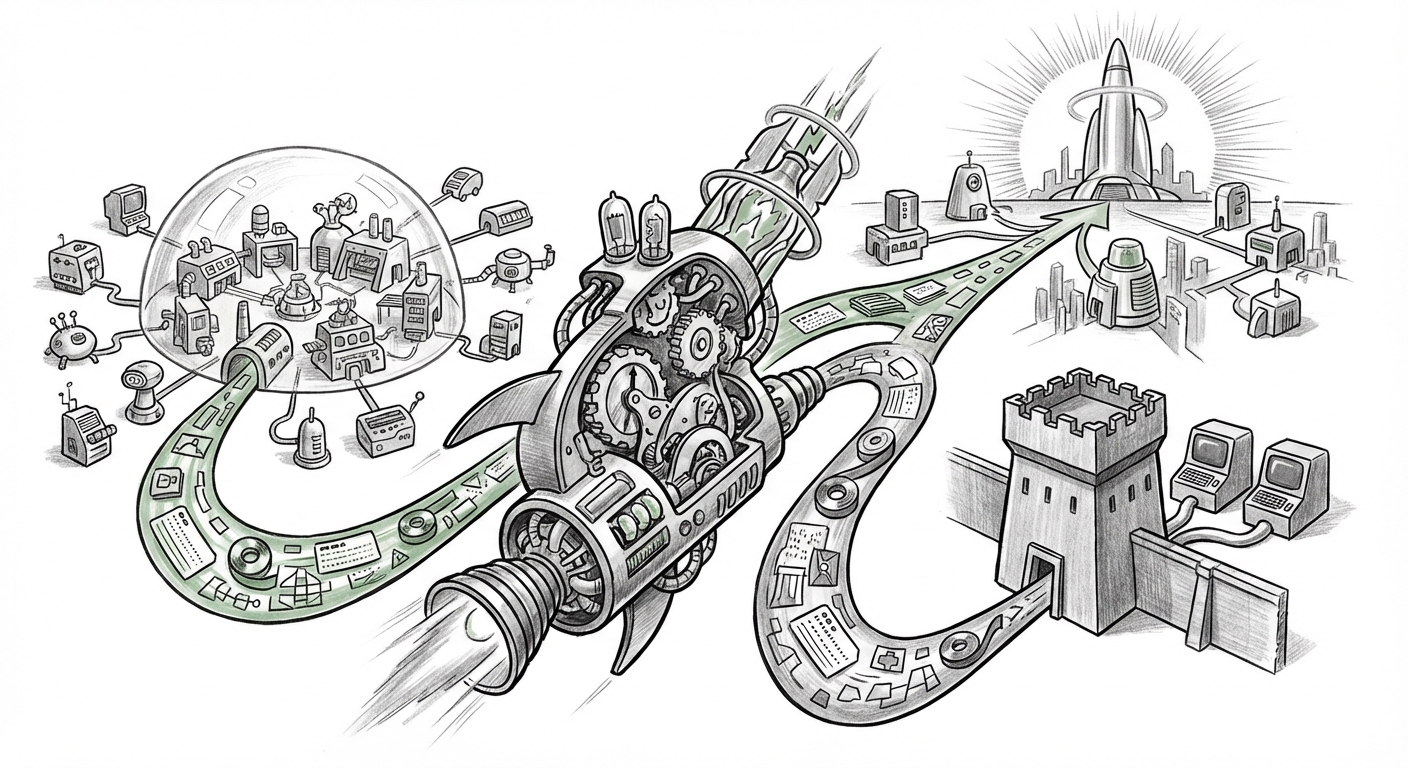
Generality Is the Enemy of Precision: Why Enterprise AI Is Stuck in Pilot Purgatory
Enterprise AI has a dirty secret. After years of hype, millions of dollars in investment, and countless pilot programs, most AI projects never make it to full production. They get stuck in what experts call "pilot purgatory" — a frustrating loop of proof-of-concepts that show promise but never deliver real-world results.
Why does this happen? The answer is simple yet powerful: generality is the enemy of precision. Most enterprise AI initiatives start with broad, general-purpose models that try to do everything. But in business, you don't need a jack-of-all-trades. You need a specialist that gets one job done perfectly every time.
This article breaks down why general AI fails in the enterprise, what precision really means, and how to escape pilot purgatory for good.
The Allure of General-Purpose AI
It is easy to see why companies are drawn to general AI. Large language models and other broad AI systems seem magical. They can write emails, answer questions, summarize documents, and even generate code. They feel like a one-stop shop for intelligence.
But here is the catch: general-purpose AI is designed to be average at many things, not exceptional at one thing. In an enterprise setting, average is dangerous. A financial audit tool that is 95% accurate might still miss critical compliance issues. A customer service bot that works well 80% of the time can frustrate the other 20% of callers — costing you loyal clients.
The business world does not reward good-enough. It rewards trusted, repeatable, auditable outcomes. General AI, by its very nature, struggles to deliver that level of reliability.
What Pilot Purgatory Looks Like
Pilot purgatory follows a familiar pattern in organizations:
- Step 1: A team launches a promising pilot with a general-purpose AI tool. Early results look great in a controlled demo.
- Step 2: The pilot expands to a real business process. Suddenly, the AI struggles with edge cases, inconsistent data, or ambiguous rules.
- Step 3: The team tweaks the model, adds more training data, and tries again. Results improve but remain unreliable.
- Step 4: Leadership loses patience. The pilot stalls. Resources shift to the next shiny AI tool. The cycle repeats.
Sound familiar? Thousands of companies are trapped in this loop. According to industry research, nearly 70% of enterprise AI projects never make it past the pilot stage. That is a staggering amount of wasted time, money, and talent.
The Precision Problem
At the heart of pilot purgatory lies a single issue: precision. General AI models are built to handle a wide range of inputs and produce plausible outputs. But they do not truly understand the specific business rules, regulations, and exceptions that govern real-world enterprise decisions.
Consider an insurance claim processor. A general AI might correctly process routine claims. But when a claim involves a complex policy exclusion, state-specific regulation, or a unusual accident scenario, the general model often guesses — and guessing is not acceptable when money, compliance, and customer trust are on the line.
Precision requires that the AI system:
- Follows explicit business rules without deviation.
- Handles edge cases gracefully by knowing when to escalate to a human.
- Provides a clear audit trail so every decision can be explained and reviewed.
- Adapts to changing regulations without needing a complete retrain.
General-purpose AI models are not built for any of these requirements. That is why they stall.
Why Precision-First AI Wins
The solution is not to abandon AI. It is to flip the approach. Instead of starting with a general model and trying to cram it into a specific business problem, start with the problem itself and build a precision-first AI system around it.
Precision-first AI means:
- Start with the rules. Instead of training a model on thousands of examples, encode the actual business logic, regulations, and expert knowledge that human decision-makers use. This creates a transparent, auditable foundation.
- Use AI for what it is good at. Let machine learning handle pattern recognition and fuzzy matching. But always ground those predictions in a rules-based framework that guarantees precision.
- Design for exceptions. A precision system knows its limits. When it encounters a situation it cannot handle with certainty, it escalates to a human — rather than guessing and risking a costly mistake.
- Build for change. Business rules and regulations evolve. A precision-first system makes it easy to update specific rules without retraining the entire model.
When you combine the pattern-matching power of AI with the rigor of explicit business rules, you get a system that is both powerful and trustworthy. That is the kind of system that escapes pilot purgatory.
Real-World Examples: Precision in Action
Let us look at a few enterprise areas where precision-first AI is already making a difference:
Financial Services Compliance
Banks and insurance companies face a maze of regulations. A general AI cannot reliably determine whether a transaction violates anti-money laundering rules. But a precision-first system that combines regulatory rules with AI-powered anomaly detection can flag suspicious activity with high accuracy and a clear rationale. Regulators love that.
Healthcare Claims Processing
Medical claims involve hundreds of diagnosis codes, procedure codes, and payer-specific policies. A general AI might approve a claim that violates a payer's policy. A precision-first system applies the exact policy rules and only uses AI to help match supporting documentation. The result: fewer denials, faster payments, and happier patients.
Legal Document Review
In legal discovery, missing a single relevant document can have serious consequences. A general AI might surface 80% of relevant documents, but a precision-first system that combines expert-defined search criteria with AI similarity scoring can push recall to 99% or higher — and provide a defensible audit trail.
The Future of Enterprise AI Is Hybrid
The debate between general AI and specialized AI misses the point. The future is hybrid: using the best of both worlds. General models are great for brainstorming, summarizing, and creative tasks. But when the stakes are high — when accuracy, compliance, and trust matter — you need precision-first systems that put business rules at the center.
Think of it this way: you would not use a Swiss Army knife to perform open-heart surgery. You would use a scalpel — a precision instrument designed for a specific purpose. Enterprise AI needs more scalpels and fewer Swiss Army knives.
In the coming years, the organizations that win with AI will be those that:
- Stop chasing generality. They will reject the idea that one model can solve every problem.
- Invest in precision. They will build or buy AI systems that encode expert knowledge and business rules as a first-class citizen.
- Demand auditability. They will require every AI decision to be explainable and traceable.
- Design for humans. They will build AI that knows when to hand off to a person, rather than trying to replace people entirely.
Actionable Insights for Business Leaders
If you are leading AI adoption in your organization, here are practical steps to escape pilot purgatory:
- Audit your current pilots. For each stalled project, ask: did we start with a general model and try to force it into a specific problem? If yes, consider restarting with a precision-first approach.
- Pick one high-value, rule-heavy process. Look for a business process that involves clear rules, regulations, or expert knowledge. This is a perfect candidate for precision-first AI. Start small and prove the model.
- Involve subject matter experts from day one. The people who know the business rules and exceptions are your most valuable resource. They should be part of the design team, not just testers at the end.
- Insist on explainability. Any AI vendor you consider must be able to explain why the system made a particular decision. If they cannot, that system will never earn the trust needed for production.
- Plan for maintenance. Business rules change. Your AI system should make it easy to update rules without rebuilding the entire model. Factor ongoing maintenance into your budget from the start.
What This Means for the Future of AI
The era of "one model to rule them all" is coming to an end — at least for serious enterprise applications. The future belongs to specialized, precision-driven AI systems that are deeply integrated into specific business processes and governed by explicit rules.
This shift will reshape the AI industry. We will see a move away from massive, opaque general models toward modular, transparent, auditable systems. Vendors that focus on precision over generality will become the trusted partners of enterprise customers.
For society, this is a positive development. When AI makes decisions that affect people's lives — their finances, health, legal rights — we need systems that are reliable, explainable, and accountable. Precision-first AI delivers on that promise. General AI, for all its flash, does not.
So the next time your team is tempted to launch a pilot with a general-purpose model, pause. Ask yourself: are we building a Swiss Army knife or a scalpel? The answer will determine whether your AI project soars — or gets stuck in purgatory forever.