Microsoft Copilot Cowork's Shift to Usage Billing & DeepSeek: What It Means for the Future of AI
The enterprise software world is bracing for a seismic shift. According to a recent report by The Decoder (June 16, 2026), Microsoft is making two pivotal changes to its Copilot Cowork service. First, the company is moving away from traditional per-seat subscriptions toward a usage-based billing model. Second, Microsoft may be tapping DeepSeek as a foundational model provider for the service.
These announcements are more than simple product updates. They represent a fundamental change in how AI will be valued, deployed, and consumed in the coming years. Whether you are a CTO planning a budget, a developer building an AI-powered app, or a business leader investing in automation, the ripple effects of this decision will reshape your strategy. Let's break down what this means and why it matters for the future of AI.
The Era of Usage-Based Billing for AI
For the last several years, enterprise AI tools like Microsoft Copilot have been sold much like traditional software: you pay a flat monthly fee for every user, regardless of how much they actually use the AI. This is the "per-seat" model. It is simple and predictable. However, it creates a massive disconnect between cost and value. A power user who generates thousands of lines of code or complex reports pays the same as a casual user who asks a few questions per week.
Moving to usage-based billing changes everything. This model operates like a utility—you pay for exactly what you consume, whether it is tokens processed, API calls made, or computing power used. This aligns costs directly with the value the AI delivers. If an employee uses the AI to automate a tedious workflow and saves ten hours, the cost reflects that intense period of usage. If they only use it for a few quick emails, they pay very little.
This mirrors the massive shift we saw in cloud computing a decade ago when businesses moved from buying fixed server capacity to paying for compute on-demand. Just as Amazon Web Services and Azure revolutionized IT infrastructure with consumption pricing, Microsoft is now signaling that AI will follow the same path. For businesses, this reduces the barrier to entry. You no longer need to make a large upfront commitment to deploy AI across your organization. Instead, you can start small, let usage grow organically, and scale costs in lockstep with the value you are generating.
However, this model also introduces a new challenge: cost variability. CFOs who love predictable software budgets will need to learn new skills. Without proper governance, AI usage can spiral out of control. A single viral internal tool or a poorly optimized prompt chain could generate a massive bill. This is where the emerging field of "AI FinOps" comes in. Companies will need new dashboards, alerts, and budgets to track token consumption just as they track cloud compute spend. Microsoft's move is a bet that the flexibility and lower barrier to entry outweigh the budgeting complexity. For the market as a whole, it forces every other AI vendor to justify their pricing models. Per-seat pricing may soon become a relic of the past.
Why DeepSeek? The Multi-Model Mandate
The second bombshell is that Microsoft may be tapping DeepSeek as a model provider for Copilot Cowork. For context, DeepSeek is a Chinese AI lab that has produced some of the most efficient and powerful open-weight language models in the world. Their models, such as DeepSeek-V3, have consistently rivaled the performance of GPT-4 and Claude while operating at a fraction of the cost and compute requirement.
Why would Microsoft, the primary financial backer of OpenAI, integrate a rival model into its flagship product? The answer lies in a concept we call the "Multi-Model Mandate." No single AI model is perfect for every task. OpenAI's GPT-4 is brilliant at creative writing and complex reasoning but it is expensive and sometimes slow. DeepSeek excels at structured tasks, data extraction, and cost-efficient inference. It also offers the unique advantage of being fine-tunable and inspectable, at least compared to a closed-source API.
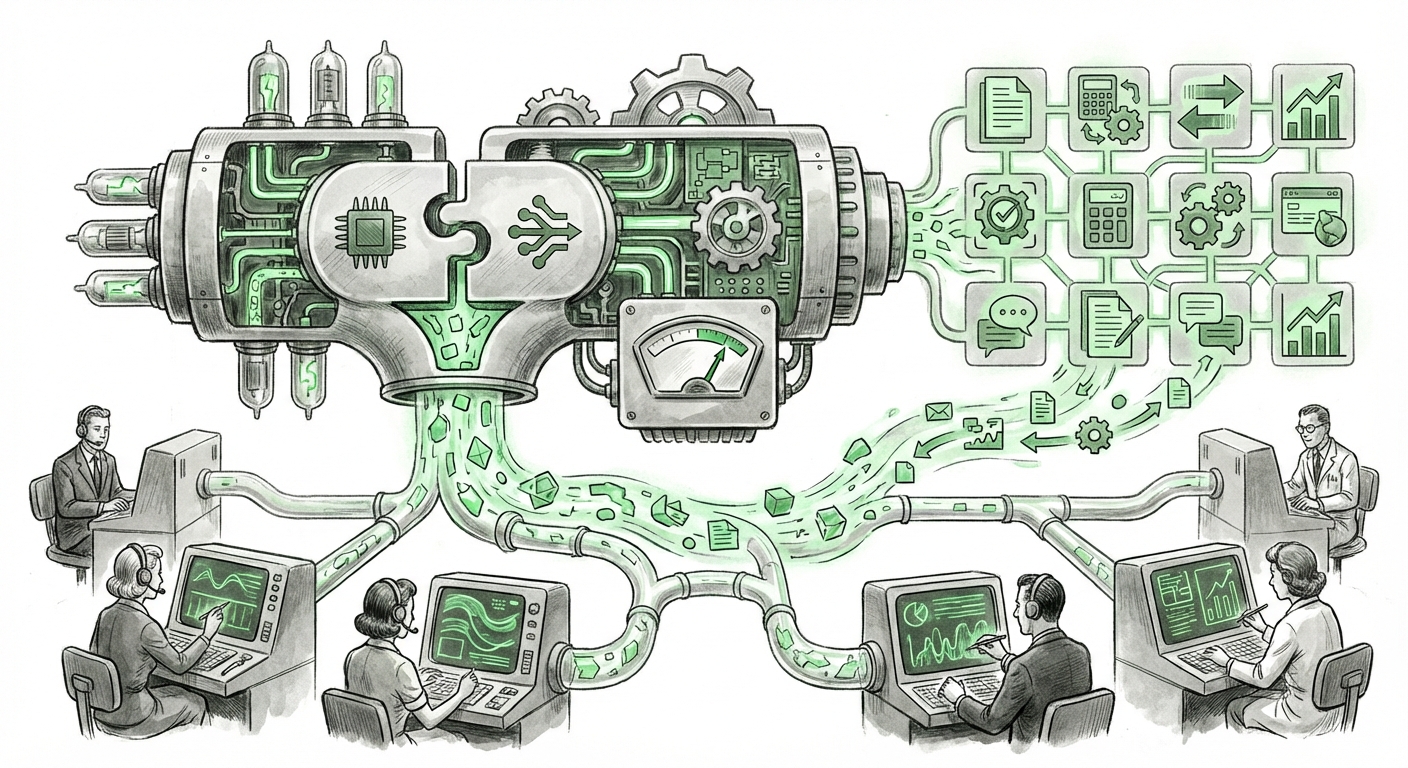
By tapping DeepSeek, Microsoft is admitting that a single-model strategy is a weakness. It allows Copilot Cowork to route different types of tasks to the best model for the job. Simple data entry or email drafting might be handled by a lightweight, cost-effective DeepSeek model. Complex strategic analysis might be escalated to OpenAI's most advanced system. This "model routing" is the next frontier of AI architecture, and Microsoft is placing a massive bet on it.
This also has major geopolitical implications. DeepSeek is a Chinese company. Microsoft's willingness to integrate Chinese AI into its enterprise stack shows that global AI supply chains are becoming deeply interwoven, despite trade tensions and security concerns. It signals that excellence in AI is increasingly borderless, and that even the most patriotic Silicon Valley giants will look to the best technology regardless of origin. For other companies, this is a green light. It validates the strategy of running a multi-model architecture, even if it means dealing with overseas providers.
What This Means for the Future of AI
We are witnessing the commoditization of AI models. Just as electricity is generated by different plants but delivered through the same grid, intelligence will be generated by different models but delivered through unified platforms like Copilot. The value moves up the stack—away from the raw model and toward the user experience, the integration with data, and the seamless orchestration of multiple AI services.
For Businesses
The era of "one model to rule them all" is over. Your future AI strategy should be built on a foundation of model agnosticism. Do not handcuff your data architecture to a single provider's API. Build abstraction layers that allow you to swap models in and out as prices change and new capabilities emerge. Microsoft's move to DeepSeek proves that even the strongest partnerships can yield to a multi-vendor strategy. Your enterprise should plan for the same flexibility. This also means you need to invest in internal benchmarking. If your IT department can rigorously test which model performs best on your specific business tasks (customer support, contract analysis, code generation), you can save millions by routing work to the most efficient model.
For Developers
Developers should start thinking of AI as a commodity rather than a single API key. The rise of usage-based billing and multi-model platforms means you will need to build applications that can dynamically adjust their behavior based on model availability, cost, and latency. Learn to use AI orchestration frameworks that can handle model failover and intelligent routing. Also, prompt engineering will become even more critical. A prompt that works well on GPT-4 may fail or produce different results on a DeepSeek model. You must test your prompts across multiple backends to ensure consistent user experiences.
For Society
On a macro level, this trend towards usage-based billing and diverse model sourcing is incredibly healthy for the AI ecosystem. It lowers the monopoly risk that has concerned regulators. If one model provider becomes too expensive or politically unstable, enterprises can seamlessly switch to another. This creates a true marketplace for AI capabilities. It also democratizes access—small startups can now afford to use state-of-the-art AI because they only pay for what they consume, rather than committing to expensive enterprise contracts.
Actionable Insights for Leaders
Based on these developments, here is how leaders should prepare for the next wave of AI evolution:
- Prepare for Cost Variability: Establish new financial governance for AI. Just as you monitor cloud spend, you must monitor token consumption and API costs. Educate your finance teams on AI pricing models.
- Invest in Model Routers: Implement middleware that intelligently routes tasks to the most cost-effective and performant model. Do not rely on a single provider even if you have a strategic partnership.
- Embrace Open Source and Open Weights: DeepSeek's rise proves that open-weight models are no longer inferior toys. They are enterprise-grade tools. Build internal expertise to fine-tune and deploy these models on your own infrastructure for sensitive data.
- Track Regulatory Developments: The integration of Chinese AI into Western enterprise stacks will attract regulatory attention. Ensure your legal and compliance teams are monitoring cross-border data flows and model governance requirements.
- Redesign Product Metrics: If you are a SaaS vendor, reconsider your own pricing. The industry is moving away from per-seat subscriptions to value-based consumption. Can you measure and bill for the outcomes your AI produces rather than just access to it?
Conclusion
Microsoft's decision to move Copilot Cowork to usage-based billing and potentially tap DeepSeek is a watershed moment for the artificial intelligence industry. It signifies the end of the AI novelty phase and the beginning of the AI utility phase. No longer will companies pay for the promise of AI; they will pay for its precise, measurable performance.
The integration of DeepSeek also shatters the illusion of AI singularity. There is not one "best" AI. There is a spectrum of intelligences, each with unique strengths and cost structures. The winning platforms of the future will not be those that build the single best model, but those that orchestrate the best ensemble of models to serve the user seamlessly.
This is a call to action for every business leader. The era of passive AI consumption is over. We are entering the era of active AI management. The companies that thrive will be those that build the systems, the teams, and the financial models to harness this new, fluid, and incredibly powerful utility. The future of AI is not a single super-brain; it is a highly efficient, multi-polar network of specialized intelligence. And thanks to these shifts, it is about to become more accessible than ever before.