OpenAI Burned $34 Billion Last Year — Here's What That Means for the Future of AI
In a jaw-dropping revelation, reports confirm that OpenAI burned through $34 billion last year. That's not a typo — thirty-four billion dollars. For context, that's more than the entire annual budget of many small countries. This staggering number forces us to ask: How can an organization spend that much money, and what does it signal about the direction of artificial intelligence?
This article peels back the layers on that single, explosive fact. We'll explore what the money might be buying, why the burn rate matters, and what it means for businesses, investors, and everyday people who use AI tools. No speculation beyond what's known — just a clear-eyed look at the implications of the biggest investment in AI history.
The Scale of the Burn
Let that number sink in: $34 billion in one year. Even for a company like OpenAI — the creator of ChatGPT, GPT-4, and other market-leading models — this is an extraordinary level of spending. To put it in perspective, that's about $93 million every single day. It's roughly the cost of running a small country's entire education system.
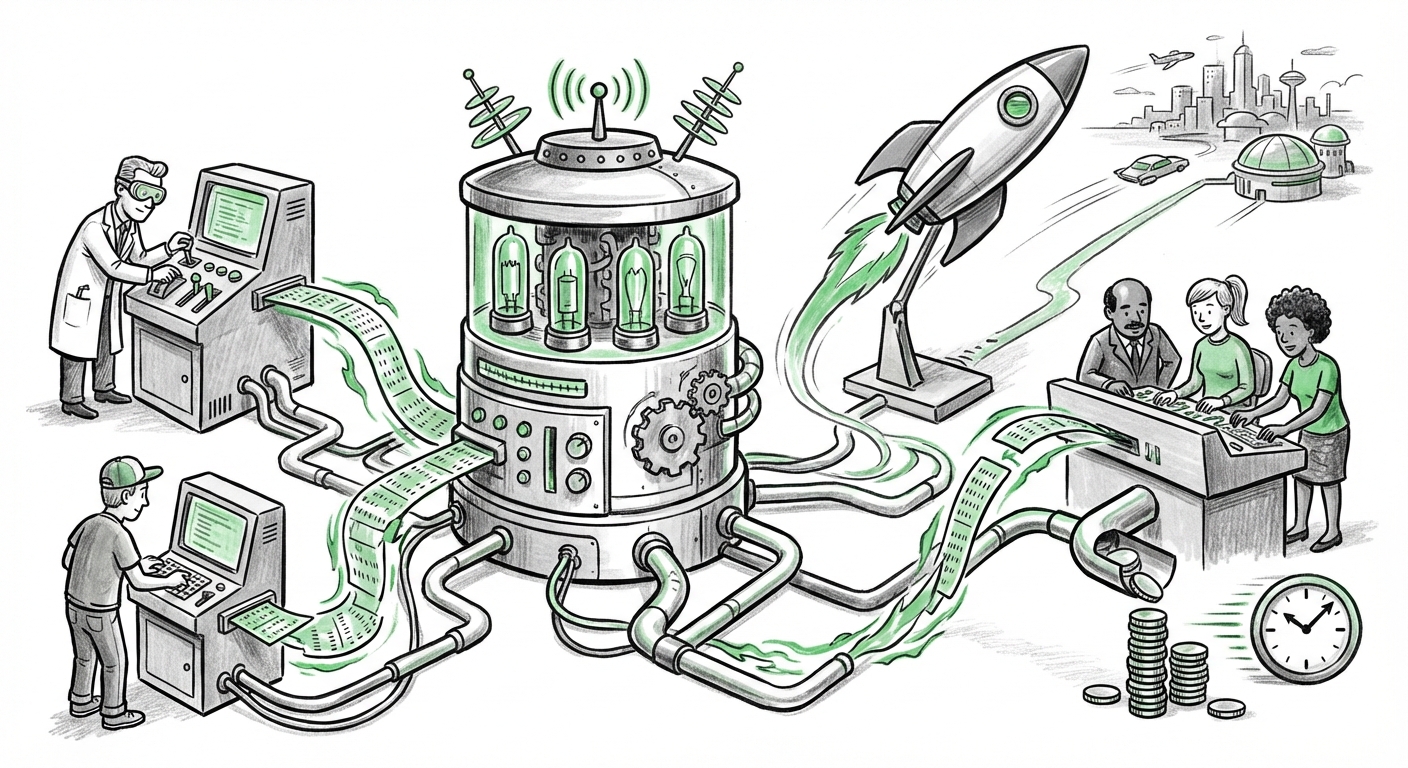
Why so high? While OpenAI hasn't published a detailed breakdown, the vast majority of AI-related costs come from three areas: computing infrastructure (buying and running thousands of the most powerful chips), research and development (hiring the world's top AI researchers and engineers), and operations (running ChatGPT and other services at global scale). Each of these buckets alone can cost billions.
For comparison, in 2024, many analysts estimated OpenAI's annual spending was around $5-7 billion. The leap to $34 billion shows a massive acceleration. Either the company is building out next-generation infrastructure (like data centers filled with Nvidia H100 chips), training even more advanced models (like GPT-5 or beyond), or both. It could also reflect the enormous costs of inference — every time you ask ChatGPT a question, it costs OpenAI real money in compute.
Whatever the exact mix, one thing is clear: AI at this scale is not cheap. And it's getting more expensive, not less.
What $34 Billion Gets You
While we don't have an itemized receipt, we can make educated guesses based on industry norms. Here are the most likely uses of that capital:
- Compute hardware: Top-end GPUs (like Nvidia H100 or B200) cost $30,000–$50,000 each. A cluster of 50,000 GPUs alone would cost billions. Training a frontier model can require hundreds of thousands of GPU-hours, and running inference for millions of users continuously adds up fast.
- Energy and cooling: Data centers that run AI models consume enormous amounts of electricity. A single training run can use more power than a small town. Annual electricity bills can easily exceed $1 billion for a large operation.
- Workforce: Top AI researchers command salaries in the millions. OpenAI employs thousands of people, and the talent war is fierce. Compensation (including stock and benefits) for a world-class team of 5,000 could easily run $3–5 billion per year.
- Research and experimentation: Failed experiments, training runs that never produced useful models, and long research cycles all burn cash. The path to AGI (artificial general intelligence) is not linear — it's littered with expensive dead ends.
- Infrastructure scaling: Building new data centers, buying land, networking equipment, and securing cloud contracts are capital-intensive activities.
- Legal, regulatory, and safety: As AI becomes more powerful and scrutinized, spending on compliance, safety research, and legal teams skyrockets.
At $34 billion, we're likely seeing a combination of all these factors. The spending may include one-time capital expenses (like building new data centers) plus ongoing operational costs. Even so, the figure is unprecedented for a single AI company.
Implications for the AI Industry
1. The barrier to entry just got higher. If OpenAI is spending $34 billion a year, any competitor that wants to match its pace needs similar resources. That means only the biggest tech companies (Google, Microsoft, Meta, Amazon) and state-backed initiatives (like China's AI push) can realistically compete. The era of small startups building foundational AI models is ending. Instead, we'll see a two-tier system: a handful of giants running the infrastructure, and many smaller players building applications on top.
2. Monetization becomes paramount. OpenAI must generate enough revenue to eventually justify this burn rate. Currently, it makes money through ChatGPT subscriptions (Plus, Pro, Enterprise), API access, and partnerships. But $34 billion in spending dwarfs typical revenue forecasts. To become sustainable, OpenAI likely needs to hit tens of billions in annual revenue — which means prices for AI services will rise or new business models (like advertising, licensing, or custom models) will emerge.
3. Consolidation accelerates. Smaller AI companies that cannot match the spending will either get bought by larger players or go bankrupt. Microsoft's deep partnership with OpenAI is a sign of this trend. We may see more acquisitions and strategic alliances as the cost of staying on the cutting edge becomes prohibitive.
4. The race for AGI intensifies. Spending at this level suggests OpenAI is betting everything on achieving artificial general intelligence — a system that can outperform humans at most cognitive work. If they succeed, the payoff could be astronomical. If they fail, the losses would be historic. Either way, the entire industry is watching.
Business and Societal Impact
For businesses that rely on AI: Prepare for price increases. If OpenAI needs to cover its costs, API fees will likely go up. Companies building on top of these models should diversify their AI providers (Anthropic, Google, open-source models) to avoid over-dependence on a single, expensive source.
For society: The enormous spending on AI raises questions about resource allocation. Could those billions be better used for healthcare, education, or climate change? AI proponents argue that transformative AI could solve those problems, but the timeline is uncertain. In the meantime, the concentration of power in a few companies creates both risks and opportunities.
For workers: The massive investment will lead to faster automation, but also new jobs in AI infrastructure, data center operations, and AI oversight. The key is adaptability — while some roles will vanish, others will appear in unexpected places.
For governments: Regulation and oversight become critical. When a single organization controls the most advanced AI and spends $34 billion a year, national security and economic competitiveness are at stake. Expect more government funding for AI research and stricter rules about safety and transparency.
Actionable Insights
What can you do with this information? Here are practical steps:
- For business leaders: Audit your AI dependencies. If you rely heavily on OpenAI's models, start testing alternatives like Anthropic's Claude, Google Gemini, or open-source Llama. Price volatility is coming.
- For investors: The AI infrastructure sector (chip makers, data center operators, energy companies) may benefit from this spending. Consider companies supplying hardware and power.
- For developers: Learn to work with multiple AI platforms. The ability to switch between providers or fine-tune open-source models will be a valuable skill.
- For policymakers: Push for transparency in AI spending and safety research. The public deserves to know how these massive sums affect model behavior and security.
- For everyone: Stay informed. The next few years will determine whether this investment leads to a golden age of AI or a bubble. Understanding the money flows helps predict the direction.
What This Means for the Future
The $34 billion burn rate is not just a number — it's a statement. OpenAI is betting that the future of intelligence, economy, and society will be built on AI. The spending suggests they believe we are in the critical phase where investment now determines leadership for decades. But it also signals risk. If the returns don't materialize, the fallout could impact the entire tech ecosystem.
One thing is certain: The AI industry is no longer a niche sector. It's a capital-intensive, high-stakes global race. The decisions made today about where this money goes will shape how AI evolves, who controls it, and how it impacts our lives.
As users, we benefit from increasingly capable AI. As citizens, we need to ensure that power is wielded responsibly. And as businesses, we must navigate a world where the cost of the very best AI is stratospheric — but so is the potential reward.
The $34 billion burn is a wake-up call. It tells us that AI's future is being built right now, at a scale none of us fully anticipated. The question is whether that future will be inclusive, safe, and sustainable — or whether the burn rate will become a cautionary tale in a few years' time.