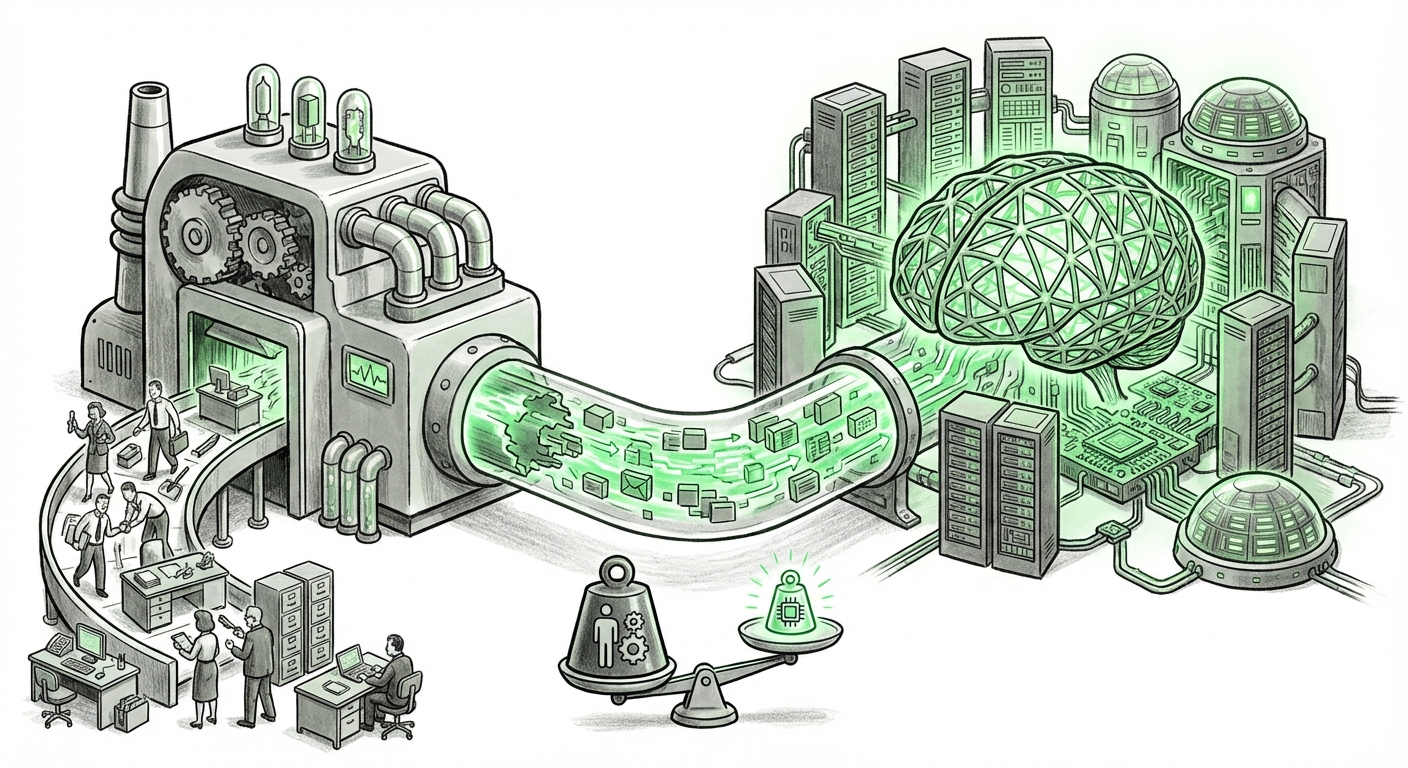
The AI Infrastructure Funding Crisis: Why Hyperscalers Can't Keep Up With Their Own Ambitions
For years, the biggest names in tech — Amazon, Microsoft, Google, and a handful of others — have been on a spending spree like no other. They have poured billions into building massive data centers, buying cutting-edge AI chips, and laying the groundwork for the next generation of artificial intelligence. The message has been clear: AI is the future, and they intend to own it.
But a major storm is brewing beneath the surface. According to a recent analysis, hyperscalers may soon be unable to fund their AI buildout from cash flow alone. This is not a small detail. It is a sign that the engine powering the AI revolution is running low on fuel. And the ripple effects will touch every business, every developer, and every person who uses AI tools in their daily life.
In this article, we break down what this funding crunch means, why it is happening, and — most importantly — what it means for the future of AI and how it will be used.
The Great AI Buildout: A Spending Spree Like No Other
To understand the problem, we first need to understand the scale of the AI buildout. Hyperscalers — the companies that operate the world's largest cloud computing platforms — have been spending money at a pace that is hard to wrap your head around. We are talking about tens of billions of dollars every year, directed at building new data centers, buying GPUs, and developing custom AI hardware.
The reasoning has been simple: AI models are getting bigger and more capable. Training a state-of-the-art large language model or a multimodal AI system requires enormous amounts of computing power. And once those models are trained, running them — what the industry calls "inference" — also requires massive infrastructure. The hyperscalers have been racing to build that infrastructure before anyone else does, believing that whoever owns the compute wins the AI race.
But here is the problem: that spending has been growing faster than the revenue coming in from AI services. For a while, that was okay. The companies had strong cash flows from their existing cloud and advertising businesses. They could fund the AI buildout out of pocket. But that window is closing.
What "Unable to Fund from Cash Flow Alone" Really Means
The phrase "unable to fund their AI buildout from cash flow alone" sounds like financial jargon, but it describes a very real and serious situation. It means that the money these companies generate from their normal operations — their profits and cash earnings — is no longer enough to pay for the AI infrastructure they want to build.
Think of it like a family that has been saving up for a big home renovation. Initially, they pay for each room out of their regular paychecks. But then the renovation gets bigger and more expensive. Soon, they are spending more on the renovation than they earn each month. They have to start dipping into savings, taking out loans, or finding other sources of money.
That is exactly where the hyperscalers are heading. The AI buildout has grown so massive that it is outpacing the cash flow generated by their core businesses. This creates a set of uncomfortable choices:
- Borrow more money — take on debt to fund the buildout, which increases financial risk.
- Slow down the buildout — reduce spending on AI infrastructure, which could mean losing the AI race to competitors.
- Raise prices — charge more for AI services to generate more revenue, which could slow adoption.
- Find new sources of capital — seek investment from outside, which could mean giving up some control.
None of these options are easy. And each one has significant implications for the future of AI.
Why This Is Happening Now: The Cost of AI Keeps Climbing
The root cause of the funding crunch is simple: the cost of building and running AI systems is rising faster than the revenue they generate. Let us look at the main drivers.
The Hardware Arms Race
AI chips — especially the GPUs made by companies like NVIDIA — are in incredibly high demand. The most advanced chips can cost tens of thousands of dollars each, and a single data center can require tens of thousands of them. Hyperscalers are also investing in their own custom chips, which requires massive upfront research and development spending. The hardware bill for AI is astronomical and shows no signs of coming down.
The Scale of Data Centers
Modern AI data centers are not just big — they are enormous. A single facility can consume as much electricity as a small city. Building one costs billions of dollars. And because the latest AI models are so compute-intensive, hyperscalers need to build many of these centers, often in multiple locations around the world to reduce latency and comply with data regulations.
The Competition for Talent
Hiring the engineers and researchers needed to build and operate AI systems is extremely expensive. Top AI talent commands salaries in the high six figures or even seven figures. The hyperscalers are in a bidding war for this talent, and that adds heavily to their operating costs.
The Revenue Gap
While AI services like ChatGPT, Copilot, and cloud-based AI APIs are growing quickly, they are not yet generating enough revenue to cover the enormous upfront costs. For many AI products, the cost of serving each user — the inference cost — is still very high. That means even as usage grows, profitability is elusive.
When you add all of this together, you get a situation where spending on AI infrastructure is growing much faster than the cash coming in. And that is a recipe for a funding crisis.
What This Means for the Future of AI: Five Big Shifts
The funding crunch at the hyperscaler level will not stay contained. It will send shockwaves through the entire AI ecosystem. Here are the most important changes to expect.
1. AI Development Will Become More Selective
When money is tight, you cannot build everything. Hyperscalers will have to make hard choices about which AI models to train and which products to launch. We can expect to see fewer "moonshot" projects and more focus on applications that have a clear path to revenue. This could slow the pace of AI innovation in some areas, especially in research that does not have an immediate commercial use.
2. The Cost of AI Services Could Rise
If hyperscalers need to generate more cash from their AI investments, they will likely raise prices. Businesses and developers who rely on cloud-based AI APIs may see their costs go up. This could make AI less accessible for startups and smaller companies, who may struggle to afford the same tools that larger competitors use.
3. A Shift Toward Efficiency Over Size
For years, the trend in AI has been "bigger is better." Bigger models, more data, more compute. But when funding is constrained, the incentive shifts toward making AI more efficient. We are already seeing this with smaller, specialized models that can run on less hardware. The funding crunch will accelerate this trend. The future of AI may be less about building the biggest model and more about building the smartest, most efficient one.
4. More Partnership and Consolidation
Not every company can afford to build its own AI infrastructure. The funding crunch will push smaller AI companies to partner with hyperscalers or be acquired by them. We may also see more joint ventures and shared infrastructure projects among the hyperscalers themselves, as they look for ways to split the enormous costs.
5. The "AI Bubble" Could Deflate
There has been a lot of talk about whether AI is in a bubble. The funding crunch at the hyperscaler level is a strong signal that the market is starting to correct. If the biggest players cannot sustain their spending, it suggests that the revenue expectations for AI were too optimistic. A deflation of the AI hype cycle could lead to a period of slower investment and more realistic expectations.
Practical Implications for Businesses and Society
These shifts are not abstract. They will affect how companies use AI and how AI impacts everyday life. Here is what to watch for.
For Businesses: Prepare for a Tighter AI Market
If you run a business that relies on AI — whether you use cloud-based APIs, run your own models, or build AI-powered products — the funding crunch matters to you. Here is how to prepare:
- Diversify your AI suppliers. Do not become too dependent on a single hyperscaler. If their prices rise or their services change, you need alternatives.
- Invest in efficiency. Look for ways to use AI more efficiently. Smaller, fine-tuned models can often do the job at a fraction of the cost of a giant model.
- Plan for price increases. Build your budgets assuming that AI services will cost more in the next few years. If they do not, you will have a pleasant surprise. If they do, you will be ready.
- Focus on ROI. Be ruthless about measuring the return on your AI investments. In a tighter funding environment, only AI applications that deliver clear, measurable value will survive.
For Society: The AI Divide Could Widen
One of the biggest concerns about the AI funding crunch is that it could widen the gap between the "haves" and the "have-nots." If AI becomes more expensive to use, only large companies and wealthy countries will be able to afford the best AI tools. Smaller businesses, schools, and developing nations could be left behind.
This could have serious consequences for education, healthcare, and economic opportunity. Policymakers need to be thinking about how to ensure that AI remains accessible, even as the infrastructure costs rise.
For Developers: The Era of Free AI May End
We have become used to free AI tools — chatbots, image generators, code assistants. Many of these are subsidized by the hyperscalers as part of their buildout strategy. If that funding dries up, we may see more paywalls, usage limits, and premium tiers. Developers should plan for a world where access to powerful AI is no longer free, and build their business models accordingly.
Actionable Insights: How to Navigate the AI Funding Crunch
Whether you are a business leader, a developer, or an investor, the hyperscaler funding crunch is something you need to take seriously. Here are concrete steps you can take right now.
- Audit your AI spending. Understand exactly how much you are spending on AI infrastructure and services. Identify areas where you can cut costs without sacrificing performance.
- Explore open-source models. Open-source AI models like Llama, Mistral, and others are becoming increasingly capable. They offer a way to use AI without being locked into a hyperscaler's pricing.
- Build flexibility into your contracts. If you are signing long-term agreements with cloud providers, include clauses that allow you to adjust usage if prices change significantly.
- Watch for consolidation. Keep an eye on mergers and acquisitions in the AI space. Consolidation could change the competitive landscape quickly.
- Stay informed. The situation is evolving rapidly. Follow trusted sources like the-decoder.com for updates on hyperscaler spending and AI industry trends.
The Big Picture: AI's Adolescence Is Costly
It is easy to see the funding crunch as bad news. But it is important to put it in perspective. AI is still a young technology. The massive investment we have seen in recent years is like the early spending on railroads, electricity, or the internet. It was always going to be expensive, and it was always going to require more capital than the early revenue could cover.
The good news is that AI is delivering real value. Companies are using it to automate tasks, improve customer service, accelerate research, and create new products. The revenue will come — but it will take time. The funding crunch is not a sign that AI is failing. It is a sign that AI is moving from the "experimental" phase to the "commercial" phase. And that transition is always painful.
The hyperscalers have deep pockets and strong incentives to keep investing. They will find ways to fund the buildout, even if it means taking on debt or making tough choices. But the era of unlimited, no-questions-asked AI spending is coming to an end. From here on, every dollar spent on AI will need to earn its keep.
That is not a bad thing. It will force the industry to focus on what actually works, to build more efficient systems, and to deliver real value to users. In the long run, that is how a technology becomes sustainable.
Conclusion: The Next Phase of AI Begins Now
The news that hyperscalers may soon be unable to fund their AI buildout from cash flow alone is a watershed moment. It signals the end of the "spend at all costs" era and the beginning of a more disciplined, efficiency-driven phase of AI development.
This does not mean AI is in trouble. Far from it. It means that AI is growing up. The technology will continue to advance, but the path forward will be shaped by economic realities, not just technological ambition. Businesses that adapt to this new reality — by focusing on efficiency, diversifying their AI sources, and measuring ROI carefully — will be the ones that thrive.
The AI revolution is not over. It is just entering a new chapter. And understanding the funding dynamics behind it is the key to navigating what comes next.