New Benchmark Exposes How Badly AI Struggles With Real Knowledge Work (And What It Means for Your Business)
For the past two years, the narrative around Generative AI has been one of relentless, exponential progress. Models can pass the bar exam, write poetry, and generate computer code in seconds. Enterprises have poured billions into integrating AI, dreaming of a future of fully autonomous knowledge workers. But a critical new benchmark has emerged, and its findings are sobering. According to a report detailed by The Decoder, this benchmark exposes a fundamental, uncomfortable truth: when it comes to the messy, multi-step, deeply contextual reality of real knowledge work, even the most advanced AI systems struggle badly.
This gap between impressive demo performances and underwhelming real-world utility is the most important story in AI right now. Understanding this disconnect isn't just academic—it's the key to building a realistic, profitable, and sustainable strategy for AI adoption in your organization.
The Hype vs. The Reality Check
We have been inundated with headlines claiming that AI will replace entire departments overnight. Vendors have been eager to sell the vision of a fully automated workforce where human oversight is a relic of the past. The new benchmark sounds a much-needed alarm. It shifts the focus away from what AI is good at—short, well-defined tasks with clear right answers—and toward the kind of work that actually drives business value.
This benchmark specifically tests "real knowledge work." While the exact methodology is new, the concept is familiar to anyone who has worked in a professional services firm, a corporate strategy department, or a research lab. Knowledge work is not about answering a single question. It is about defining the right questions, resolving conflicting information, synthesizing insights across dozens of documents, and creating a nuanced deliverable.
What Is 'Real Knowledge Work' and Why Is It So Hard for AI?
To understand why the new benchmark results are so damning, we first need to define what real knowledge work actually looks like. It is the antithesis of a simple Q&A prompt.
- Multi-Step Reasoning: Real work rarely has a one-step answer. An analyst might need to read a quarterly report, cross-reference it with industry trends, and then project future earnings. This requires a chain of logic that spans many pages of context.
- Ambiguity and Noise: Real-world data is messy. It contains contradictions, irrelevant information, and subtle biases. AI models are highly sensitive to noise. A single contradictory sentence in a long document can derail an entire analysis.
- Long-Term Planning: Knowledge work requires planning. "First, I need to gather data from three departments. Then, I need to interview stakeholders. Finally, I need to draft a proposal." Current AI models lack the robust executive function to stick to a complex plan without veering off course.
- Domain Expertise: Knowing where to look and what to ignore requires deep domain knowledge that general-purpose AI models often lack.
The benchmark demonstrates that while AI can write a perfectly professional email on the first try, it falls apart when asked to execute a complex, multi-stage research project that requires deep synthesis and oversight.
Why Does the New Benchmark Matter Right Now?
The timing of this benchmark is critical. We are at the peak of the "deployment curve." Companies have moved past experimentation and are trying to integrate AI into their core workflows. The risk of automating flawed processes with brittle AI is enormous.
According to the source material published by The Decoder on June 19, 2026, this benchmark exposes the "brittleness" of current models. Here is what the benchmark likely reveals about the root causes of failure:
- The Reasoning Mirage: Large Language Models are brilliant at predicting the next token. They sound incredibly logical. But their reasoning is often brittle. Change a name or a date in a complex prompt, and the entire logical output can collapse. Real knowledge work requires subtle reasoning over ambiguous facts, something the benchmark highlights as a critical weakness.
- Context Window Overload: Can a model read a 100-page report? Yes. Can it keep track of a cross-reference on page 5, an assumption on page 40, and a conclusion on page 80? That is significantly harder. The longer the task, the more likely the model is to "forget" or hallucinate connections between disparate pieces of information.
- Lack of Self-Correction: When a human analyst makes a mistake early in a project, they usually catch it later. AI models, by contrast, often fail silently. They will confidently produce a flawed analysis because they lack the metacognitive ability to double-check their own work.
What This Means for the Future of AI and How It Will Be Used
This benchmark is not bad news for the AI industry. It is the healthy, necessary maturation of the hype cycle. We are moving from the "wow" phase to the "work" phase. Here is what the future of AI looks like in light of these findings.
1. The End of the "Black Box" AI Worker
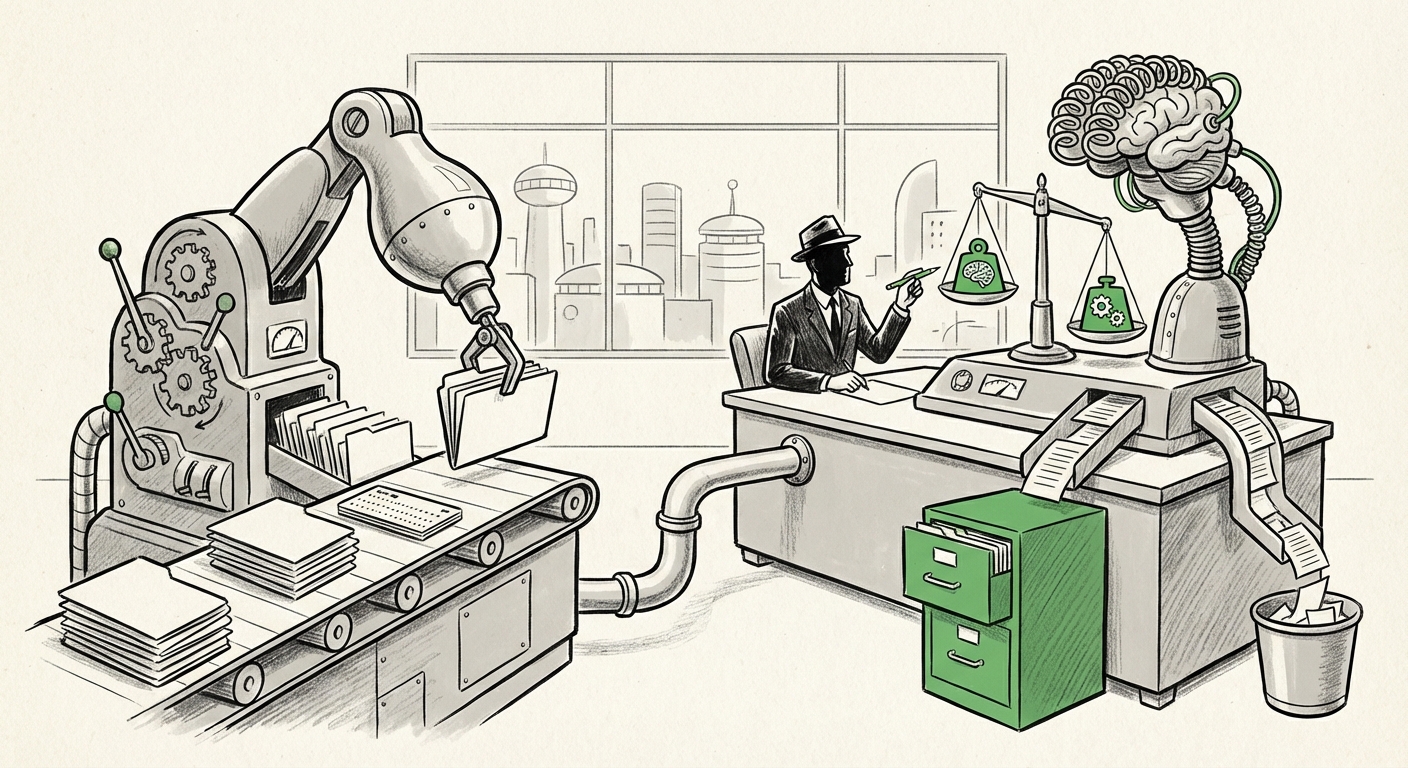
The dream of giving an AI a vague goal like "write the Q3 strategy report" and getting a perfect result is dead. The future belongs to hybrid intelligence. AI will handle the scut work—gathering data, summarizing meetings, drafting initial versions—but humans will remain firmly in the loop for judgment, synthesis, and complex decision-making.
Businesses must stop looking for "AI employees" and start looking for "AI assistants." These are tools that augment human capability rather than replace it.
2. The Rise of Agentic Workflows (with Guardrails)
To tackle real knowledge work, AI will need to be structured into agentic workflows. This means breaking a massive task into smaller, verifiable steps. A human might assign an AI agent to "find all relevant data points from the last five years," then another agent to "draft a summary of the key findings," and finally a human to "review and approve the final narrative." This modular approach compensates for AI's inability to handle long, unstructured tasks on its own.
3. A Premium on Data Architecture
If AI struggles with ambiguity, the solution is to reduce ambiguity. Companies that invest in clean, structured, and well-indexed data will see dramatically better results than those that rely on the model's general knowledge. Retrieval Augmented Generation (RAG) is not a luxury; it is a necessity for any organization hoping to use AI for knowledge work.
4. New Kinds of Jobs Will Emerge
The skills that become most valuable in an AI-augmented workplace will be critical thinking and evaluation. We will need "AI sherpas" or "knowledge engineers" who can translate messy business problems into structured AI tasks and then validate the output. The ability to prompt engineer effectively and audit AI reasoning will be a core competency, not a niche skill.
Practical Implications for Businesses and Society
What should a business leader do with this information? The temptation might be to slow down AI investment. The smarter response is to accelerate strategically.
- Audit Your Workflows: Not every task is a knowledge work task. Identify the simple, high-volume tasks that AI can do reliably today (e.g., data extraction, email drafting, code generation). Automate those. For complex tasks, design a human-in-the-loop process.
- Invest in Evaluation: Don't just test AI on what it is good at (like writing a poem). Test it on the hardest, most ambiguous tasks your team faces. Use benchmarks like the one highlighted by The Decoder to set realistic expectations internally.
- Train Your People: Your most valuable asset is your workforce's ability to use these tools. Invest in training that focuses on prompting, critical evaluation of AI output, and ethical oversight.
- Prepare for a Hybrid Future: Society needs to adjust its expectations. The fear of mass, immediate obsolescence for white-collar workers appears overblown in the short term. The most valuable skill in an AI-augmented workplace will be the ability to guide these tools effectively — prompt engineering, critical evaluation of AI output, and complex problem-solving.
Conclusion: The Wake-Up Call We Needed
The new benchmark that exposes how badly AI struggles with real knowledge work is precisely the wake-up call the industry needed. It moves the conversation away from abstract capabilities and toward practical utility. AI is not yet a replacement for the human mind, but it is an increasingly powerful partner.
The future of AI in knowledge work is collaborative, not automated. Machines will handle scale and speed, while humans will provide context, judgment, and ethical oversight. The companies that thrive will be those that understand this division of labor and build their workflows accordingly.
The hype cycle is over. The hard work of actually integrating AI into the fabric of our work has just begun.