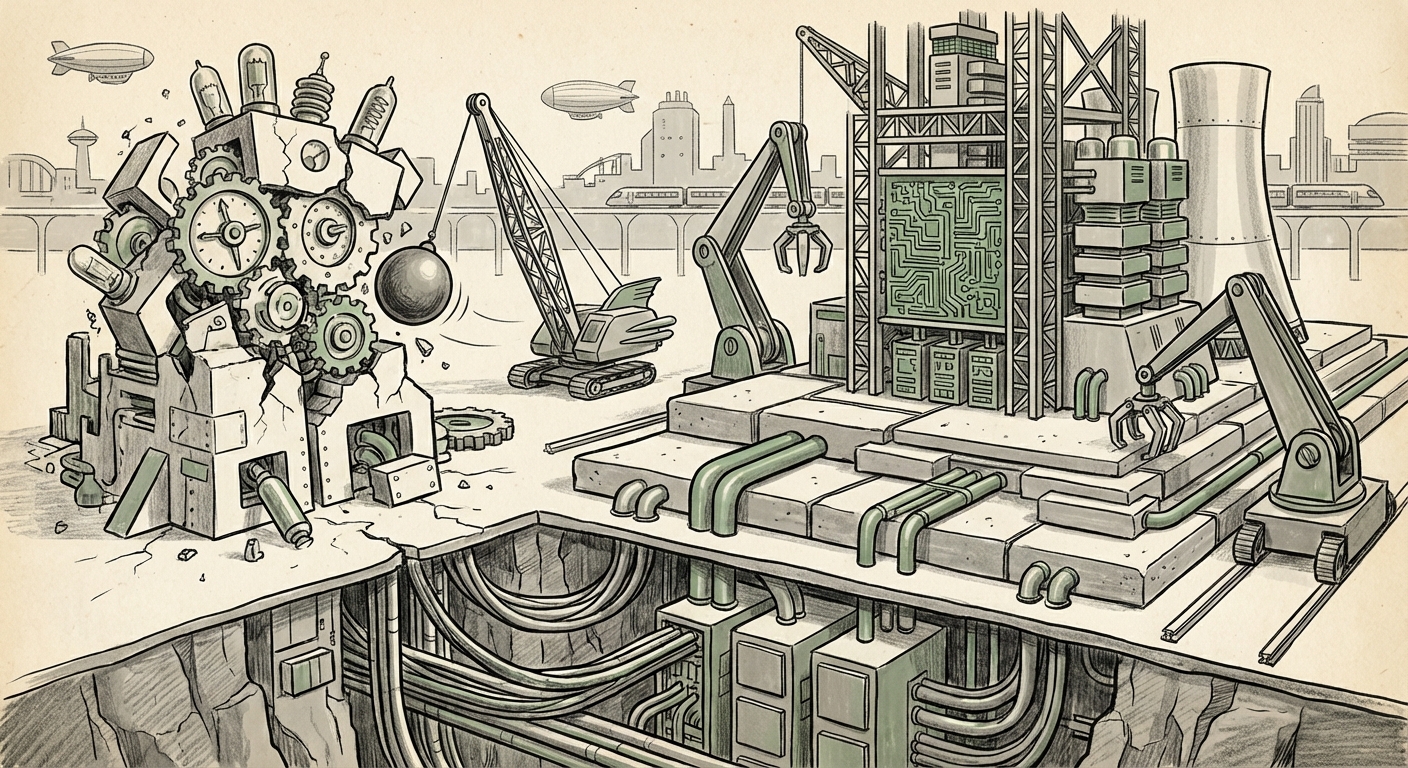
Did Integral AI's Jad Tarifi Just Announce AGI? What This Means for the Future of Artificial Intelligence
On December 8, 2025, a seismic shift rippled through the artificial intelligence community. Integral AI CEO Jad Tarifi made headlines with what many are calling a paradigm-altering announcement on Singularity Weblog regarding Artificial General Intelligence (AGI). If confirmed, this would represent one of the most significant milestones in human history — a machine capable of performing any intellectual task that a human being can do. But what exactly did Tarifi say, and what does this mean for the future of AI, businesses, and society at large? Let's break it down.
What Did Jad Tarifi Actually Announce?
The Singularity Weblog article, titled "Breaking: Did Integral AI's Jad Tarifi Just Announce AGI?", suggests that Integral AI's founder has signaled the arrival of AGI. While the full context of his statements requires careful reading, the implication is nothing short of revolutionary. Tarifi's announcement centers on the idea that we may have crossed the threshold from narrow AI — systems that excel at specific tasks like language translation or playing chess — to a general intelligence that can reason, plan, learn, and adapt across any domain without specialized retraining.
This is the holy grail that AI researchers have pursued since the 1950s. If Integral AI has indeed achieved AGI, it changes the conversation from "when will AGI arrive?" to "what do we do now that it's here?"
What Makes This Different From Previous AI Breakthroughs?
To understand the magnitude of this potential announcement, it helps to distinguish between the AI we've been using and what AGI represents.
- Narrow AI (what we have today) — Systems like GPT-4, Claude, Gemini, and other large language models are incredibly powerful at generating text, summarizing documents, writing code, and answering questions. But they are narrow in the sense that they operate within a limited scope. They don't truly understand the world; they predict what words or pixels are most likely based on their training data.
- Artificial General Intelligence (AGI) — This is a system that can understand, learn, and apply knowledge across any field, just like a human. An AGI could learn to drive a car, then pivot to solving complex math problems, then write a symphony, all without needing separate training for each task. It would possess genuine reasoning, memory, and the ability to transfer learning from one domain to another.
If Tarifi's claim holds up, Integral AI has essentially built a machine that can think — not just simulate thinking.
What This Means for the Future of AI Development
The arrival of AGI would not be an incremental update; it would be a step-change that rewrites the rules of technology development. Here's what it means for the AI landscape going forward:
1. The End of "Training" as We Know It
Today's AI systems require enormous datasets and compute resources to train for specific tasks. AGI changes that. Instead of building separate models for separate jobs — a chatbot here, a recommendation engine there — we could have a single, general intelligence that learns new tasks on the fly, much like a human employee would. This could dramatically reduce the cost and complexity of deploying AI across industries.
2. A Race to Integration
If Integral AI has indeed achieved AGI, other major players — OpenAI, Google DeepMind, Anthropic, Meta — will be under immense pressure to either replicate the breakthrough or acquire the technology. We could see a new arms race where the goal shifts from building the best narrow AI to integrating AGI into real-world products and services as quickly as possible.
3. Redefining "Intelligence" Itself
One of the most profound effects of AGI will be how it forces us to reconsider what we mean by intelligence. For decades, we measured AI progress by benchmarks — can it beat a human at Go? Can it pass the bar exam? AGI means the benchmark is no longer a test; it's the entire range of human cognitive capability. This could lead to new fields of study around machine cognition and even challenge our understanding of consciousness.
What This Means for Businesses
For business leaders, the implications of AGI are both thrilling and daunting. Here are the practical effects likely to emerge if Tarifi's announcement is substantiated:
Automation Goes Universal
Right now, AI automates specific tasks — writing emails, analyzing data, recommending products. AGI could automate entire workflows, roles, and even departments. A single AGI system could manage supply chains, negotiate contracts, oversee customer service, and develop marketing strategies, all without human intervention. This doesn't mean all jobs disappear, but it does mean that every knowledge-worker role will be profoundly transformed.
Personalized Intelligence at Scale
Imagine an AGI that knows your business inside and out — your customers, your financials, your competitive landscape — and can provide strategic advice in real time. That's the promise of Integral AI's breakthrough. Instead of using a dozen different AI tools for different functions, a business could have one universal intelligence that serves as a strategist, analyst, and executor combined.
The Rise of AI-Native Companies
Businesses that are built from the ground up around AGI will have a massive advantage over incumbents that try to bolt AGI onto legacy processes. We may see the rise of AI-native startups that operate with lean teams and enormous reach, similar to how the internet gave rise to digital-native companies that disrupted brick-and-mortar industries.
What This Means for Society
The societal implications of AGI are perhaps the most important — and the most challenging.
Economic Disruption and Opportunity
AGI could drive unprecedented productivity gains, potentially lifting global GDP and creating entirely new categories of work. But it could also widen inequality if the benefits accrue primarily to those who own the technology. Governments and institutions will need to think seriously about wealth redistribution, universal basic income, and retraining programs on a scale never attempted before.
Education Transformed
If AGI can teach any subject to any student with infinite patience and perfect adaptability, the traditional model of education becomes obsolete. The role of teachers would shift from imparting knowledge to fostering creativity, critical thinking, and emotional intelligence — the uniquely human skills that even AGI may not replicate.
Governance and Safety
AGI is not just an opportunity; it's also a responsibility. How do we ensure that a general intelligence — one that could theoretically outsmart any human — remains aligned with human values? This is the alignment problem, and it becomes the single most important technical and ethical challenge of our time. Integral AI's announcement, if real, means we need robust governance frameworks now, not later.
Actionable Insights for Leaders and Decision Makers
So what should you do if you're a business leader, policymaker, or technologist in the wake of this announcement? Here are practical steps to consider:
- Audit your AI readiness. Understand where your organization currently uses AI and where AGI could have the biggest impact. Start mapping out how a general intelligence could augment or replace existing processes.
- Invest in AI literacy. Ensure your team — from executives to frontline workers — understands what AGI is and how it might change their roles. The more your organization understands this technology, the better positioned it will be to adapt.
- Watch for signal, not noise. Not every claim of AGI will be real. But Integral AI's announcement on Singularity Weblog carries weight. Pay attention to third-party validations, benchmarks, and real-world demonstrations to separate genuine breakthroughs from marketing hype.
- Engage with the safety conversation. Whether or not you work in AI, the safety and alignment of AGI is a societal issue. Join the conversation — read papers, attend forums, and advocate for responsible development. The decisions made in the next 12 months will shape the trajectory of AGI for decades.
- Prepare for radical change. AGI is not just a faster version of today's AI. It is a fundamentally different kind of technology. The organizations that thrive will be those that embrace this difference and are willing to reinvent themselves from the inside out.
Conclusion: A New Chapter Begins
Jad Tarifi's announcement on Singularity Weblog represents a potential inflection point in human history. Whether or not his claim of AGI is fully validated by the broader scientific community, the fact that a credible leader like Integral AI's CEO is making this statement publicly signals that we are closer to AGI than many believed possible.
For businesses, the message is clear: prepare for a world where intelligence is no longer a uniquely human resource. For society, the challenge is to ensure that this powerful technology is used for the benefit of all, not just the few. And for every one of us, this is a moment to pause and reflect on what it means to share the planet with another form of general intelligence.
The future is not coming — it is already here. And Integral AI's announcement may be remembered as the moment the door to that future swung wide open.