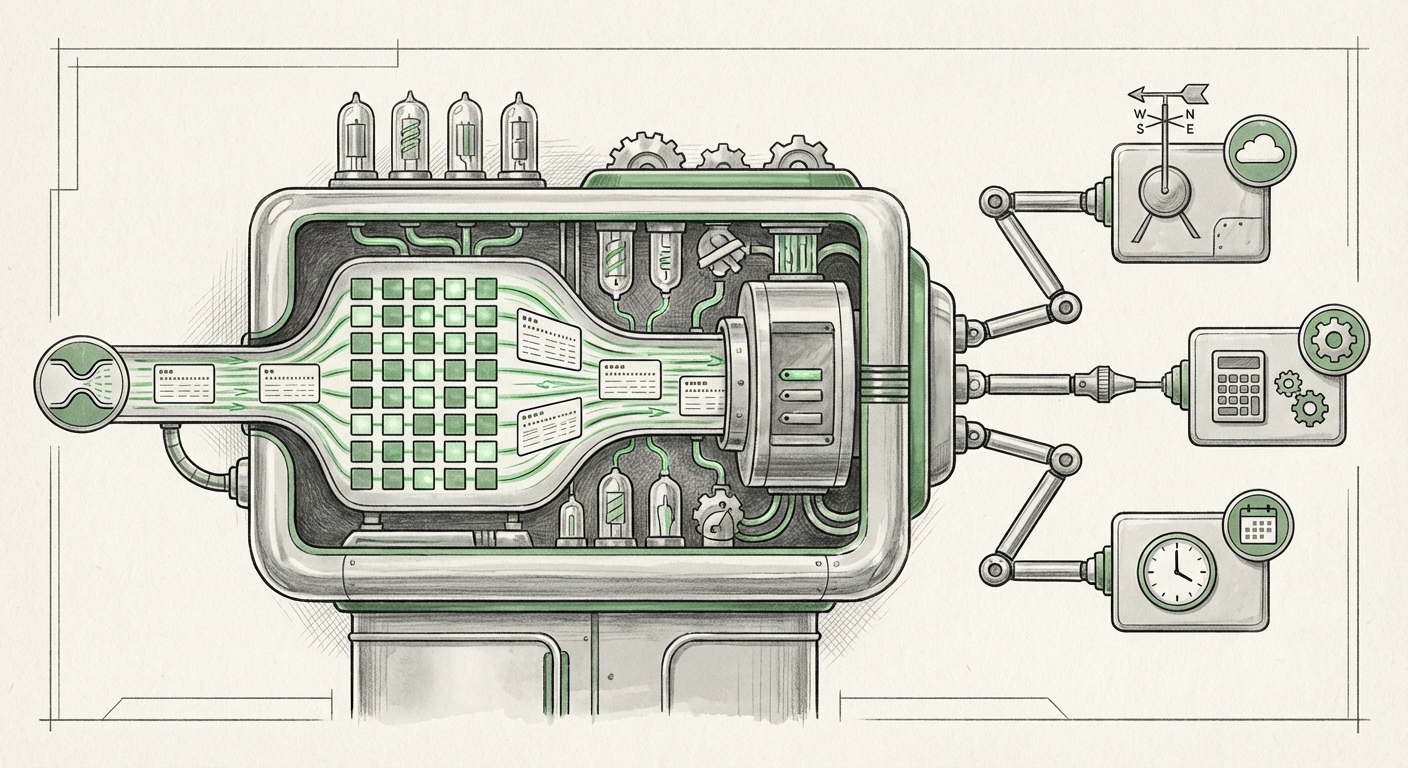
Hacking the Atmosphere: How AI Is Driving the Next Phase of Geoengineering — and Why We Need a Reality Check
In June 2026, MIT Technology Review published a landmark story titled "Hacking the atmosphere: Geoengineering gets a reality check." The article landed at a critical moment. For years, the idea of deliberately tinkering with Earth's climate systems — spraying reflective particles into the stratosphere, brightening marine clouds, or sucking carbon out of the sky — felt like science fiction. But as global temperatures climb and extreme weather events become the norm, geoengineering has moved from the fringes to the center of climate policy discussions.
And now, artificial intelligence is supercharging the conversation. From modeling complex atmospheric dynamics to monitoring real-time deployments, AI is becoming the invisible engine behind geoengineering research. But with great power comes great uncertainty. This article explores what the geoengineering reality check means for the future of AI, how businesses and governments should prepare, and why everyone — not just scientists — needs to pay attention.
The Geoengineering Landscape: A Quick Primer
Geoengineering, also called climate engineering, refers to large-scale interventions designed to counteract climate change. There are two main branches:
- Solar Radiation Management (SRM): Techniques that reflect a small percentage of sunlight back into space to cool the planet. The most discussed method is stratospheric aerosol injection (SAI) — essentially releasing reflective particles high in the atmosphere.
- Carbon Dioxide Removal (CDR): Methods that pull CO₂ out of the air, such as direct air capture, ocean alkalinity enhancement, or afforestation.
Both approaches are controversial. Critics worry about unintended side effects, governance challenges, and the moral hazard of reducing pressure to cut emissions. Supporters argue that we may need these tools to buy time while the world transitions to clean energy.
The "reality check" from the Technology Review piece signals that geoengineering is no longer a hypothetical. Real-world experiments are happening. Small-scale field tests, computer simulations, and policy frameworks are all advancing. And AI is playing a starring role.
AI's Role in Geoengineering: From Simulation to Supervision
Artificial intelligence is not just a helper in geoengineering — it is becoming essential. Here are the key areas where AI is making an impact.
1. Climate Modeling and Prediction
Earth's climate is a chaotic, non-linear system. Traditional physics-based models struggle to predict the outcomes of interventions like injecting aerosols into the stratosphere. Machine learning models, especially deep neural networks, can process vast amounts of climate data and identify patterns that classical models miss.
AI can simulate thousands of geoengineering scenarios in hours, not months. It can model how reflective particles might spread, how cloud cover might change, and how regional weather patterns could shift. This kind of high-speed, high-resolution modeling is critical for understanding risks before any large-scale deployment.
2. Real-Time Monitoring and Feedback Control
If geoengineering is ever deployed at scale, it will require continuous monitoring and rapid adjustment. AI systems can analyze satellite imagery, atmospheric sensor data, and ocean readings in real time. They can detect anomalies — a sudden temperature drop in one region, an unexpected change in rainfall — and recommend or automatically trigger corrective actions.
Think of it like an autonomous vehicle. Just as an AI car constantly senses its environment and adjusts course, an AI-driven geoengineering system would need to sense the planet's response and adapt. This is feedback control at planetary scale.
3. Optimizing Deployment Strategies
Where should you release reflective particles? At what altitude? How much? At what time of year? These are optimization problems with enormous consequences. AI algorithms, including reinforcement learning and Bayesian optimization, can find efficient strategies that balance cooling effects against regional side effects.
For example, an AI might discover that releasing particles at a specific latitude during spring minimizes disruption to monsoon patterns while still achieving global temperature reduction. Human intuition alone cannot solve these multi-dimensional problems.
4. Risk Assessment and Uncertainty Quantification
One of the biggest challenges in geoengineering is uncertainty. We do not know exactly what will happen when we start hacking the atmosphere. AI can help quantify that uncertainty by running probabilistic simulations and generating confidence intervals around outcomes. This gives policymakers a clearer picture of worst-case scenarios and trade-offs.
Bayesian neural networks, for instance, can not only predict outcomes but also tell you how confident the model is in its predictions. That is invaluable when the stakes are the entire planet.
What the Reality Check Means for AI Development
The Technology Review article serves as a wake-up call. Geoengineering is moving from theory to practice, and AI is both an enabler and a potential risk. Here are the key implications for the AI community.
AI Must Be Trustworthy and Transparent
If AI models are used to guide geoengineering decisions, they must be interpretable. A black-box neural network that recommends releasing aerosols is not acceptable. Regulators and the public need to understand why the AI made a certain recommendation. This is driving research into explainable AI (XAI) and causal inference methods.
Trust also requires rigorous validation. AI models trained on historical climate data may not generalize to the unprecedented conditions created by geoengineering. Out-of-distribution detection and robust testing will be essential.
Data Gaps Are a Bottleneck
AI thrives on data, but data about geoengineering effects is scarce. Most of what we know comes from volcanic eruptions (which naturally inject aerosols into the stratosphere) and small-scale experiments. To train reliable AI models, we need more observational data. This is driving calls for carefully controlled field experiments and better global monitoring networks.
It also means that synthetic data and simulation-to-reality transfer (sim-to-real) will be critical. AI systems trained on simulated data must be validated against real-world observations before they can be trusted.
Governance and Ethics Become an AI Problem
Who decides what AI models are used? Who audits them? Who is responsible if a geoengineering AI makes a catastrophic mistake? These governance questions are urgent. The AI community needs to work with climate scientists, ethicists, and policymakers to create frameworks for responsible AI use in geoengineering.
There is also the risk of "AI-driven geoengineering arms races." If one country deploys SRM, others may feel compelled to respond. AI could accelerate this dynamic by making deployment faster and more automated. International agreements will need to address AI capabilities specifically.
Practical Implications for Businesses and Society
Geoengineering is not just a scientific issue — it has real-world economic and social consequences. Here is what businesses and citizens need to know.
For Businesses: Risks and Opportunities
- Insurance and reinsurance: If geoengineering changes weather patterns, insurance models based on historical data will break. AI-driven climate risk models will need to account for new variables. Companies that build these models will have a competitive advantage.
- Agriculture: Changes in sunlight, temperature, and precipitation could affect crop yields. Agribusinesses should invest in AI-powered forecasting that incorporates geoengineering scenarios.
- Energy: Solar radiation management could reduce solar power output by dimming sunlight. Energy companies need to model these effects and diversify their portfolios.
- Carbon markets: CDR technologies are already part of carbon offset markets. AI can improve the verification and monitoring of carbon removal projects, making markets more transparent and efficient.
For Society: Engagement and Awareness
Geoengineering decisions should not be made by a small group of experts. The public needs to understand the trade-offs. AI can help by powering interactive simulations that let people explore different scenarios. But it also risks creating a sense of techno-fix — the belief that AI will solve climate change without behavioral change.
Education and inclusive dialogue are essential. Citizens should ask questions: Who controls the AI? What are the safeguards? How are risks communicated?
Actionable Insights: What Should We Do Now?
The geoengineering reality check is a call to action. Here are concrete steps for different stakeholders.
- Invest in open-source AI climate models: Transparency is key. Researchers should develop open-source AI models for geoengineering simulation so that the global community can audit and improve them.
- Create regulatory sandboxes for field experiments: Small-scale, well-monitored field tests are needed to gather data. These should be governed by clear rules and independent oversight.
- Develop AI safety protocols for planetary-scale interventions: Just as we have safety standards for autonomous vehicles, we need standards for AI-driven geoengineering. These should include fail-safes, human-in-the-loop requirements, and testing protocols.
- Foster interdisciplinary collaboration: Climate scientists, AI researchers, ethicists, and policymakers must work together. No single group has all the answers.
- Support public deliberation: Governments should fund citizen assemblies and public consultations on geoengineering. AI can help synthesize diverse perspectives, but the decisions must be democratic.
Conclusion: The Reality Check Is Just the Beginning
Geoengineering is no longer a thought experiment. As the Technology Review article makes clear, the time for abstract debate is over. Real experiments are happening, real risks are being assessed, and real decisions will soon be made. Artificial intelligence is at the center of this transformation — powering simulations, monitoring outcomes, and optimizing strategies.
But with this power comes profound responsibility. AI systems used in geoengineering must be transparent, trustworthy, and accountable. They must be validated against real-world data and governed by inclusive, democratic processes. The technology is moving fast, but our institutions and ethical frameworks must keep pace.
The future of the planet may well depend on how well we integrate AI into climate intervention. The reality check is here. It is up to all of us — scientists, businesses, citizens — to make sure we get it right.