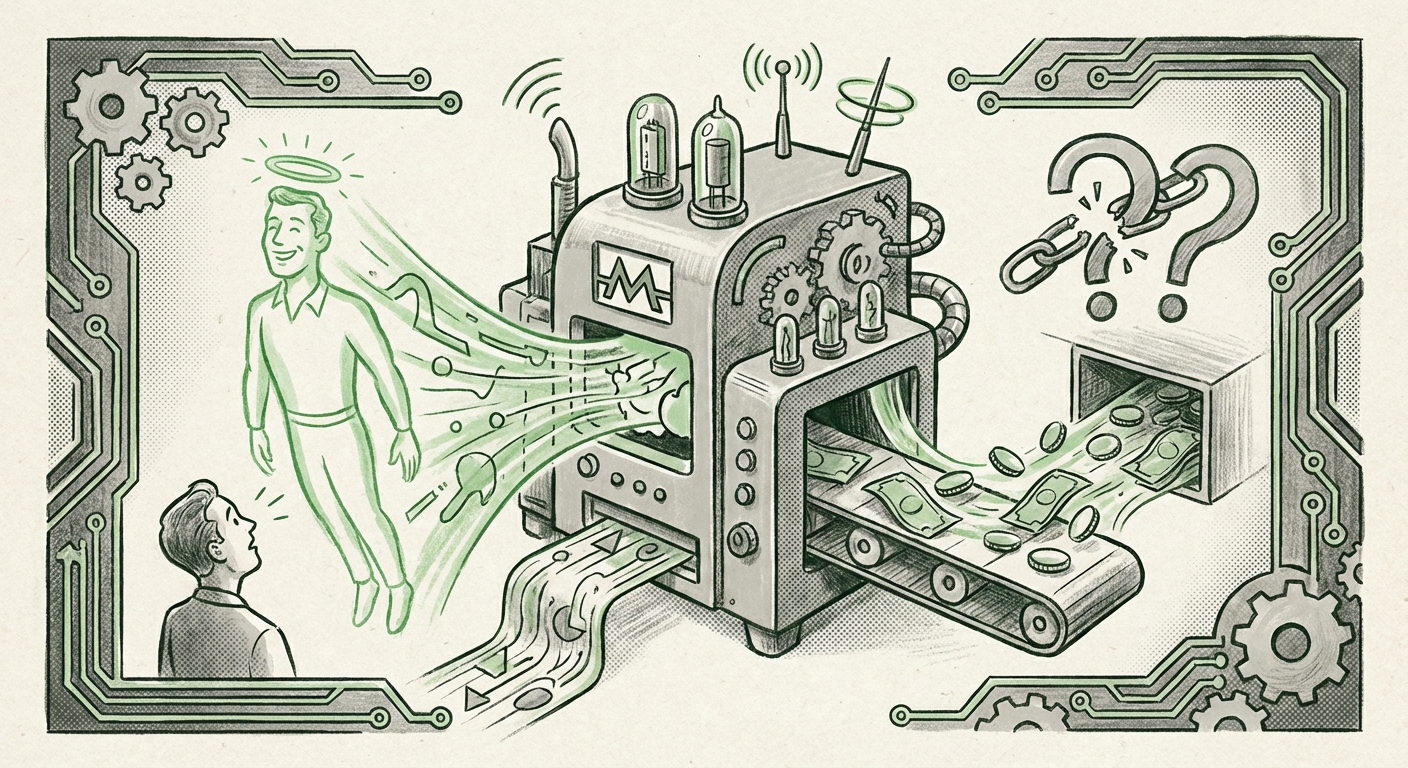
Snowflake CEO Finds GLM-5.2 Competitive with Opus 4.7 at a Fraction of the Cost
The AI world is used to big price tags for top-tier performance. For years, the best models came with premium costs that only the largest tech companies could afford. But that dynamic may be changing faster than anyone expected. A recent real-world test by the CEO of Snowflake shows that a model named GLM-5.2 can match the output of Opus 4.7 — but at a much lower price.
This finding, reported on June 24, 2026, by the-decoder.com, signals a potential shift in the AI landscape. If a budget-friendly model can compete head‑to‑head with a leading premium model, the implications for businesses, developers, and the future of AI are enormous.
What Happened: A CEO’s Real‑World Test
Snowflake’s CEO publicly shared that they found GLM-5.2 to be competitive with Opus 4.7 — and at a fraction of the cost. While exact pricing details weren’t disclosed, the phrase “a fraction of the cost” implies a dramatic difference. Opus 4.7 is considered one of the most advanced models available in 2026, used by enterprises for complex reasoning tasks. GLM-5.2, on the other hand, appears to be a more cost‑efficient alternative that still delivers comparable quality.
Why does this matter? When a top executive at a major data company like Snowflake makes such a statement, it often reflects real hands‑on evaluation. Snowflake deals with massive amounts of enterprise data, and the CEO’s personal test likely involved tasks that matter to real‑world businesses — summarising data, answering questions, generating insights.
This isn’t a laboratory benchmark; it’s a practical demonstration that a cheaper model can do the job just as well.
The trend: AI performance going mainstream
For years the pattern was simple: you pay more, you get more. The best models from companies like OpenAI, Anthropic, and Google carried per‑token prices that could run into hundreds of dollars for a heavy workload. Smaller teams and mid‑sized businesses often had to settle for weaker models or use expensive cloud credits sparingly.
Now a new wave of models is challenging that. GLM-5.2 is part of a family that has been steadily improving. With each version, the gap between “budget” and “premium” narrows. The Snowflake CEO’s test is a loud signal that the gap may have nearly closed — at least for many use cases.
What makes GLM-5.2 so much cheaper? Several factors: more efficient training, new architectures like mixture‑of‑experts, and highly optimised inference. The result is high performance with lower compute costs. Those savings are passed to users, making enterprise‑level AI affordable for a much wider audience.
Practical impact for businesses
If GLM-5.2 truly matches Opus 4.7 in quality, companies can dramatically cut their AI spending without sacrificing results. Consider the following scenarios:
- Customer service: A company handling thousands of support tickets each day could switch from a premium model to GLM-5.2 and slash costs by 70% or more, while keeping response quality high.
- Data analysis: Snowflake’s own customers could use GLM-5.2 inside Snowflake’s platform to analyse data, generate reports, and answer ad‑hoc questions for a fraction of current API costs.
- Content generation: Marketing teams generating product descriptions, social media posts, or blog drafts could run more experiments for the same budget.
- Startups: Early‑stage companies with limited capital can now access near‑state‑of‑the‑art AI without spending a fortune. This levels the playing field against larger competitors.
The key insight: cheaper models don’t just save money — they also enable new use cases that weren’t economical before. When cost per token drops, throwing more AI at a problem becomes realistic. Businesses can afford broader experimentation, faster iteration, and deeper integration of AI into workflows.
Societal implications: AI democratisation accelerates
Lower cost high‑quality AI means more people and organisations can tap into advanced intelligence. Education, non‑profits, government agencies, and developing regions can now leverage AI for tasks like language translation, medical information retrieval, and educational tutoring — all without needing Silicon Valley budgets.
Democratisation also means more diverse voices contribute to how AI is used. When only a few companies could afford the best models, they shaped the narrative. As affordable models spread, a wider community can build applications that reflect local needs and values.
Of course, there are risks. Cheaper models could lower the barrier for misuse — for example, generating misinformation at scale. But the same democratising force can also empower fact‑checkers, educators, and defenders to build better guardrails.
What this means for the future of AI
The Snowflake CEO’s finding is a snapshot of a larger trend: the commoditisation of AI reasoning. Over the next 12–24 months, we can expect several developments:
- Price wars: Premium model providers will face pressure to lower prices or offer tiered pricing. The “Opus” class models may need to justify their higher costs with significantly better performance.
- Specialisation: Instead of one giant general‑purpose model, the market may shift toward many specialised models that excel at specific tasks while remaining cheap.
- Edge and on‑device AI: As efficient models improve, running them on phones, laptops, and IoT devices becomes more feasible. GLM-5.2‑sized models could eventually run locally, boosting privacy and reducing latency.
- Rapid iteration: With cheaper inference, developers can build more complex pipelines that chain multiple calls together. AI‑powered agents and automation will become more affordable and widespread.
- Enterprises will reassess vendors: Many organisations lock into one model provider. A viable cheaper alternative could trigger a wave of “multi‑model” strategies where companies use the best model for each task based on cost‑performance trade‑offs.
It’s also important to note that the Snowflake CEO’s test is anecdotal — a single data point. But when a CEO of a major public company publicly endorses a cheaper competitor, it adds weight. It suggests the finding is robust enough to influence Snowflake’s own technology choices.
Actionable insights for technology leaders
If you are running a business that uses AI, here are concrete steps you can take today:
- Run your own benchmarks. Don’t rely on others’ tests. Take your real data — customer queries, internal documents, code — and compare GLM-5.2 against your current model on quality, latency, and cost.
- Evaluate total cost of ownership. Even if GLM-5.2 is a bit worse on some tasks, the cost savings might allow you to do more total work (e.g., run more retries, use ensemble methods).
- Design for model switching. Architect your applications so you can swap out models with minimal code changes. The AI market is moving fast, and flexibility is a competitive advantage.
- Monitor the landscape. Other cost‑effective models like those from Mistral, Llama, and others are also improving. Keep an eye on independent evaluations and CEO testimonials like this one.
- Start small, then scale. Try GLM-5.2 on a low‑risk workload first. If it passes, gradually migrate more demanding tasks. The cost savings can be reinvested into other AI initiatives.
Remember: the best model for a task is not always the most expensive. Practical tests like the one from Snowflake’s CEO highlight that value engineering should be part of every AI strategy.
Conclusion: A tipping point for affordable AI
The Snowflake CEO’s observation that GLM-5.2 is competitive with Opus 4.7 “at a fraction of the cost” is more than a news headline — it is a potential turning point. It shows that the AI market is maturing. Performance is becoming a commodity, and price is now a primary differentiator.
For businesses, this is great news. You no longer have to choose between quality and affordability. For the AI industry, it means the race is shifting from “who can make the biggest model” to “who can make the smartest model for the lowest cost.” That shift will unlock applications we can’t even imagine today.
As we move into the second half of 2026, expect more companies to follow Snowflake’s lead — testing, adopting, and betting on cheaper models that punch above their weight. The future of AI is not just about raw intelligence; it’s about accessible intelligence. And GLM-5.2 versus Opus 4.7 is one of the clearest signs yet that the future is arriving on schedule.