AI Programmed Nonstop for 19 Days on a $2,600 Task: Why This Changes the Future of Software
Imagine asking an intern to work on a single, incredibly complex programming problem. Now imagine that intern doesn't sleep, doesn't take coffee breaks, and works relentlessly for 19 straight days. Finally, imagine the bill for that internship comes to $2,600.
That is no longer a hypothetical. It is the reality of the state of AI in 2026. A single AI model recently did exactly that: it programmed nonstop for 19 days on a single task from the MirrorCode benchmark, and it cost $2,600 to run. This isn't just a line item on an expense report. It is a profound glimpse into the future of how software will be built—and who (or what) will build it.
The "Digital Factory Worker" Has Arrived
For years, we have thought of AI as a helper. You ask a question, it gives an answer. You ask for a code snippet, it writes 20 lines. You hit "enter," and the conversation is over. This new event throws that model out the window.
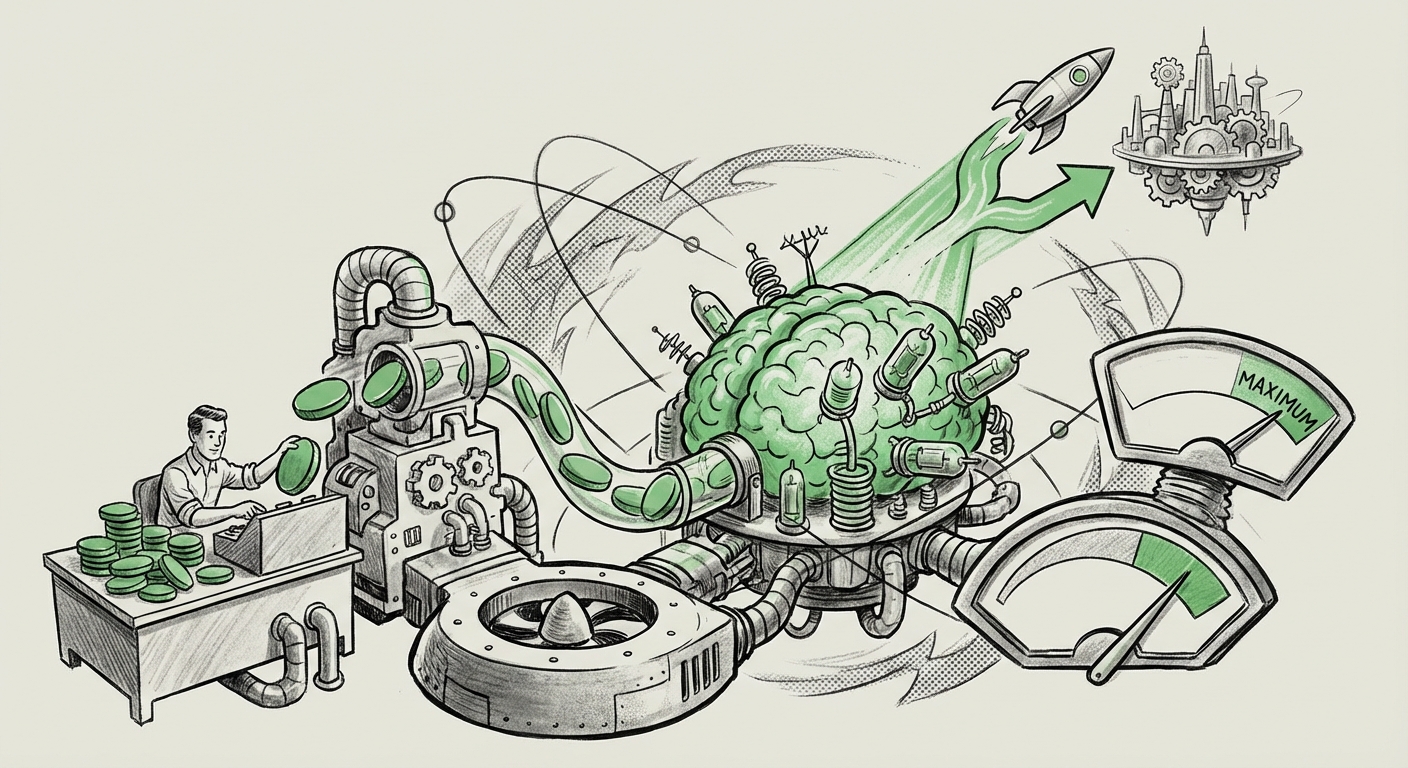
Working for 19 days on a single MirrorCode task means the AI wasn't just generating one function. It was acting like a persistent software engineer. It was planning, coding, debugging, re-planning, and pushing through long nights and weekends. The most important word here is not "AI" or "coding." It is "nonstop."
MirrorCode is a well-known benchmark in the AI world. It does not test simple text generation. It tests whether an AI can solve real-world software engineering problems. This means editing multiple files, understanding complex codebases, fixing bugs that require deep logical reasoning, and writing tests that actually pass. To succeed on MirrorCode is to prove that an AI can handle the messy, sprawling reality of a production software project. To do it for 19 days straight proves that an AI can do what humans do: stick with a hard problem until it is solved.
From Chatbot to Colleague
This shift changes how we think about AI's role in the office. A chatbot is like a vending machine: you put in a prompt, and you instantly get a response. But an AI that works for 19 days is like a factory worker. It shows up, punches the clock, and grinds away at the same task for the entire shift.
For businesses, this is the real transformation. We are moving from AI as a tool to AI as a worker. It has endurance. It has focus. And it does not get bored.
The $2,600 Question: Is This Cheap or Expensive?
Let’s talk about money. The run cost $2,600. At first glance, that sounds like a lot of money for a single programming task. But let’s do the math.
A human software engineer working for 19 days straight (152 hours) at a standard freelance rate of $100 per hour would cost over $15,000. Even a junior developer working for minimum wage would cost more than $2,600 over that time period. Plus, a human needs sleep, weekends, and supervision. The AI does not.
But money is only half the equation. The other half is time. The AI took 19 days. A talented human might have solved the same problem in 3 days. Does that mean the AI is slower? Yes, in raw speed. But here is the catch: was that human working on that problem exclusively for 3 days? Probably not. In a real office, context switching, meetings, and interruptions mean that a "3-day task" often takes 2 weeks of calendar time.
The Hidden Cost of Human Attention
The true value of a $2,600, 19-day AI run is not that it is cheaper than a human per hour. It is that it is cheaper than a human per unit of dedicated attention. The AI does not multitask. It does not get distracted. It does not check email. It lives inside the problem.
This suggests a new economic model for software development. For $2,600, you can buy an "attention span" that lasts 19 days. For a startup or a cash-strapped team, that is an incredible bargain. It means you can afford to have a relentless worker grinding away on your hardest bug while your human team focuses on creative strategy and customer interaction.
What This Means for Your Business (Beyond the Hype)
If you are a CTO, a product manager, or a business owner, you need to start thinking about the type of problems you can now solve. This event unlocks a specific class of tasks that were previously too expensive or too boring for humans to handle.
1. Technical Debt Reduction
Every company has a "code graveyard." It is the old, messy code that everyone is afraid to touch. Maybe it is a legacy system written in an old language. Maybe it is a module with no tests. Cleaning this up is hard, boring, and risky. Humans hate doing it. But an AI that works for 19 days straight? It will happily refactor, rewrite, and document that code. It does not care how boring the task is. For the first time, "cleaning up technical debt" becomes a simple cost calculation. Do you have $2,600? Then you can hire a digital worker to scrub your data and clean your code.
2. The "Impossible" Bug
Every once in a while, a bug appears that stumps the entire engineering team. It is a race condition, a memory leak, or an edge case that only happens once a month. Humans have a hard time with these because they require hours of staring at logs and stepping through code. An AI that works for 19 days can simulate thousands of scenarios, run millions of test cases, and trace the execution path until it finds the culprit. This event shows that AI can now do the "grunt work" of debugging at a scale that humans simply cannot match.
3. Long-Horizon Projects
Most AI tools today are designed for "short tasks": write an email, summarize a document, generate a snippet. This event shatters that ceiling. It proves that AI can manage long-horizon projects that require sustained logical consistency over hundreds of hours. Imagine asking an AI to migrate a database from an old schema to a new one. Or asking it to rewrite the testing framework for a major application. These are tasks that take weeks, not minutes. Businesses can now budget for "AI project labor" in the same way they budget for human project labor.
The Technical Breakthrough: Staying Smart for 19 Days
Let’s look under the hood for a moment. Why is this so difficult? Why hasn’t this happened before?
The biggest challenge for an AI that works for a long time is context. If an AI reads a codebase on Day 1, learns its structure, and makes a change, it must remember that change on Day 19. It must not contradict itself. It must remember the design decisions it made two weeks ago. This is extremely hard for current AI models, which often suffer from "forgetfulness" or "hallucination" when the prompt gets too long.
To work for 19 days, the AI must have a robust system for storing and recalling its own work. It probably uses some form of external memory, like a file system or a database, to keep track of its progress. It must also be able to re-read its own code and correct itself if it makes a mistake. The fact that it could do this for 19 days without human intervention is a massive engineering achievement.
Self-Correction and Stability
The AI essentially had to act as its own project manager. It had to decide what to work on next. It had to test its own code. It had to recognize when it was stuck and try a different approach. This is very close to the definition of "general intelligence." It is the difference between a robot that can fetch a ball (simple) and a robot that can play a full game of soccer without stopping for 19 days (extremely complex).
What Happens When the AI Works for 100 Days?
If 19 days is possible, 100 days is inevitable. The cost of inference (the "thinking" cost of AI) is dropping every year. It is following a curve similar to Moore's Law. What costs $2,600 today might cost $260 in two years, and $26 in four years.
Think about what that enables. If you can hire an AI for $260 to work on a problem for 19 days, you would probably just leave it running all the time. You might have a "background AI" that is permanently assigned to your company's codebase. It would file bug reports, suggest improvements, and fix issues as they arise, all without being asked. This is the path to the "self-healing" codebase.
The New Role of the Human Developer
Does this mean human developers are obsolete? Absolutely not. But their job changes.
In the future, a human developer's most valuable skill will be asking the right questions and reviewing the work of the AI. The human becomes an architect and a quality assurance manager. They set the vision. The AI does the heavy lifting of writing the actual lines of code.
Consider the following shift in job roles:
- Before: Developer writes code, tests it, and deploys it.
- After: Developer defines the problem, hands it to the AI, and reviews the AI's pull request after 19 days.
Trust, but Verify
The "19-day run" also raises a big question: What if the AI goes down the wrong path? If a human makes a mistake, they realize it within an hour. If an AI makes a mistake on Day 2 and doesn't notice until Day 18, that is a lot of wasted time and money. The future of this technology depends on building robust checkpoints and monitoring systems. Humans will need to "check in" on the AI regularly, not to micromanage, but to ensure the AI is still heading in the right direction.
Conclusion: The Dawn of the "Grind" Economy
The event of an AI programming nonstop for 19 days on a single task costing $2,600 is more than just a headline. It is a proof-of-concept for a new class of digital labor. We are entering the era of the "grind AI"—agents that don't just answer questions, but wrestle with complex, sprawling problems over days and weeks. They do not get tired. They do not get bored. They just work.
For businesses, the implication is simple: You now have a new type of worker available to you. This worker is not perfect. It is slow. It can make mistakes. But it is relentless and it is cheap. The smartest companies will start experimenting today. They will take one messy, boring, difficult coding problem and hand it to an AI for 19 days. They will learn the quirks of this new worker. They will learn how to review its work. And they will gain a massive competitive advantage over companies that are still waiting for the technology to mature.
The question is not "Can AI code?" We knew that. The question is "What 19-day problem are you willing to finally solve?"