The Laboratory That Chooses Its Next Experiment: How Self-Driving Labs Are Revolutionizing Scientific Discovery
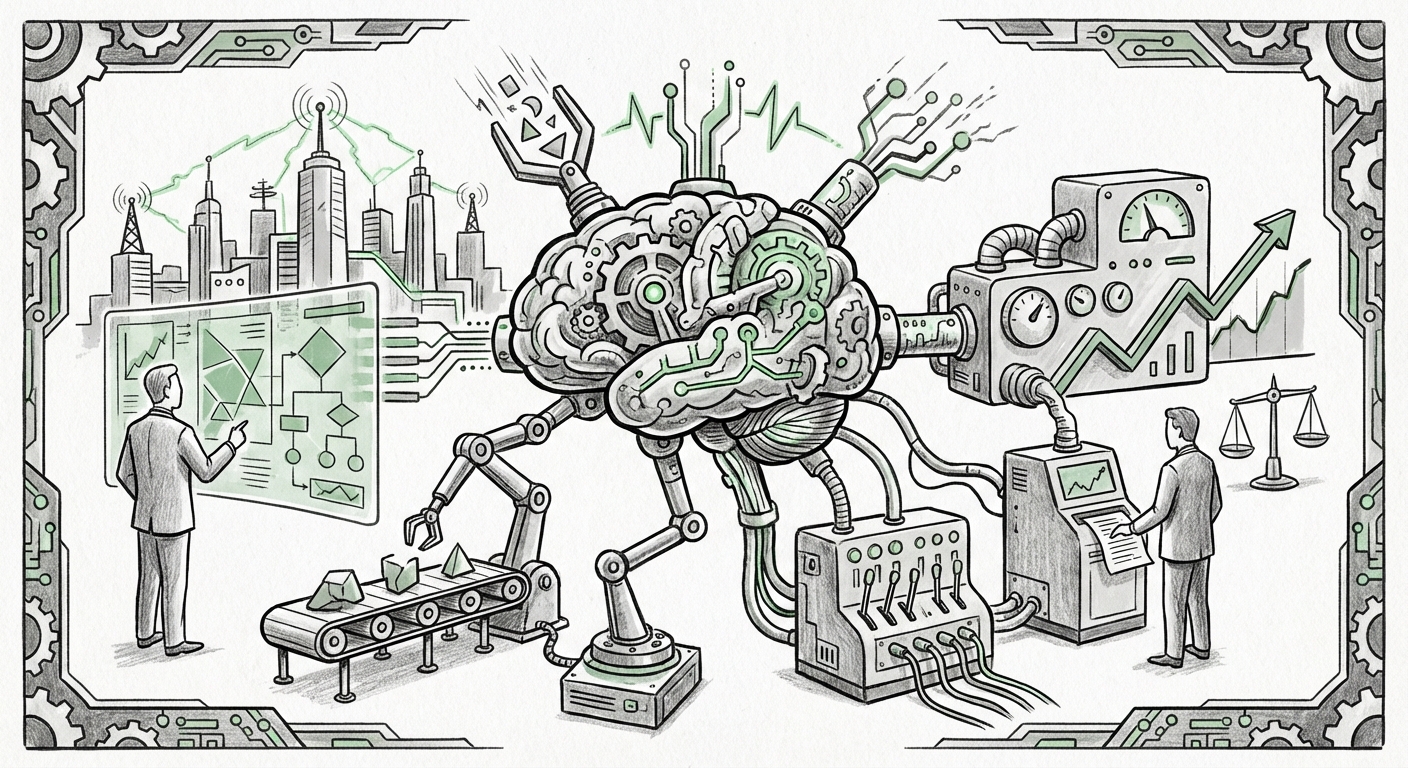
Imagine a laboratory that never sleeps, never gets tired, and most importantly, decides on its own what experiment to run next. This is not science fiction. It is a technology trend that is reshaping the way we think about scientific research. A self-driving lab uses artificial intelligence to plan, execute, and learn from experiments without needing a human at the helm. It is the lab that chooses its own next experiment.
This concept is part of a larger shift toward autonomous experimentation. Instead of relying on a scientist's intuition to decide what test to run, the AI looks at the data from previous experiments and figures out the most valuable experiment to do next. It runs the experiment, gathers the results, learns from them, and then picks the next one. Over time, this cycle speeds up discovery by huge amounts.
In this article, we will look at what self-driving labs are, how they work, why they matter for the future of AI, and what businesses and regular people need to know about them. Whether you are a scientist, a business leader, or just someone curious about the future, this story affects you.
What Exactly Is a Self-Driving Lab?
A self-driving lab is a combination of three big things: robotic hardware that can physically perform experiments, AI software that can analyze results and decide what to try next, and a feedback loop that lets the system keep improving without human help. The idea is not new, but advances in AI have made it much more powerful.
Think of it like a self-driving car. A self-driving car uses sensors to see the road, AI to decide where to turn, and wheels to move. A self-driving lab uses sensors to measure results, AI to decide what experiment to run, and robots to actually do the experiment. The intelligence is in the decision-making, not just in the automation.
Early versions of automated labs mostly just did the same thing over and over, like putting samples into machines. But a self-driving lab does something smarter. It learns from every result. It changes its mind based on data. It gets better over time.
How AI Powers the Laboratory That Chooses Its Next Experiment
At the heart of every self-driving lab is an AI system that acts like a kind of digital scientist. This AI has a few important jobs.
First, it keeps track of everything that has been tried before. It stores results, measurements, and even failed experiments. This is important because in science, failures are often just as useful as successes. They tell you what does not work.
Second, the AI uses a technique called active learning to decide what experiment to try next. Instead of just guessing randomly, it picks the experiment that will give it the most new information. It might choose to try something that is risky but could reveal something new. Or it might choose to test a theory it is not sure about yet. This is the "chooses its next experiment" part of the idea.
Third, the AI judges its own work. After each experiment, it compares what it expected to happen with what actually happened. It updates its understanding of the science. Over many cycles, the AI builds a mental model of how the system works.
Key point: The AI does not replace scientists. It does the boring, repetitive work of running many small experiments. Scientists still ask the big questions and design the overall system. But the AI does the heavy lifting of exploring all possible answers.
Why This Matters for the Future of AI
Self-driving labs are not just a cool tool for scientists. They are a big step forward for artificial intelligence itself. Here is why.
AI learns from real-world data, not just from the internet. Most AI today is trained on text and images scraped from the web. That data is useful, but it is limited. A self-driving lab generates its own data from real physical experiments. This teaches AI about the real world, not just about what people have written online. This is a huge deal for the future of AI because it means AI can learn about chemistry, biology, and materials science directly from nature.
AI becomes a partner in discovery. In a self-driving lab, the AI is not just a tool. It is a collaborator. It suggests and runs experiments. It surfaces surprising results. It speeds up the process of finding new materials, drugs, or chemical reactions. This changes the relationship between humans and machines. We are used to AI being a calculator or a search engine. Now, AI is becoming a research assistant that actually does the work.
AI gets better at reasoning under uncertainty. Science is full of unknowns. A self-driving lab has to make decisions when it is not sure what will happen. This pushes AI to develop better reasoning skills. The AI has to weigh risks, estimate probabilities, and plan ahead. These are the same skills needed for any advanced AI system of the future.
Practical Implications for Businesses
If you run a business that depends on research or product development, self-driving labs are going to change the game. Here are some ways they will matter.
Faster Product Development
Instead of spending months testing new materials or formulas, a self-driving lab can do the same work in days or weeks. This is huge for industries like pharmaceuticals, battery manufacturing, paints and coatings, food science, and cosmetics. Anywhere you need to mix ingredients and test the results, a self-driving lab can speed things up.
Lower R&D Costs
Robots are getting cheaper. AI software is often open-source or low-cost. The biggest cost in research is usually the highly skilled scientists. A self-driving lab amplifies what those scientists can do. Instead of spending time running routine tests, they can focus on bigger problems. That saves money and makes the whole team more productive.
More Reproducible Science
One huge problem in research today is that many experiments are hard to repeat. Different labs get different results. A self-driving lab runs experiments exactly the same way every time. It keeps perfect records. So when you find something that works, you can trust it. For businesses, this means fewer wasted months chasing results that turn out to be false.
Actionable insight: If your business involves any kind of formulation or testing, now is the time to explore self-driving lab technology. Start with a small project. Pick one simple experiment that you run over and over. Automate it with AI. Learn the process. Then scale up.
What This Means for Society
The effects of self-driving labs will reach far beyond individual companies. They will change how science is done and who gets to do it.
Faster cures and better materials. The most obvious benefit is that we will find new medicines, better solar panels, stronger materials, and cleaner chemical processes much faster. A self-driving lab can try thousands of combinations while a human lab runs a few dozen. That brute-force search ability can lead to breakthroughs that would take decades otherwise.
Democratizing science. Not every university or small company can afford a huge team of PhD scientists. But a self-driving lab can let a smaller team do big science. A startup with one good idea and access to an automated lab could compete with a giant corporation. This could spread innovation across the globe, not just in rich countries.
New risks and ethical questions. Faster discovery is not always good. Self-driving labs could be used to make new drugs of abuse, dangerous chemical weapons, or materials that harm the environment. We need rules and safeguards. The same AI that finds a cure could also find a poison. Society will need to think carefully about who controls these labs and what they can be used for.
Jobs will change. Some lab technician jobs will be automated. But new jobs will appear: AI trainers who teach the system, data analysts who interpret results, and systems integrators who keep the robot and AI working together. The human role shifts from doing to designing, from running experiments to deciding which questions to ask.
How Self-Driving Labs Work: A Simple Explanation
If you want to understand how the lab that chooses its own experiment actually operates, think of it as a cycle.
Step 1: The AI has a goal. Maybe it wants to find the strongest glue, the best battery electrolyte, or the most effective drug molecule. The goal is set by the human scientist.
Step 2: The AI looks at its memory. It checks what experiments have been done already. What worked? What did not? Where is there the most uncertainty?
Step 3: The AI picks the next experiment. It uses math to choose the test that will give it the most valuable information. It does not just try random things. It aims to reduce uncertainty as fast as possible.
Step 4: Robots do the experiment. Robotic arms, pipettes, and machines mix chemicals, apply heat, measure strength, or test reactions. The AI commands the hardware automatically.
Step 5: The AI learns from the result. The outcome goes into its memory. The AI updates its understanding of the problem. It then loops back to Step 2 and picks the next best experiment.
Over dozens or hundreds of cycles, the AI narrows in on the best solution. It finds answers faster than any human could because it never forgets, never gets bored, and always picks the most informative test.
Real-World Uses Today and Tomorrow
Self-driving labs are already being used in a few areas, and the number is growing fast.
- Pharmaceutical research: Finding new drug candidates by testing how different molecules interact with proteins.
- Materials science: Discovering new alloys, polymers, or battery materials with ideal properties.
- Chemical synthesis: Finding the best conditions to make a specific chemical, like the right temperature, pressure, and catalysts.
- Agriculture: Testing different fertilizer formulas or growth conditions for crops.
In the future, self-driving labs could be used for even bigger challenges. Imagine a lab that tries to invent a new type of plastic that biodegrades in months, or a lab that searches for a new type of solar cell that is cheap and efficient. The same technology could one day help us design new materials for building on Mars or cleaning up pollution in the ocean.
Challenges and Limitations
Self-driving labs are not magic. They come with real challenges that must be solved.
Cost and complexity. Setting up a self-driving lab requires expensive robots and software. It takes a team of experts to get everything working together. For many small labs, the upfront cost is still too high.
Reliability. Robots break. Sensors fail. Experiments go wrong. A self-driving lab must be able to handle problems without human help. That is harder than it sounds.
AI limitations. The AI is only as good as its models. If the AI does not understand the science well enough, it might choose experiments that are not useful. It can get stuck or give misleading results.
Data overload. A self-driving lab generates huge amounts of data. Storing, organizing, and making sense of that data is a challenge. Without good data management, the AI cannot learn effectively.
But these challenges are being solved. Costs are dropping. AI is improving. And more and more researchers are sharing their designs and software, making the technology accessible to more people.
Actionable Insights for Your Business
If you are ready to think about using self-driving labs in your own work, here are some steps you can take right now.
Start small and learn. Pick one simple experiment that you do regularly. Look for a way to automate it with a robot. Add AI that can suggest small changes to the recipe. Run the cycle a few times. See what you learn.
Invest in data infrastructure. A self-driving lab runs on data. If your current experiments are not recorded in a clean, usable way, fix that first. Good data is the foundation of everything.
Train your people. Your team will need new skills. They need to understand AI, data analysis, and automation. Start training now so you are ready when the technology is ready for prime time.
Watch the trends. Keep an eye on companies and universities that are leading in self-driving labs. Read their papers. Watch their talks. The field is moving fast, and you do not want to be left behind.
Conclusion: The Lab That Thinks for Itself
The idea of a laboratory that chooses its own next experiment is not just a clever phrase. It describes a real and powerful shift in how science is done. By combining AI with robotics, we are creating systems that can explore the physical world at speeds humans could never match.
The future of AI is not only about better chatbots or smarter search engines. It is about machines that can interact with reality, learn from their own actions, and make decisions that lead to genuine discoveries. Self-driving labs are one of the most exciting examples of this new kind of AI.
For businesses, the message is clear: this technology is coming, and it will change the way we invent, test, and develop new products. The sooner you start understanding it, the better positioned you will be to use it. For society, self-driving labs promise faster solutions to big problems like disease, energy, and pollution. But they also bring new risks that we must handle carefully.
One thing is certain. The lab that chooses its own experiment is here to stay. It will push the boundaries of what we know and how fast we can know it. That is a future worth getting excited about.