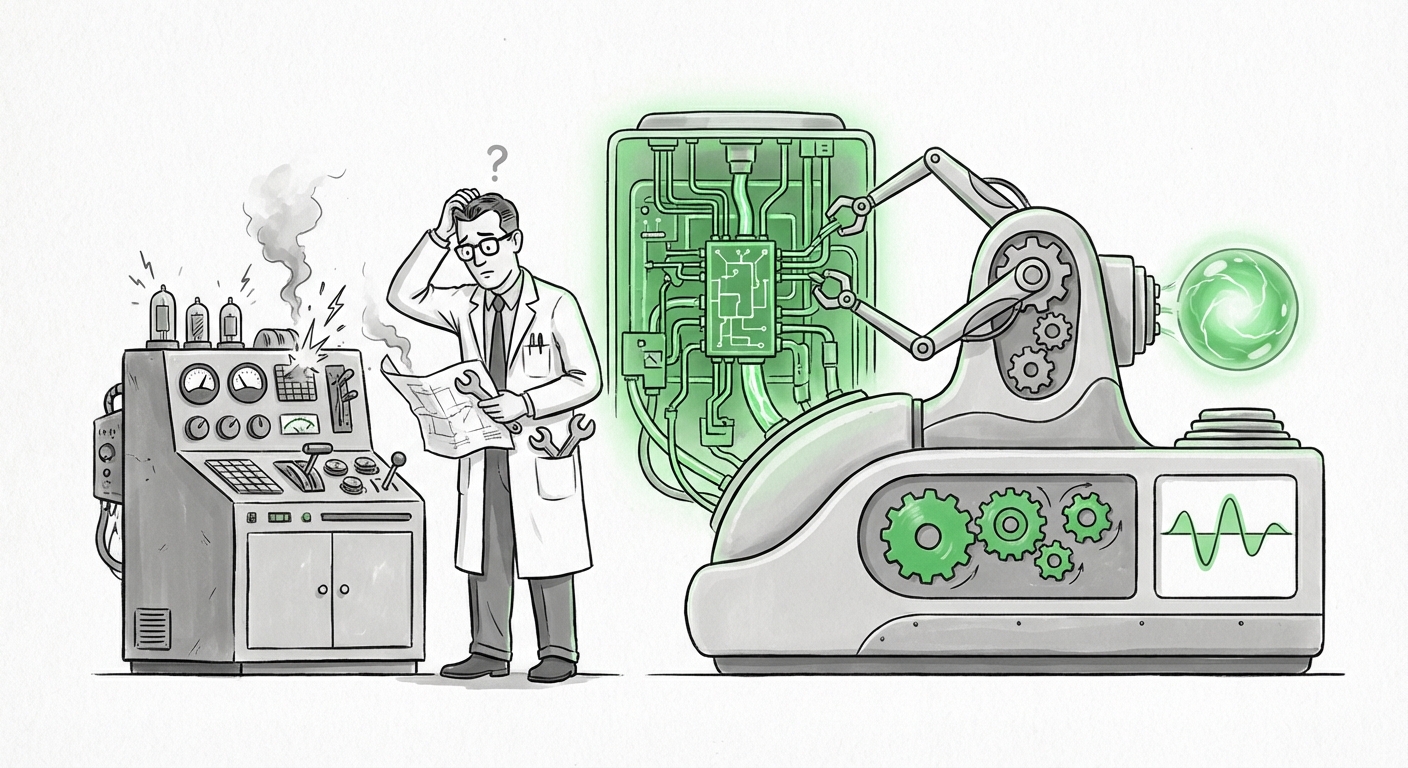
Baidu's Unlimited OCR: How 'Human-Like Forgetting' Lets AI Process Dozens of Pages at Once
For decades, optical character recognition (OCR) has been a workhorse technology—useful, reliable, but fundamentally limited. Traditional OCR reads documents one page at a time, struggling with long or complex files because its memory fills up quickly. But a breakthrough from Baidu is rewriting that rulebook. By treating memory like human forgetting, Baidu's "Unlimited OCR" can process dozens of document pages in a single pass, opening up new possibilities for everything from legal document review to historical archive digitization.
This isn't just a faster scanner. It's a fundamental rethink of how AI manages information. And it points to a future where machines don't just compute—they remember the way we do, forgetting what's trivial and retaining what matters.
What Is Unlimited OCR—And Why Does It Matter?
OCR converts images of text—think scanned documents, photographs of receipts, or screenshots—into machine-readable text. It's the invisible engine behind everything from searchable PDFs to automated data entry. But traditional OCR has a hard bottleneck: memory. Each page consumes computing resources, and processing a multi-page document usually means tackling one page at a time, stitching results together afterward.
Baidu's "Unlimited OCR" shatters that bottleneck. By borrowing a core principle from neuroscience—how human brains selectively forget—the system can process dozens of pages in one continuous pass. Instead of trying to remember every pixel of every page, it builds a dynamic "memory" that prioritizes what's important and lets go of what isn't. The result is a system that doesn't slow down as documents get longer.
Think of it this way: a traditional OCR is like a librarian who must read every word of every book out loud before cataloging it. Unlimited OCR is like a librarian who skims, notes key themes, and only remembers the shelf location and summary—instantly ready for the next book.
The Brain-Inspired Breakthrough: Memory as a Filter
The core innovation here is the shift from "store everything" to "store what matters." This mirrors how human memory works. You don't remember every detail of yesterday's commute. You remember the shortcut you discovered, the traffic jam, or the interesting podcast. Your brain forgets the mundane to free up space for the meaningful.
Baidu's system applies a similar principle to OCR. As it processes page after page, it builds an internal representation that compresses repetitive or irrelevant details—margins, headers, page numbers—while preserving text, layout structure, and semantic meaning. This selective memory means the system can maintain context across dozens of pages without running out of resources.
This is a significant departure from traditional OCR architectures, which treat each page as an independent task. Those systems lose cross-page context—things like a table that spans two pages, a footnote that continues, or a document theme that develops over multiple sheets. Unlimited OCR keeps that thread alive.
What This Means for the Future of AI Architecture
Baidu's approach is part of a larger trend in AI: moving away from brute-force computation toward smarter, human-inspired memory management. For years, the mantra in AI was "more data, more compute, more memory." But that approach hits physical and economic limits. Even the most powerful GPUs can't scale indefinitely.
The future of AI, I believe, will look more like the human brain—not because it's perfect, but because it's efficient. The brain uses about 20 watts of power. A single AI training run can use megawatts. By adopting forgetting mechanisms, AI systems can dramatically reduce computational waste.
We're already seeing this in other areas. Attention mechanisms in transformer models (the "T" in GPT) prioritize certain tokens over others. Sparse memory architectures in systems like Google's Pathways allow models to retrieve only relevant past information. Forgetting gates in neural networks help decide what to keep and what to discard. Baidu's Unlimited OCR is a practical, real-world application of these same principles—and it works.
For AI Developers and Engineers
If you're building AI systems that process long sequences—whether text, video, or sensor data—the lesson is clear: don't assume you need infinite memory. Design for selective retention. Build priority filters that identify what matters in your domain. Your models will run faster, cost less, and often perform better because they aren't distracted by noise.
Business Applications: From Legal to Logistics
Unlimited OCR isn't just a neat technical trick. It has direct, practical implications for any business that handles documents. Let me walk through a few scenarios.
Legal and Compliance
Legal firms review thousands of pages during discovery. Traditional OCR can handle them, but slowly—and often requires splitting documents into single-page chunks. Unlimited OCR processes entire contracts, depositions, and evidence files in one go. It can track clauses across pages, maintain context for redactions, and flag inconsistencies that span multiple sheets. For a firm billing by the hour, that speed is money saved.
Healthcare
Medical records are notoriously long and fragmented. A single patient file might include lab results, doctor's notes, imaging reports, and insurance forms spanning months. Unlimited OCR could digitize an entire patient record in one pass, preserving the sequence of care. Search and retrieval become instant. For hospitals still running on paper or legacy systems, this is transformative.
Finance and Accounting
Think of annual reports, tax filings, or audit trails—documents that can run hundreds of pages. Unlimited OCR lets finance teams digitize and analyze these documents without the usual page-by-page grind. It becomes possible to search across an entire document for specific figures, flags, or compliance issues. For global firms dealing with regulatory filings, the efficiency gain is enormous.
Libraries and Archives
Historical societies, university libraries, and government archives hold millions of pages of documents, newspapers, and manuscripts. Many are brittle—handling them damages them. OCR is the only way to make them searchable without physical contact. Unlimited OCR can process entire bound volumes in one pass, reducing handling time and preserving fragile originals.
Societal Implications: Democratizing Document Intelligence
Beyond business, Unlimited OCR has a societal dimension. Access to information is a cornerstone of opportunity. Yet vast amounts of human knowledge remain trapped in scanned images and PDFs that aren't searchable or machine-readable. This is especially true for non-English languages, historical documents, and materials from developing regions.
By making OCR faster and cheaper, Baidu's approach could help unlock these information silos. Imagine a small non-profit in Southeast Asia digitizing land records for a rural community. Or a university in Africa making historical newspapers searchable for the first time. Or a journalist sifting through thousands of leaked documents to find the one smoking gun. Unlimited OCR reduces the time and computing power needed—lowering the barrier to entry.
Of course, with great power comes great responsibility. Faster OCR also means faster surveillance, faster data harvesting, and faster erosion of privacy. As OCR becomes more powerful, we need safeguards. But the potential for good is enormous.
How Unlimited OCR Changes the AI Landscape
Let me step back and look at the bigger picture. Baidu's work on Unlimited OCR is a signal of where AI is heading. Here are three major shifts I see:
1. From Stateless to Stateful Processing
Traditional AI systems treat each input as independent. That's simple but wasteful. The future is stateful—systems that maintain context across inputs, remembering what matters and forgetting what doesn't. Unlimited OCR is a stateful system, and it points the way for chatbots, virtual assistants, and automated workflows to become more coherent and efficient.
2. From Fixed Memory to Adaptive Memory
Current AI memory is usually a fixed-size buffer—once it fills, you lose context. Adaptive memory, inspired by human forgetting, adjusts its capacity dynamically. Important things stay; trivial things go. This is far more scalable and cost-effective. Expect to see adaptive memory become a standard feature in future AI models.
3. From Hardware-Limited to Algorithm-Limited
For years, AI progress meant better hardware: more GPUs, more memory chips. But that's slowing down. The next leaps will come from better algorithms—smarter ways to use the hardware we already have. Unlimited OCR demonstrates that clever software can achieve what brute-force hardware cannot. That's an encouraging sign for a field that sometimes feels addicted to compute.
Actionable Insights for Business Leaders
If you're a decision-maker reading this, here's what you can do:
- Audit your document workflows. Identify processes that involve scanning, OCR, or digitization of multi-page documents. Ask whether page-by-page processing is a bottleneck. Unlimited OCR could cut that time by a factor of ten or more.
- Look for AI that remembers context. When evaluating AI vendors, ask how they handle long documents or extended conversations. The ones using memory-filtering techniques will give you better results.
- Invest in digitization. The cost of OCR is dropping. The value of accessible data is rising. Now is the time to digitize paper archives, legacy files, and historical records. Technologies like Unlimited OCR make this more practical than ever.
- Consider the human angle. Your employees waste hours on repetitive document handling. Automating OCR with smarter AI frees them for higher-value work. That's not just an efficiency gain—it's a morale boost.
The Road Ahead: What's Next for Unlimited OCR
Baidu's Unlimited OCR is still early, but it's already showing what's possible. The next logical step is to extend this approach to other modalities—think video, audio, or sensor data. A system that "forgets" irrelevant video frames could process hours of footage in minutes. A speech recognition system that forgets background noise could transcribe noisy meetings with high accuracy.
We may also see this technology integrated into edge devices—phones, tablets, and scanners that do OCR locally without sending data to the cloud. Combined with selective memory, these devices could handle entire document stacks on a single battery charge.
Another exciting direction is self-supervised learning: let the system learn what to forget by itself, rather than relying on human-designed rules. That would make Unlimited OCR adaptable to any domain without manual tuning.
A Final Thought: The Wisdom in Forgetting
We often think of forgetting as a failure—a glitch in the system. But forgetting is essential to intelligence. Without it, your mind would be a cluttered attic, not a sharp workshop. Baidu's Unlimited OCR embraces that truth. It doesn't just process documents; it processes them like a human would—skimming, remembering, and letting go.
That's a powerful lesson for the entire AI field. The smartest system isn't the one that remembers everything. It's the one that knows what to forget.
As Unlimited OCR finds its way into products and services, expect to see document processing that's not just faster, but smarter—able to understand entire documents rather than just pages. For businesses, for researchers, and for anyone who works with information, that's a future worth waiting for.