GPT-4 Ruled for a Year – Now Top AI Models Last Just 7 Weeks. Here's What's Next.
Not long ago, the release of a major AI model was a once-a-year event. When GPT-4 arrived, it sat unchallenged at the top for an entire twelve months. Businesses built entire workflows around it. Consultants wrote playbooks for it. Everyone assumed that pace was normal.
It was not. That era is already over.
Today, the landscape has flipped so dramatically that the current top models barely hold the crown for seven weeks before being overtaken. The shelf life of state-of-the-art intelligence has collapsed by roughly 85 percent. If you blinked, you probably missed three new leaders.
This shift is not just a footnote in tech history. It changes everything about how companies should invest in AI, how developers build applications, and how society prepares for what comes next. Let's break down what happened, why it matters, and what you should do about it.
The Great Compression: From Yearly Dominance to Weekly Churn
To understand how radical this change is, look back at the timeline. GPT-4 launched and held the benchmark crown for roughly 52 weeks. Competitors were still catching up. Products were designed around its specific capabilities. There was time to optimize, to train teams, to build moats.
Fast-forward to today. Model releases come in waves so fast that a leaderboard-topping system in June can look mid-pack by August. The average reign of a top-tier model is now under two months. Some have held the top spot for only a matter of weeks before a new architecture, a new training technique, or a new dataset pushed them aside.
What caused this compression? Several forces collided at once.
First, research labs learned how to iterate faster. Techniques like mixture-of-experts, improved reinforcement learning from human feedback, and synthetic data generation shortened the training cycle. What once took eighteen months now takes six.
Second, competition exploded. What was a two-horse race became a field of dozens. Major technology companies, well-funded startups, and open-source communities all began releasing capable models in rapid succession. Nobody gets a free year anymore.
Third, benchmarks themselves became better and more granular. With more ways to measure performance, every new model finds a niche where it excels. The idea of a single "best" model is becoming obsolete.
What This Means for the Future of AI
If models rotate every seven weeks, the entire concept of "the best AI" changes. It is no longer a fixed point. It is a moving target. And that has profound implications for where the technology is heading.
Specialization Will Replace Generalization as the Goal
When you cannot count on any single model staying on top, the smart strategy is to stop chasing the general champion. Instead, the future belongs to models that excel at specific tasks. A coding model that is best at Python refactoring. A medical model that dominates diagnosis but cannot write a poem. A legal model that knows every jurisdiction inside out.
We are already seeing this. The era of one model to rule them all is giving way to a world of many models, each optimized for a narrow domain. Companies will not ask, "Which model is best?" They will ask, "Which model is best for this exact job right now?"
Model Switching Becomes a Core Infrastructure Capability
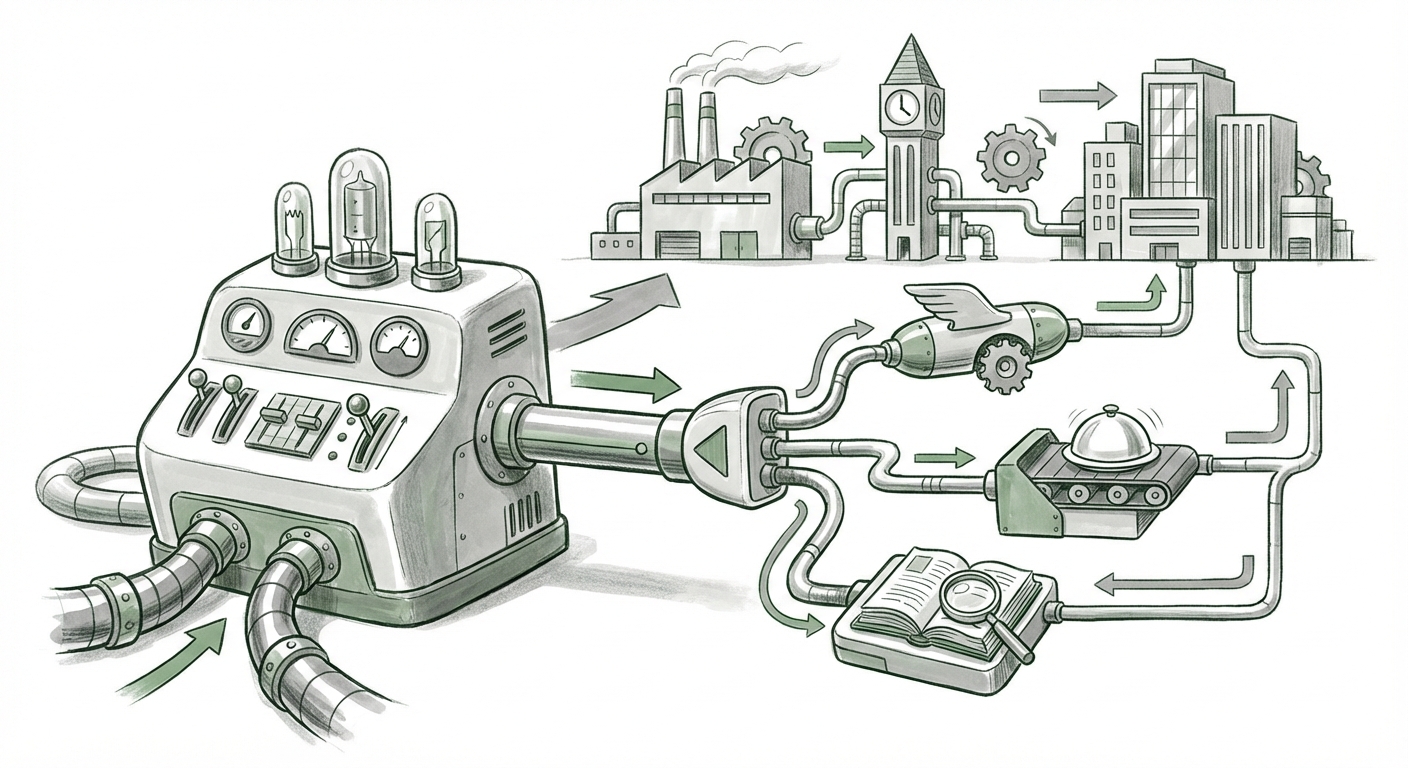
If your application is hard-coded to one model, you are behind before you even launch. The new reality demands that AI systems be built with a routing layer — a smart middleman that decides which model to call for each request. This is sometimes called a model router or an AI orchestration layer.
In the future, the companies that win will be those that can swap models in and out as easily as changing an API key. The model is no longer the product. The orchestration is the product.
The Pace of Improvement Will Accelerate Further
Short leadership cycles create a feedback loop. When a model gets dethroned quickly, the team behind it goes back to work with fresh data about what the competition did better. That accelerates the next release. The gap between generations shrinks. We are heading toward a world where the top model might change every few weeks, then every few days.
This is good news for capability but hard news for stability. Businesses that hate uncertainty will need to build systems that thrive on it.
Practical Implications for Businesses
For non-technical leaders, this trend can feel like a blur. But the practical takeaways are clear once you step back from the noise.
Stop Betting on a Single AI Vendor
One of the biggest mistakes companies made in the GPT-4 era was becoming overly dependent on a single provider. They built custom fine-tunes, tailored prompts, and integrated deeply. When the landscape shifted, those investments became liabilities.
Today, the smartest companies are diversifying. They use multiple models from multiple sources. They keep their prompt engineering model-agnostic. They treat every AI provider as a commodity that can be replaced. This is not disloyalty. It is survival.
Invest in Evaluation, Not Just Integration
If you are constantly swapping models, you need a way to test which one actually works better for your specific use case. That means building an evaluation pipeline — a system that runs your real-world data against candidate models and scores them on accuracy, cost, latency, and safety.
Companies that invest in robust evaluation infrastructure will be able to ride the wave of improvements. Those that do not will be stuck with whatever model they picked last year, watching competitors outpace them.
Redesign Products for Model Agnosticism
Product features that rely on specific model behaviors — like a certain way of formatting answers or a particular style of reasoning — break when the model changes. The solution is to design products that treat the AI as a plugin, not a foundation.
Think of it like the smartphone app store. The phone hardware and operating system stay constant, while apps (models) can be swapped, updated, or replaced without breaking the user experience. That is the architecture every AI product should aim for.
What This Means for Society
The collapse of model leadership cycles has implications far beyond the boardroom. Society at large needs to adapt to a world where AI capability advances in sprints, not marathons.
Regulation Must Be Adaptive, Not Fixed
Regulations written for a specific generation of AI will be obsolete before they are enacted. The only viable approach is adaptive regulation — rules that govern the process of development and deployment, not the specific capabilities of a given model. This is hard, but it is necessary.
Education and Workforce Training Need to Keep Up
If the tools change every few weeks, teaching people to use "the AI" is the wrong approach. Instead, we need to teach critical thinking about AI — how to evaluate outputs, how to combine multiple tools, and how to know when to trust or question a result. The specific interface will keep changing. The skills to navigate that change will not.
Safety and Alignment Become Moving Targets
Every new model brings new risks. Alignment techniques that worked for one generation may fail for the next. The safety community needs to move from a "certify and release" model to a "continuously monitor and adjust" model. This is not impossible, but it requires a shift in mindset and resources.
Actionable Insights for Leaders
If you are a business leader, a developer, or a policymaker, here are concrete steps you can take today to prepare for the era of seven-week model cycles.
- Build a model evaluation harness now. Before you need it. Pick three representative tasks from your business and set up a simple scoring system. Run new models through it as they appear. Keep a running scorecard.
- Adopt a multi-model architecture. Design your application to call different models for different subtasks. A router or gateway layer can handle this. Open-source tools already exist to do this at scale.
- Negotiate flexible contracts. When dealing with AI vendors, avoid long-term lock-in. Insist on the ability to switch models or providers with minimal penalty. Treat every relationship as temporary.
- Train your team on model evaluation, not model specifics. Teach them how to test, compare, and select models. Do not train them on the quirks of a single system that may be irrelevant in two months.
- Monitor the open-source ecosystem. Some of the fastest-improving models come from open communities. They may not always be the easiest to deploy, but they offer transparency and control that can be invaluable.
- Prepare for cost volatility. As models compete, pricing swings wildly. Build flexibility into your budget. Plan for scenarios where the best model gets cheaper or more expensive rapidly.
The Bigger Picture: Why This Is a Good Thing
It is easy to see the rapid churn as chaotic or exhausting. But there is a positive story here. The compression of leadership cycles means AI is improving faster than almost anyone predicted. The gap between "good" and "great" is shrinking. More players are contributing. The benefits are spreading wider.
For users, this is a golden age. You are no longer stuck with whatever the market leader decided was best a year ago. You can pick the right tool for the job today, and a better tool will arrive before you have time to get complacent.
For businesses that adapt, the ability to harness a continuous stream of improving models is a massive competitive advantage. The winners will not be those who built on one model. They will be those who built the infrastructure to ride them all.
The era of a single sovereign model is over. The era of the agile, model-agnostic, continuously evaluating enterprise has begun. Seven weeks at the top is no longer a sign of weakness. It is the natural rhythm of a field that is moving at full speed. The only question is whether you are ready to keep up.