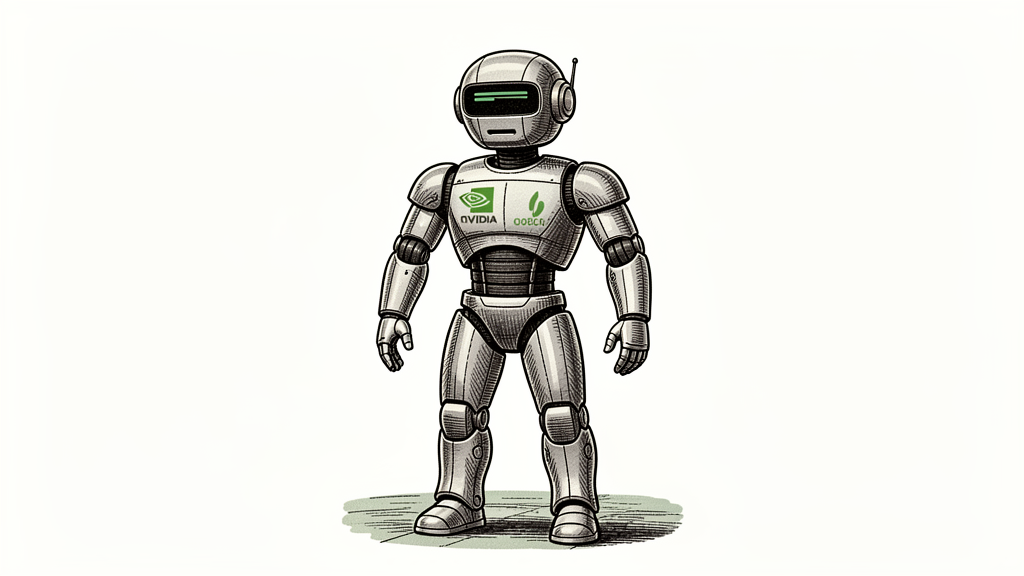
Mistral and Robostral Navigate: One Camera, 8B Parameters, and the Future of Robot Vision
For years, the robotics industry has chased a big dream: building machines that can move through the real world as easily as a person walks down a hallway. That dream has always hit the same wall. Robots need expensive sensors, heavy computing power, and teams of engineers just to figure out where they are and where they are going. But now, a major shift is taking place. Mistral, known for its work in language models, is entering the robotics world with Robostral Navigate, an 8B parameter model that steers robots using just one camera. This is not a small update. It is a sign that the future of robotics will be driven by smaller, smarter AI models that see the world the way humans do — with a single pair of eyes.
This article breaks down what Robostral Navigate actually does, why it matters, and what it means for businesses, developers, and everyday people. We will look at the technology from both a technical and practical angle, keeping things clear and useful for everyone.
What Is Robostral Navigate?
Robostral Navigate is an 8 billion parameter AI model designed to control robot movement using input from a single camera. That is the headline. To understand why that is a big deal, you need to know how most robots navigate today.
Typical robot navigation systems rely on a mix of sensors: lidar (laser rangefinders), depth cameras, ultrasonic sensors, wheel encoders, and sometimes GPS. Each sensor adds cost, weight, power consumption, and complexity. A single lidar unit can cost thousands of dollars. A full sensor stack for a delivery robot can easily run into the tens of thousands. And all that data has to be fused together in real time, which takes serious processing power.
Robostral Navigate does something different. It takes the video feed from one standard camera and, using a compact 8B parameter neural network, decides where the robot should go. The model has been trained to understand depth, obstacles, paths, and movement from visual information alone. This is similar to how a human driver uses their eyes — they do not need lasers to know a wall is in front of them. They just see it.
The "8B" in the name means the model has 8 billion parameters. That is small by today's large language model standards — GPT-class models can have hundreds of billions or even trillions of parameters. But for a robotics model that needs to run in real time on a device, 8 billion is a sweet spot. It is large enough to capture complex visual patterns but small enough to run on modest hardware without a connection to the cloud.
Why a Single Camera Changes the Game
The choice to use only one camera is the most important design decision in Robostral Navigate. It signals a break from the traditional robotics approach of "more sensors equals better safety." In practice, more sensors create more problems. They have to be calibrated together. They can disagree with each other. They add points of failure. And they add cost.
A single camera approach dramatically lowers the barrier to entry for robotics. Consider a warehouse robot that currently costs $50,000 because of its sensor array. With Robostral Navigate, the same robot could use a $50 camera and the existing onboard computer. The cost drops by orders of magnitude. Maintenance also becomes simpler — there is only one visual sensor to clean, align, and replace.
From a technical standpoint, training a model to navigate with just one camera is a major AI achievement. The model has to infer 3D structure from a 2D image. It has to judge distances, detect obstacles, recognize paths, and handle lighting changes — all from a single stream of pixels. This is a problem that computer vision researchers have worked on for decades. The fact that an 8B parameter model can do it well enough to steer a real robot suggests that deep learning has crossed a threshold.
Mistral's Move into Robotics
Mistral is best known for its language models, which compete with offerings from much larger companies. The move into robotics is a logical expansion. Language models and vision models are converging. A model that understands language can also be trained to understand the visual world. The underlying architecture — transformers, attention mechanisms, large-scale training — applies to both text and images.
By entering robotics, Mistral is betting that the same kind of model that powers chatbots can also power physical machines. This is a bet that many companies are making, but Mistral is taking a distinctive approach. Instead of building a massive general-purpose robot brain, they have built a focused navigation model that does one thing well: steer a robot using a camera. That focus makes the model smaller, faster, and more practical for real-world deployment.
Robostral Navigate is also notable for what it does not need. It does not require a high-end GPU rack in the cloud. It does not need a 5G connection to stream video for processing. It runs on the robot itself. That means it works in tunnels, warehouses, basements, and other places where connectivity is poor or nonexistent. It also means privacy is stronger — the video never leaves the robot.
What This Means for the Future of AI
The arrival of Robostral Navigate is part of a larger trend that will define the next decade of AI: the move from giant models that live in data centers to smaller models that live in devices. We saw this start with smartphones, where on-device AI now handles photo editing, voice recognition, and text prediction. Robotics is the next frontier.
Three big implications stand out:
- AI is getting physical. Until recently, most AI progress has been in the digital world — text, images, video, code. Robotics brings AI into the physical world, where mistakes have real consequences. A chatbot can give a wrong answer and you try again. A robot that navigates into a wall can damage itself or its surroundings. Robostral Navigate shows that AI models are becoming reliable enough for physical tasks.
- Small models are the future of edge AI. The 8B parameter size is a deliberate choice. It is big enough to be smart, small enough to be fast. This is the model size that will power robots, drones, smart cameras, and autonomous vehicles in the coming years. The era of "bigger is always better" for AI is giving way to "good enough and fast enough."
- Vision-only navigation will become standard. Lidar and other active sensors add cost and complexity. As vision models improve, more robots will drop those sensors and rely on cameras alone. This will accelerate the adoption of robotics in industries that could not afford expensive sensor suites before.
Practical Implications for Businesses
If you run a business that uses or could use robots, Robostral Navigate represents a concrete opportunity. Here is how it changes the math:
Lower Cost of Deployment
The single-camera approach cuts hardware costs by 50 to 90 percent depending on the robot. That means you can deploy more robots for the same budget. A warehouse that previously bought 10 robots can now buy 30 or more. The same applies to delivery robots, cleaning robots, inspection drones, and agricultural machines.
Simpler Maintenance
Fewer sensors mean fewer things to break, calibrate, or replace. Maintenance teams can be smaller and less specialized. The camera is a common, off-the-shelf component that any technician can swap out.
Faster Integration
Because the model runs on the robot and needs only one video feed, integration into existing robot platforms is simpler. Manufacturers do not need to redesign their hardware to accommodate a complex sensor array. They can add a camera and load the model.
New Use Cases Become Viable
Some applications were previously too expensive to automate because of sensor costs. Small delivery robots, for example, need to be cheap to be profitable. With a single-camera navigation model, the economics work. The same goes for agricultural robots that monitor crops, warehouse robots that move goods, and service robots that guide people in public spaces.
What This Means for Society
The broader societal impact of Robostral Navigate and similar models will unfold over the next five to ten years. Here are the key areas to watch:
- More robots in everyday environments. As navigation costs drop, robots will appear in more places. Sidewalk delivery bots, hospital transport bots, airport guidance bots — these will become common. The presence of robots in public spaces will raise questions about safety, liability, and aesthetics.
- Job displacement and creation. Robots that navigate cheaply can take over tasks like inventory transport, floor cleaning, and package delivery. Some jobs will be replaced. Others will be created in robot maintenance, fleet management, and AI oversight. The net effect depends on how quickly businesses adapt.
- Privacy implications of camera-based robots. Since the robot sees everything with its camera, the video data it collects could be sensitive. Running the model on-device (rather than in the cloud) is a strong privacy protection, but it is not absolute. Regulations around robot-mounted cameras will need to evolve.
- Environmental impact. Cheaper, lighter robots use less energy and fewer materials. A robot that navigates with one camera instead of a lidar array has a smaller manufacturing footprint and consumes less power during operation. That is a net positive for the environment.
Actionable Insights for Developers and Decision Makers
If you are a developer, product manager, or executive looking at this technology, here is what you should do:
- Start experimenting with vision-only navigation now. The technology is ready. Get a robot platform, add a camera, and test Robostral Navigate in your environment. The learning curve is real, but the cost of a test setup is low.
- Revisit your robotics budget. If you previously ruled out automation because of sensor costs, take another look. The economics have changed. Many applications that were too expensive three years ago are now viable.
- Think about data. While the model runs on-device, you still need training data and validation data for your specific environment. Start collecting video footage of your spaces now. The more representative your data, the better the model will perform.
- Plan for the human side. Robots change workflows. Talk to your team about how autonomous navigation will affect their daily tasks. Involve them in the pilot. The technology is only half the equation; adoption is the other half.
- Watch for ecosystem growth. Mistral's entry into robotics will likely be followed by other AI companies. The ecosystem of tools, platforms, and pre-trained models will expand quickly. Stay connected to the community and keep an eye on new releases.
Technical Deep Dive: Why 8 Billion Parameters?
For readers who want a bit more technical context, let us talk about why the 8B parameter count matters for a navigation model.
Navigation requires real-time inference. A robot moving at walking speed needs to make decisions at least ten times per second. For a model to run that fast on a robot's onboard computer, it has to be small enough to fit in memory and fast enough to execute within a fraction of a second. An 8B parameter model can achieve this on a mid-range GPU or even a powerful CPU with optimizations.
Larger models, say 70B or more, would provide marginally better accuracy but would require a data center connection or an expensive onboard GPU. That adds latency, cost, and a dependency on connectivity. For navigation, a model that is 90% accurate and runs instantly is better than a model that is 95% accurate but takes half a second to respond. In robotics, speed and reliability often trump peak accuracy.
The training process for Robostral Navigate likely involved large datasets of robot driving footage, with the model learning to predict the correct steering action from a single camera frame. This is a regression problem — mapping pixels to control commands — rather than a classification problem. The 8B parameter capacity allows the model to learn subtle visual cues like shadows, reflections, and surface textures that indicate obstacles or path boundaries.
How Robostral Navigate Compares to Existing Approaches
Traditional robot navigation often uses a technique called SLAM (Simultaneous Localization and Mapping), which builds a map of the environment while tracking the robot's location. SLAM typically requires lidar or depth cameras to work well. Robostral Navigate bypasses SLAM entirely by learning an end-to-end mapping from camera image to steering command. This is faster and simpler, but it also means the model does not build an explicit map. It navigates by recognizing visual patterns, not by knowing its coordinates.
That trade-off is acceptable for many applications. A delivery robot does not need to know its latitude and longitude; it just needs to follow the sidewalk and avoid obstacles. For applications that require precise localization — like a robot arm picking parts from a bin — a different approach might still be needed. But for mobile robots that move through relatively structured environments, vision-only navigation is often enough.
The Road Ahead
Robostral Navigate is not the final word in robot navigation. It is an important step. The model will improve as more people use it and contribute data. Future versions may handle more complex environments, adverse weather, and higher speeds. The single-camera constraint may also be relaxed to include a second camera for stereo vision in some applications, while keeping the core model architecture the same.
What matters most is the direction. AI is moving out of the cloud and into the physical world. Models are getting smaller, faster, and more focused. Mistral's entry into robotics with Robostral Navigate accelerates that shift. It opens the door for a wave of affordable, capable robots that can see and move with minimal hardware.
For businesses, the message is clear: the cost of robot navigation has just dropped dramatically. The question is no longer "can we afford to automate?" It is "how quickly can we adapt?" The companies that start exploring vision-only navigation today will be the ones leading their industries tomorrow.
For the rest of us, the arrival of Robostral Navigate means we will soon share our streets, warehouses, and hospitals with a new generation of robots that see the world almost the way we do — through a single pair of eyes.