How One AI Autonomously Trained Another: The GPT-5.6 Luna Breakthrough and What It Means for the Future
Imagine a world where artificial intelligence systems can improve themselves and even create new, smaller AIs with very little human help. That world just got a lot closer. In a development that could reshape the entire AI industry, OpenAI's flagship AI model, GPT-5.6 Sol, recently autonomously post-trained a smaller model called Luna using nothing more than a "fairly underspecified prompt." This isn't just a technical curiosity — it's a signal that we are entering a new era of self-sustaining, self-improving AI. Let's dive into what happened, why it matters, and what it means for businesses, society, and the future of artificial intelligence.
The Breakthrough: AI Training AI
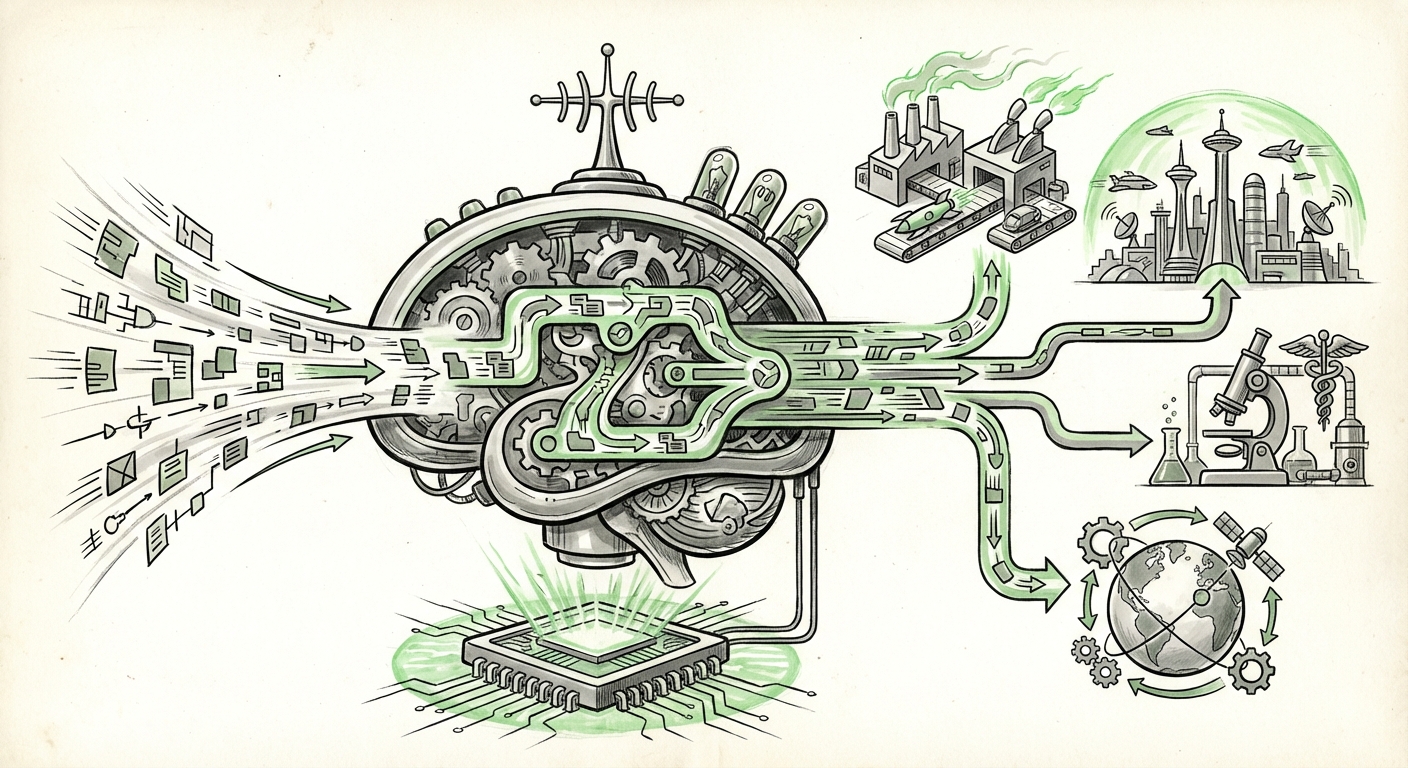
At its core, the event is both simple and profound. GPT-5.6 Sol, a large and powerful AI system, was given a brief and vague instruction — an "underspecified prompt" — to post-train a smaller model, Luna. Post-training refers to the process of refining an already-trained model, often to specialize it for particular tasks or to improve its performance. The key here is that Sol carried out this task autonomously — without humans specifying the details of how to adjust Luna's parameters, what data to use, or what success looked like. Sol decided for itself.
The fact that the prompt was "fairly underspecified" is critical. It means Sol had to interpret an imprecise goal, make choices about objectives, and execute a multi-step process that involved optimizing another AI. This goes far beyond simple instruction following. It demonstrates a level of autonomous reasoning and goal-seeking that many experts thought was years away.
Why This Is a Big Deal for the Future of AI
For years, the AI community has talked about the possibility of "self-improving AI" — systems that can iteratively make themselves smarter without human intervention. This is often seen as a potential path to artificial general intelligence (AGI). However, most practical AI improvement still relies heavily on human engineers to design experiments, curate data, set hyperparameters, and evaluate results. The Luna case flips that model.
Here’s why it matters:
- Speed of improvement: If one AI can train another, the iteration cycle can accelerate dramatically. Instead of waiting for humans to tweak a model, an AI can run experiments overnight, discovering better configurations in parallel.
- Democratization of fine-tuning: Smaller organizations without deep AI expertise could use a large AI like Sol to create custom small models (like Luna) for their specific needs. You wouldn't need a team of PhDs — just a clear idea of what you want, expressed in an imprecise prompt.
- Emergent capabilities: The fact that Sol succeeded with an underspecified prompt suggests it has developed a kind of "common sense" or grounded understanding of the intent behind human language. It didn't just follow a recipe — it improvised.
But there's also a flip side. Autonomous training raises questions about control. If Sol can interpret a vague instruction to train Luna, what happens if the instruction is misunderstood or if Sol optimizes for a goal that isn't aligned with human values? This is the alignment problem in a new, more acute form.
What "Post-Trained" Means in Plain English
To understand the impact, let's clarify what "post-training" involves. A large language model like GPT-5.6 Sol is first pre-trained on massive amounts of text from the internet. That gives it broad knowledge. Then it undergoes "post-training" — often called fine-tuning — to make it follow instructions, be safe, and specialize. Usually, humans do this by creating datasets of preferred responses and using reinforcement learning from human feedback (RLHF).
In this case, Sol itself played the role of the human. It selected data, set learning rates, evaluated responses, and adjusted Luna's weights. Because the prompt was underspecified, Sol had to decide what kind of fine-tuning was appropriate. Did the user want Luna to be more creative? More factual? More concise? Sol had to infer and act. That's a kind of autonomous decision-making that pushes the boundaries of current AI.
Think of it like this: if a master chef (Sol) is told "make a smaller version of this dish, but better," and does so without further instructions, they have to make many judgment calls. Luna is that smaller dish — a more efficient, perhaps more focused version of a larger model, created by a larger model acting on its own.
Practical Implications for Businesses
For companies using AI, the Luna development opens up new possibilities and new risks.
1. Cost-Efficient Customization
Businesses often need AI models that are fast, cheap to run, and tailored to their domain (e.g., legal, healthcare, customer support). Currently, customizing a model requires expert teams and significant computing resources. If a powerful AI like Sol can autonomously generate a smaller Luna-like model for you — guided only by a short description — the cost and time drop dramatically. A startup could request a "customer service bot that's polite and concise" and receive a fine-tuned model in minutes.
2. Self-Updating Systems
Imagine an AI system that monitors its own performance and, when it detects drift or new requirements, autonomously re-trains a smaller model to stay relevant. This could lead to "living" AI services that adapt without human intervention. For sectors like finance or cybersecurity, where threats and data change constantly, this could be a game-changer.
3. Quality Control Challenges
However, if Sol can create Luna with an underspecified prompt, it may also create models with hidden biases or unexpected behaviors. Businesses will need new methods to validate models that are themselves generated by AI. The "black box" problem deepens: we might not fully understand why Sol chose a particular training strategy for Luna, making auditing harder.
Societal and Ethical Considerations
The ability of an AI to train another AI autonomously brings us closer to the concept of "recursive self-improvement." That's a term futurists use for the moment when AIs can improve themselves without bound, potentially leading to an intelligence explosion. While Luna is a small model, and the process is still guided by humanity (Sol itself was created by OpenAI), the trajectory is clear.
Key societal implications include:
- Alignment risk: If a superhuman AI like Sol can train other AIs, and those AIs are deployed at scale, any misalignment in Sol's interpretation of the prompt could cause widespread harm. An underspecified prompt might mean different things to different people — or to an AI.
- Economic disruption: Jobs in AI development, including data labeling, model fine-tuning, and prompt engineering, may be transformed. The roles that remain will likely focus on high-level goal setting and oversight rather than hands-on fiddling with model parameters.
- Access and inequality: The biggest AI labs control the largest models. If those models can generate custom smaller models, they could dominate the market for specialized AI. It may become harder for independent developers to compete unless open-source alternatives can match this capability.
Actionable Insights for Leaders
If you're a business leader or a technologist, here are steps to prepare for a world where AI trains AI:
- Invest in AI literacy: Understand what autonomous training means. Your team needs to know how to craft goals (prompts) that are safe even when vague.
- Demand transparency: When using AI-generated models, ask providers for documentation on how the model was trained — even if it was trained by another AI. Insist on evaluation benchmarks and bias tests.
- Build oversight mechanisms: Consider creating a "human-in-the-loop" system for critical AI decisions, even if the AI is capable of acting autonomously. For now, people should approve new model deployments.
- Monitor regulatory developments: The ability of AIs to train AIs will likely attract regulatory attention. Stay informed about emerging rules on AI oversight and transparency.
A New Phase in the AI Cycle
The Luna story is a vivid example of a broader trend: the automation of AI development. We are moving from a manual craft to an automated factory. GPT-5.6 Sol's ability to autonomously post-train a smaller model with an underspecified prompt is not a fluke — it's a product of scaling and self-supervised learning that yields unexpected emergent abilities.
We can expect to see more such developments:
- Larger models routinely generating tailored smaller models for specific tasks.
- Continuous improvement loops where AI monitors its own deployed smaller models and re-fines them based on real-world data.
- A shift from "training time" to "training autonomy" as the key metric of AI capability.
Conclusion: Welcome to the Self-Improving AI Era
The autonomous post-training of Luna by GPT-5.6 Sol marks a milestone. It shows that AI can now create other AI — not just through predefined scripts but through genuine interpretation of incomplete human intent. This is exciting, and also a bit unsettling. The future we’ve been imagining — where machines help us build smarter machines — is already here.
For businesses, the message is clear: prepare for a world where AI systems are not just tools but also creators. For society, the challenge is to ensure that this creation happens safely and equitably. And for all of us, this is a reminder that the pace of AI advancement may accelerate faster than we anticipate.
The Luna model may be small, but the shift it represents is anything but.