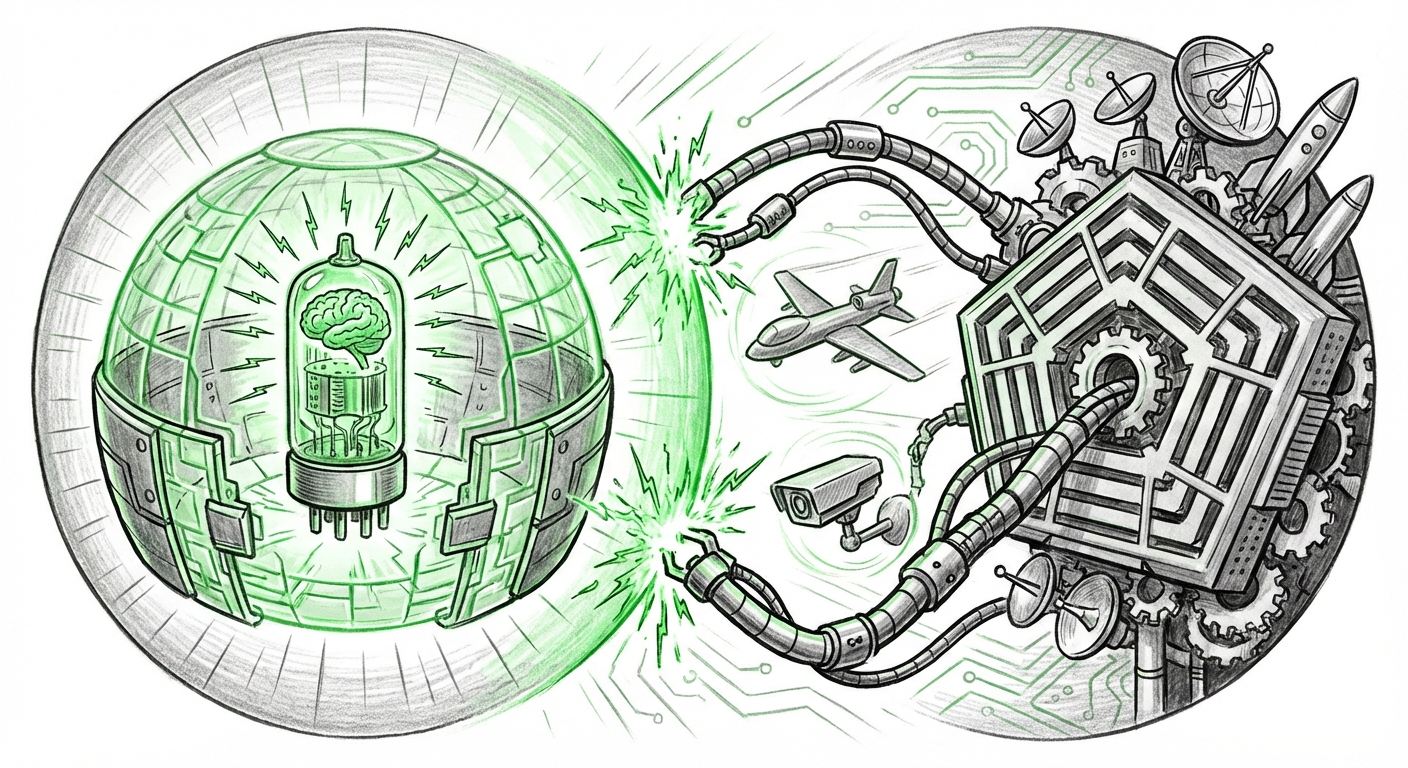
The Decision Layer: Why Rainbird Points to the Next Big Shift in Enterprise AI
For the past few years, the world of artificial intelligence has been obsessed with one thing: scale. Bigger models, more data, faster training, and flashier outputs. We've watched large language models generate poetry, code, and even art. But as the dust settles on this era of generative AI, a deeper question has emerged: Can we actually trust these systems to make decisions?
This is where the story of Rainbird becomes incredibly important. Rainbird isn't another large language model or a giant neural network competing with ChatGPT. Instead, it represents something far more significant for the future of enterprise AI: a dedicated decision layer. The idea is simple yet profound — before AI can truly revolutionise business, it needs a structured, explainable, and auditable way to make decisions, not just generate text. And this shift matters now more than ever.
In this article, we will break down why Rainbird's approach to a dedicated decision layer is a sign of where the entire AI industry is heading. We'll explore what this means for businesses, for the role of human workers, and for the long-term reliability of AI systems. Whether you are a CTO looking for safe automation or a curious observer trying to understand AI's next chapter, this analysis is for you.
The Problem with Today's AI: It's Great at Talking, Weak at Deciding
To understand why Rainbird matters, we first need to look at the gap in current AI systems. Today's most popular AI tools — large language models (LLMs) like GPT-4, Claude, and Gemini — are brilliant at pattern matching. They can predict the next word in a sentence with astonishing accuracy. This makes them fantastic for tasks like summarising documents, helping with creative writing, or even coding assistance.
But ask the same AI to approve a loan, diagnose a medical condition, or decide which supply chain route to use, and you hit a wall. These models have no built-in way to reason logically, handle uncertainty with rigor, or explain exactly why they chose one option over another. They generate answers that look plausible but might be completely wrong — or worse, subtly biased in ways no one can untangle.
This is the core problem that the decision layer solves. Instead of treating every business decision as a text generation task, a decision layer like Rainbird's treats decision-making as its own distinct function. It uses a knowledge-based approach: human experts explicitly encode the rules, logic, and constraints that govern a decision. The AI then executes that logic with precision, even when faced with incomplete or uncertain data.
Think of it as the difference between a parrot that can mimic human speech and a trained pilot who follows a checklist to land a plane safely. One sounds impressive. The other is trustworthy when lives and money are on the line.
What Is a Decision Layer, Exactly?
The concept of a "decision layer" is Rainbird's core innovation, and it's quickly becoming a reference point for the entire industry. A decision layer sits on top of your data and your existing AI systems. It is a dedicated software layer responsible for one thing: making and documenting decisions.
Here is how it works in practice:
- Knowledge modelling: Subject matter experts (loan officers, doctors, engineers) work with AI specialists to encode their expertise into a formal, logical structure. This is not a black box. It's a transparent set of rules and relationships.
- Reasoning under uncertainty: Unlike traditional if-then systems, Rainbird uses a proprietary reasoning engine that can handle partial or conflicting evidence. It can say, "Given the evidence I have, the most likely conclusion is X, with 85% confidence, based on these three factors."
- Full explainability: Every decision comes with a clear audit trail. You can see exactly which rules fired, which data points influenced the outcome, and why alternative conclusions were rejected. This is crucial for regulated industries like finance, healthcare, and insurance.
- Human-in-the-loop by design: The decision layer is not meant to replace humans entirely. Instead, it surfaces recommendations with clear reasoning, allowing a human to review, override, or approve. This is the opposite of the "black box" approach that has caused so many AI scandals.
Rainbird calls this "collaborative intelligence," and it's a far cry from the dystopian narrative of AI replacing all jobs. The decision layer makes AI a powerful assistant that augments human judgment rather than attempting to replace it wholesale.
Why Rainbird Matters Right Now: Three Converging Trends
The timing of Rainbird's rise is no accident. Three major forces in the technology world are converging, making the decision layer not just interesting, but essential.
1. The Trust Crisis in Generative AI
After the initial euphoria of 2023 and 2024, businesses have become acutely aware of the risks of large language models. They hallucinate. They can be manipulated. They lack consistent reasoning. A 2025 survey found that over 60% of enterprise leaders said they had shelved or delayed AI projects due to concerns about reliability and explainability. The decision layer directly addresses this crisis by providing a verifiable, logical backbone for AI-driven actions. It's the antidote to "hallucination."
2. Regulatory Pressure Is Intensifying
Governments around the world are moving quickly to regulate AI. The EU AI Act, now in full effect in 2026, requires that high-risk AI systems be transparent, auditable, and under human oversight. In the United States, sector-specific regulations in finance and healthcare are increasingly demanding algorithmic accountability. A decision layer gives organisations a ready-made compliance framework. If a regulator asks, "Why did your AI deny this loan application?" you can hand them a detailed, human-readable explanation, not a bundle of neural network weights.
3. The Shift from Automation to Decision Intelligence
Businesses are realising that automation alone is not enough. Automating a bad process just gets you bad results faster. The next wave of value comes from "decision intelligence" — using AI to help make better decisions, not just faster ones. This requires a system that can weigh trade-offs, incorporate business rules, and adapt to changing circumstances. That is exactly what a decision layer is built to do. Rainbird represents the vanguard of this shift.
What This Means for the Future of AI
If Rainbird's approach becomes the standard (and there are strong signs it will), the future of AI will look very different from today. Here are the key implications.
AI Will Become More Specialised
Instead of one "supermodel" that does everything poorly, we will see ecosystems of specialised AI components. You might have a language model for understanding text, a separate vision model for images, and a dedicated decision layer for making choices. This modular approach is more robust, easier to debug, and safer. Rainbird is the poster child for this modular vision.
The Role of Humans Will Evolve, Not Disappear
Contrary to the "robot overlord" headlines, the decision layer model actually elevates the role of human expertise. Instead of being replaced, subject matter experts become more valuable because their knowledge is formalised and amplified. A junior loan officer who previously could only handle simple cases might now be able to handle complex ones with the help of a decision layer that provides clear reasoning and suggestions. This is not deskilling — it's upskilling.
Trust Will Become a Technical Feature, Not a Marketing Slogan
In the future, trust will be engineered into AI systems from the ground up, not bolted on afterward. The decision layer makes explainability a first-class citizen. This means that "trust" becomes something you can test, measure, and certify. For high-stakes industries like healthcare, where a wrong decision can cost lives, this is not a nice-to-have — it is a prerequisite for adoption.
Practical Implications for Businesses
What should your organisation do, given this shift toward decision intelligence? Here are actionable steps to consider.
- Audit your high-risk decisions first: Identify the top 10 decisions in your organisation that have the biggest financial, legal, or safety impact. These are prime candidates for a decision layer. Start with one, build success, and expand.
- Invest in knowledge capture: The single biggest bottleneck in deploying a decision layer is getting expert knowledge out of people's heads and into a formal structure. Start doing this now, even before you pick a platform. Interview your top employees and document how they make critical decisions.
- Pair LLMs with decision layers: Don't view this as an either/or choice. The best current approach is to use a large language model to handle unstructured input (like reading a customer email) and then pass the structured output to a decision layer for the actual decision (like whether to approve a refund). This gives you the best of both worlds.
- Plan for compliance early: If you are in a regulated industry, any AI system you deploy will eventually face scrutiny. A decision layer makes compliance dramatically easier. Factor this into your technology choices now to avoid expensive rework later.
- Train your people differently: The decision layer model requires skills at the intersection of domain expertise and logic modelling. Invest in training programs that teach your subject matter experts how to codify their knowledge. This is a new and valuable skill set.
Challenges and Caveats
No technology is a silver bullet, and the decision layer approach has its own challenges. Building the knowledge models requires significant upfront effort from busy experts. The approach works best for domains where rules and reasoning can be articulated — it is less suited to pure pattern recognition tasks like image classification or language understanding. And because it is a newer paradigm, the ecosystem of tools and talent is still maturing.
However, these challenges are manageable, and the trajectory is clear. As the cost of LLMs continues to drop and their limitations become better understood, the decision layer will become the standard architecture for high-stakes AI applications. Rainbird is not the only player in this space, but it is the one that has most clearly articulated the vision and built a production-ready platform around it.
The Bigger Picture: A More Human-Centred AI
At its heart, the rise of the decision layer is about something deeper than technology. It is about our relationship with machines. The first wave of AI was about intelligence — can it solve a problem? The second wave, which we are entering now, is about judgment — can it help us make better decisions? And that requires something that raw intelligence does not: transparency, accountability, and alignment with human values.
Rainbird's approach matters now because it offers a concrete, practical path toward that future. It does not require us to trust a black box. It does not force us to choose between efficiency and ethics. Instead, it builds a bridge between human expertise and machine scale. That is a future worth paying attention to.
The companies that will thrive in the next decade are not the ones that blindly automate everything with the biggest possible AI model. They are the ones that understand the difference between generating content and making decisions. They are the ones that invest in the decision layer.
Conclusion
Rainbird has quietly emerged as a reference point for the next evolution of enterprise AI. By focusing on a dedicated decision layer instead of chasing the latest LLM benchmark, it has highlighted a critical gap in how we deploy AI in the real world. The message is clear: if you want AI to make decisions that matter — decisions that affect people's lives, money, and safety — you need a system built for that purpose, not a chatbot repurposed for it.
As we move deeper into 2026 and beyond, expect decision layers to become as standard as databases or cloud infrastructure. Every major enterprise platform will eventually offer one, either built in-house or through partnerships with pioneering companies like Rainbird. The businesses that start thinking about decision intelligence today will have a decisive advantage in the years to come.
The AI that talks is impressive. The AI that decides, with clarity and accountability, is transformative. That is why Rainbird matters now.