OpenAI Wants You to Ditch the Keyboard: Why a Joystick Is the Future of Controlling AI Agents
For years, interacting with advanced AI has meant typing cryptic commands into a terminal, writing lines of Python, or crafting carefully worded prompts. That paradigm is about to shift. In a move that signals a radical rethinking of human-AI collaboration, OpenAI is encouraging developers to stop typing commands and instead use a joystick to control their AI agents.
At first glance, swapping a keyboard for a joystick might sound like a step backward—a return to video-game controllers rather than a leap forward. But look closer, and this seemingly simple change hints at a much deeper transformation in how we will interact with intelligent systems. It’s about moving from indirect, symbolic control to direct, intuitive manipulation. And that changes everything—from the way we build software to the kinds of tasks we can hand off to AI.
In this article, we’ll explore what this joystick-driven future means for developers, businesses, and society. We’ll break down the underlying trends, analyse the real-world implications, and offer actionable insights for anyone who wants to stay ahead of the curve.
The End of the Command Line for AI?
OpenAI’s push isn’t just about a physical joystick—it’s about embracing a whole new interaction paradigm. The idea is to give developers a way to steer their AI agents in real time, much like a pilot controls a drone. Instead of describing every step in code, you nudge the agent with a controller: left to explore, right to confirm, up to accelerate, down to abort. The agent learns from the continuous stream of feedback, adapting its behaviour on the fly.
This approach draws inspiration from decades of research in teleoperation and shared autonomy. In robotics, operators have long used joysticks to guide robots through complex environments, while the robot handles low-level motor control. Now, the same concept is being applied to purely digital AI agents—software that can browse the web, manipulate files, control applications, and even make decisions.
Why now? Because today’s large language models (LLMs) have reached a point where they can understand intent and execute multi-step tasks with surprising reliability. But they still struggle with ambiguity and edge cases. A joystick provides a natural way for a human to step in, correct a misstep, and then let the agent continue. It’s a form of human-in-the-loop control that is faster and more intuitive than typing out corrections.
From Prompts to Puppetry
To understand the magnitude of this shift, consider the current state of AI agent development. Today, building an agent that can book a flight or fill out a form typically involves:
- Writing a detailed prompt describing the goal
- Structuring the agent’s reasoning process (chain-of-thought, etc.)
- Handling errors with explicit error-handling code
- Repeating the whole cycle after every failure
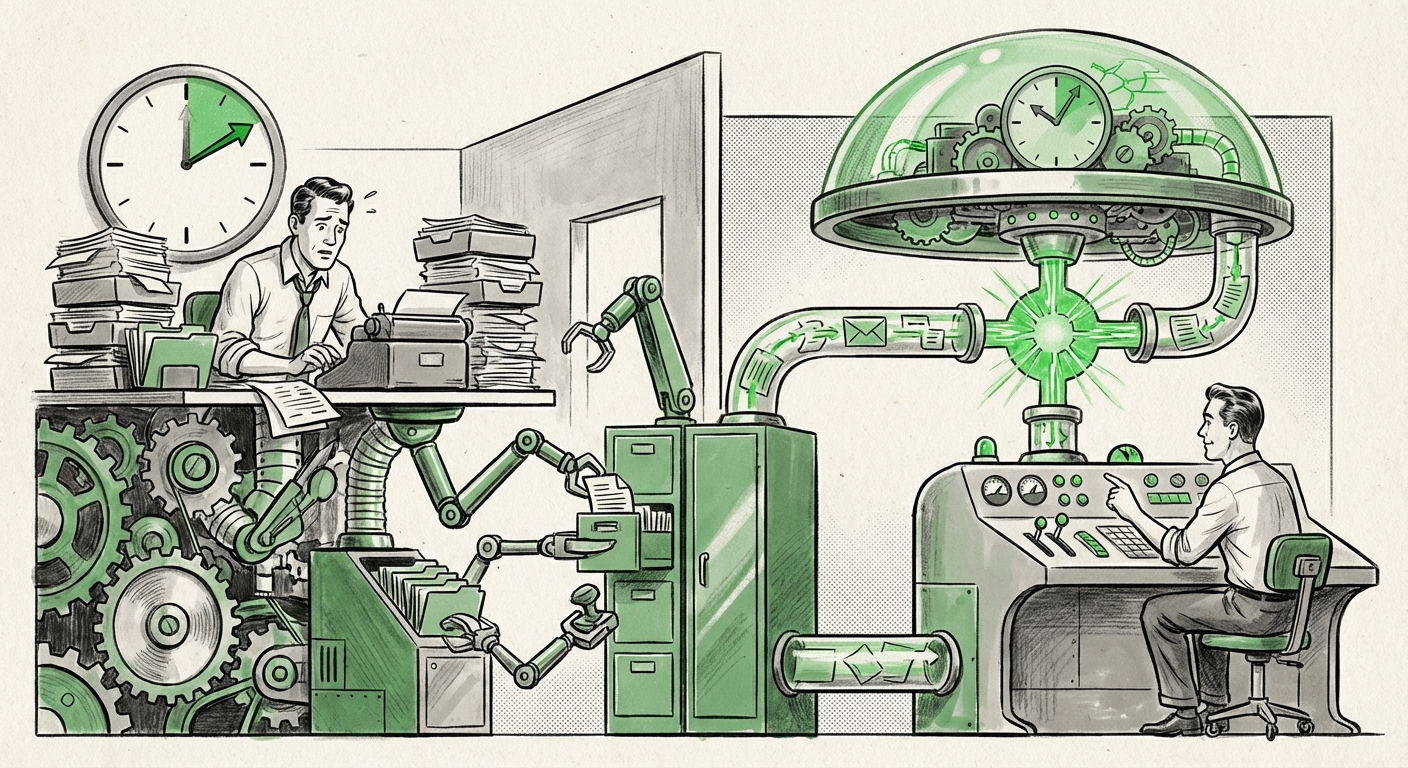
This is slow, brittle, and requires a skilled programmer. The joystick paradigm flips the script. Instead of telling the agent what to do in advance, you guide it in real time. The agent learns from your demonstrations and corrections, gradually reducing the need for human intervention. It’s a form of interactive imitation learning—and it’s far more accessible to non-programmers.
Imagine a marketing manager who wants an AI to analyse customer reviews and generate a report. Instead of hiring a developer to write the script, the manager could simply take the agent by the “joystick,” show it where to fetch data, point out which insights matter, and let the agent take over after a few demonstrations. The barrier to entry drops dramatically.
Implications for Developers: New Skills, New Opportunities
For professional developers, the rise of joystick-based control doesn’t mean the end of coding—but it does mean a shift in focus. The core skills will move from writing explicit instructions to designing feedback loops and training agents through teleoperation. Developers will become more like tutors and less like micromanagers.
We can already see early echoes of this in the gaming industry, where AI agents are trained through reinforcement learning with human feedback (RLHF). But RLHF is batch-oriented: you collect a dataset of human preferences, then train the model. The joystick approach promises online, continuous feedback, where the agent adapts instantly. That could dramatically speed up development cycles.
Developers who embrace this change will also need to think about ergonomics and interface design. A joystick is just one option; we might see steering wheels, motion controllers, or even brain-computer interfaces. The key is that the control modality becomes physical and continuous, not linguistic and discrete.
What This Means for Businesses and Society
The most profound implications are for automation of knowledge work. Today, many white-collar jobs involve repetitive digital tasks: data entry, report generation, email triaging, website monitoring. These are prime candidates for AI agents, but the cost of building and maintaining them has been too high for most SMBs. Joystick-controlled agents could slash that cost by making agent creation a matter of minutes of demonstration rather than days of coding.
Consider a small real estate agency. The owner could teach an AI agent to scrape listings, check for new properties, and send notifications to clients—all by guiding the agent through the steps once. The agent then repeats the process autonomously, with the option to step in with a joystick if a new edge case appears. That’s a direct productivity gain without needing a tech team.
On a societal level, this technology could widen the gap between companies that adopt it and those that don’t. Early adopters will automate more tasks with less effort, potentially displacing some routine jobs. But it also creates new roles: agent behaviour designers, teleoperation specialists, and feedback loop engineers. The net effect on employment will depend on how quickly education and training systems adapt.
Potential Pitfalls and Challenges
Of course, the joystick future isn’t without risks. One major concern is safety and alignment. When a human is constantly in the loop, they can catch mistakes and prevent disasters. But as the agent becomes more autonomous, the human may become less attentive—a classic automation complacency problem. How do we ensure the agent stays aligned with human values when the joystick is used only sporadically?
Another challenge is scalability. One person can only control one agent at a time. To get the economic benefits, we need techniques like behavioural cloning from demonstration and offline reinforcement learning that allow a single human to train many agents in parallel. OpenAI’s joystick approach is likely a step toward collecting high-quality demonstration data that can be used to bootstrap general-purpose agent policies.
There’s also the issue of latency and connectivity. Real-time teleoperation of cloud-based agents requires low-latency connections. A lag of even a few hundred milliseconds can make steering feel unresponsive or even dangerous, especially if the agent is manipulating financial data or controlling a physical robot.
The Broader Trend: Embodied Control of Digital Spaces
Look beyond the joystick, and you’ll see a broader movement toward embodied interaction with AI. We’ve already seen it in virtual reality (VR) and augmented reality (AR), where hand gestures and eye tracking are replacing keyboards. Now, that same principle is being applied to the abstract realm of software agents. It’s a recognition that humans are fundamentally physical beings—we think with our hands as much as our heads.
This trend aligns with research in active inference and predictive coding, which suggests that the brain evolved to control a body, not to parse language. By providing a physical control channel, we tap into our natural ability to learn through manipulation. It’s no coincidence that children learn best by doing, not by reading manuals.
In the coming years, we can expect to see more interfaces that blur the line between the virtual and the physical: haptic gloves, foot pedals, eye trackers, and eventually thought-controlled interfaces. The joystick is just the first ripple in a wave that will fundamentally change how we command our digital helpers.
Actionable Insights for Today’s Professionals
So, what should you do to prepare for this joystick-driven future? Here are some concrete steps:
- Learn the principles of human-in-the-loop AI. Even if you never touch a joystick, understanding how to design effective feedback loops will be a core skill. Look into imitation learning, RLHF, and interactive task specification.
- Experiment with teleoperation tools. Several platforms already allow you to control a simulated robot or a browser-based agent with a gamepad. Get hands-on experience to understand the latency, precision, and fatigue trade-offs.
- Think about your own workflows. Identify repetitive digital tasks that could be automated by a trained agent. Start prototyping with today’s language model APIs and see where the bottlenecks lie. The joystick will not solve everything, but it will lower the bar for entry.
- Prepare for organisational change. If you manage a team, consider how roles will evolve. A customer support agent might soon spend their day not answering tickets, but steering an AI through tricky escalations. Plan for reskilling and role redefinition.
- Stay informed about safety research. As agents become more autonomous, the methods we use to keep them safe must evolve. Follow developments in reward modelling, uncertainty estimation, and human-in-the-loop verification.
Conclusion: A New Way to Steer Intelligence
The news that OpenAI is pushing developers toward joystick-based control of AI agents is more than a quirky product experiment. It is a signal that the industry is moving away from the keyboard as the primary interface for supervising intelligent systems. We are entering an era where we don’t just talk to AI—we pilot it.
This shift has the potential to democratise AI development, making it accessible to people who never learned to code. It will accelerate the pace of automation in knowledge work, creating both opportunities and disruptions. And it will challenge our assumptions about what it means to “program” a computer.
As with any major change, there will be winners and losers. Those who embrace the joystick and the philosophy behind it—continuous, embodied, intuitive control—will be able to build smarter agents faster. Those who cling to the command line may find themselves left behind.
The keyboard isn’t dead. But the future of AI control is no longer about typing. It’s about steering. And the hand that holds the joystick will guide the next generation of intelligent systems.