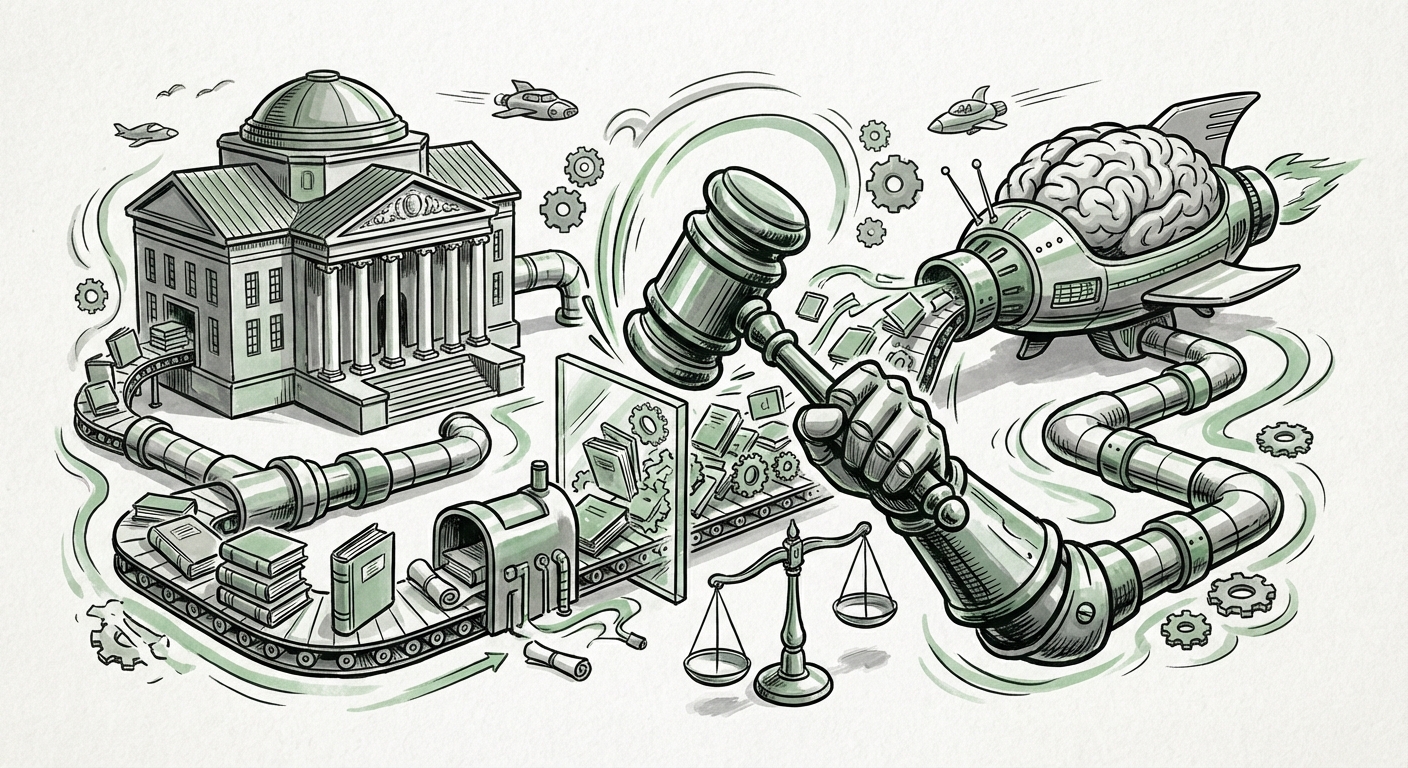
How a Trillion-Parameter Model That Only Wakes 41 Billion at a Time Is Redefining AI Efficiency
Artificial intelligence has reached a curious inflection point. For years, the mantra was simple: bigger models, better results. We watched parameter counts climb from millions to billions to trillions, each leap accompanied by jaw‑dropping capabilities—and equally jaw‑dropping computational costs. Running a model with a trillion parameters requires immense clusters of GPUs, vast amounts of energy, and budgets that only the world’s largest technology companies can afford. But what if you could have a trillion‑parameter brain that only ever uses a tiny fraction of its neurons at any given moment? That is precisely the idea behind the newly highlighted model codenamed Inkling—a trillion‑parameter architecture that wakes up just 41 billion parameters at a time.
This development isn't just another milestone on the endless road of scaling. It represents a fundamental shift in how we think about intelligence and efficiency. Instead of firing every synapse for every question, Inkling uses a technique that activates only the most relevant parts of the network for a given input. The result is a model that retains the broad knowledge and reasoning power of a trillion‑parameter giant while actually running inference with the cost and speed of a much smaller model—roughly 1/25th of the total size. This article explores what makes Inkling special, why it matters for the future of AI, and what businesses and society can learn from this breakthrough.
The Rise of Sparse Activation
The core idea behind Inkling is not entirely new. Researchers have long explored mixture‑of‑experts (MoE) architectures, where different sub‑networks (experts) specialize in different tasks and only a few are activated per input. What sets Inkling apart is both its scale—a trillion parameters—and its extreme sparsity: only about 4% of the model’s total weights are active for any single forward pass. This means that while the model’s knowledge capacity is enormous, its computational cost during use is comparable to that of a 41‑billion‑parameter model.
To understand why this is a game‑changer, consider the difference between storage and computation. A trillion parameters consume a lot of memory—on the order of terabytes—but memory is relatively cheap and continues to become cheaper. The expensive part is computation: the matrix multiplications, the attention operations, the activation functions that run for every token. By only bringing 41 billion of those parameters to life at a time, Inkling slashes the flops needed for each query without sacrificing the breadth of knowledge that a trillion‑parameter model can hold. In effect, it’s like having a library with millions of books but only pulling out the one shelf you need, rather than reading the entire library each time.
The technical details of how this is achieved involve carefully designed routing mechanisms that decide which experts to activate. Traditional MoE setups often use a learned gating network that picks the top‑k experts. Inkling seems to push this further, employing a hierarchical or adaptive selection that ensures the activated set is always narrowly focused on the input. This reduces the overhead of routing itself and avoids the common pitfall of load imbalance among experts. The result is a model that can serve requests at a latency and cost that would have been unthinkable for a model of its total size even a year ago.
Breaking the Scaling Cost Curve
For years, the AI community has debated whether we are hitting diminishing returns from scaling model size. While larger models do generally perform better, the cost increases roughly quadratically with performance gains. A model that is twice as good might require four times the compute. Sparse activation changes this equation fundamentally. With Inkling, the performance ceiling of a trillion‑parameter model is unlocked while the inference cost stays squarely in the regime of models an order of magnitude smaller. This could make state‑of‑the‑art reasoning, multilingual understanding, and multimodal capabilities accessible to a much wider range of applications.
Consider what this means for cloud‑based AI services. Today, running a large language model (LLM) for real‑time chat or document analysis is expensive. Providers often charge per token because of the raw compute involved. If a trillion‑parameter model can be served at the cost of a 41‑billion‑parameter one, the economics improve dramatically. Startups and mid‑sized companies that previously could not afford top‑tier AI can now integrate it into their products. Customer support, content generation, code assistance, and even personalised tutoring could all benefit from the intelligence of a trillion‑parameter model without the trillion‑parameter price tag.
Moreover, energy consumption—a growing environmental concern—could also shrink. The majority of a model's carbon footprint comes from inference, not training. Using only 4% of the parameters per query reduces energy use by roughly the same factor. If sparse activation becomes standard across the industry, the collective environmental impact of AI could be significantly lower than what current scaling trajectories imply. This aligns with global sustainability goals without sacrificing AI progress.
What This Means for Businesses
For business leaders, the lesson from Inkling is that size isn’t everything—or rather, that the right kind of size matters. Investing in a huge model that sits idle most of the time is inefficient. The future will favour models that combine vast knowledge with intelligent, context‑dependent activation. Here are several actionable insights for organisations looking to stay ahead:
- Rethink model selection criteria. Instead of simply comparing parameter counts, evaluate the active parameter ratio. A model that activates only a fraction of its weights can offer the best of both worlds: high capability and low cost.
- Prioritise inference efficiency. When building AI‑powered products, cost per query often matters more than benchmark scores. Sparse models like Inkling can provide superior business metrics (lower latency, lower cost) even if they slightly underperform a dense trillion‑parameter model on academic tests.
- Look for hybrid architectures. The technology behind Inkling can be applied to other domains—vision, speech, recommendation systems. Companies should explore sparse activation in their own custom models or through third‑party services that already support it.
- Prepare for more specialised experts. As sparse models become mainstream, we may see a rise in “expert libraries” where companies train modules for their unique domain (legal, medical, finance) and plug them into a larger sparse backbone. This could democratise customisation.
For technology leaders, this development reinforces a key principle: the most successful AI systems will not be the biggest, but the most efficient. The race is shifting from raw scale to smart scale. Inkling is an early demonstration of this shift, but it is far from the last. In the coming months, expect to see more models that balance capacity and activation, and expect the bar for “good enough” efficiency to rise rapidly.
Societal Implications: Access and Equity
On a broader level, techniques like those used in Inkling could help bridge the AI equity gap. Today, the ability to use advanced AI is concentrated among a handful of companies with deep pockets. Small businesses, non‑profits, educators, and researchers in developing countries are often priced out of frontier models. By slashing inference costs, sparse activation lowers the barrier to entry. A school in a low‑income region could afford to run a state‑of‑the‑art tutoring system; a small farm co‑operative could use precision agriculture advice from a model that knows as much as the largest AI labs’ creations.
There are also implications for privacy and edge computing. With fewer active parameters, it becomes more feasible to run powerful models on local devices—a phone, a laptop, or an IoT sensor. This reduces the need to send data to the cloud, addressing privacy concerns and enabling offline operation. Imagine a personal assistant that runs entirely on your smartphone, yet has the knowledge of a trillion‑parameter network. That vision, once a distant fantasy, is becoming tangible.
Of course, there are risks. The same efficiency could be used to build more pervasive surveillance systems or to generate disinformation at lower cost. As with any powerful technology, the societal outcome depends on how we choose to deploy it. But the underlying technical trend—doing more with less—tends to be a force for democratisation, provided that the benefits are broadly shared.
The Road Ahead
Inkling represents a proof point that the future of AI is not just about brute force. It is about intelligence that knows what parts of itself to turn on. This principle can be extended beyond parameters: future models might dynamically adjust which layers, attention heads, or even data modalities they use based on the task. The trillion‑parameter model that only wakes 41 billion at a time is a beacon, showing that we can have our cake and eat it too—vast knowledge without vast waste.
The next steps will involve improving the routing mechanisms so that the model selects the right experts even faster and more accurately. We might see models that learn to further compress the active set over time, or that use the inactive parameters as a kind of long‑term memory that can be accessed asynchronously. The intersection of sparse activation, retrieval‑augmented generation, and continual learning could produce systems that are both deeply knowledgeable and highly adaptive.
For those building with AI, the message is clear: pay attention to efficiency innovations. Benchmarks that only measure output quality are incomplete. The cost, speed, and energy consumption of AI matter enormously in the real world. Inkling shows that you don’t have to sacrifice capability for practicality. The tools are emerging to make advanced intelligence cheap, fast, and green.
Conclusion
The age of the monolithic, all‑parameters‑always‑on model is sunsetting. The new dawn belongs to architectures that are as smart about when to compute as what to compute. The trillion‑parameter model that wakes up only 41 billion at a time is a testament to how far we’ve come in designing efficient intelligence. It offers a glimpse into a future where AI is simultaneously more powerful and more accessible—a future where the biggest brains also happen to be the most thoughtful about how they spend their energy.
For technologists, business leaders, and policymakers, the lesson is to embrace this paradigm. Invest in sparse, modular, and efficient designs. Support research that reduces the compute footprint of intelligence. And anticipate a world where the best AI isn’t just the one with the most parameters, but the one that uses them most wisely. Inkling is a remarkable first step. Many more will follow.