Model Distillation: The Hidden Force Reshaping AI
Artificial intelligence is getting bigger, faster, and more powerful. But there is a quiet revolution happening behind the scenes that most people have not heard about. It is called model distillation, and it may be the single most important technique for making AI practical, affordable, and widely available.
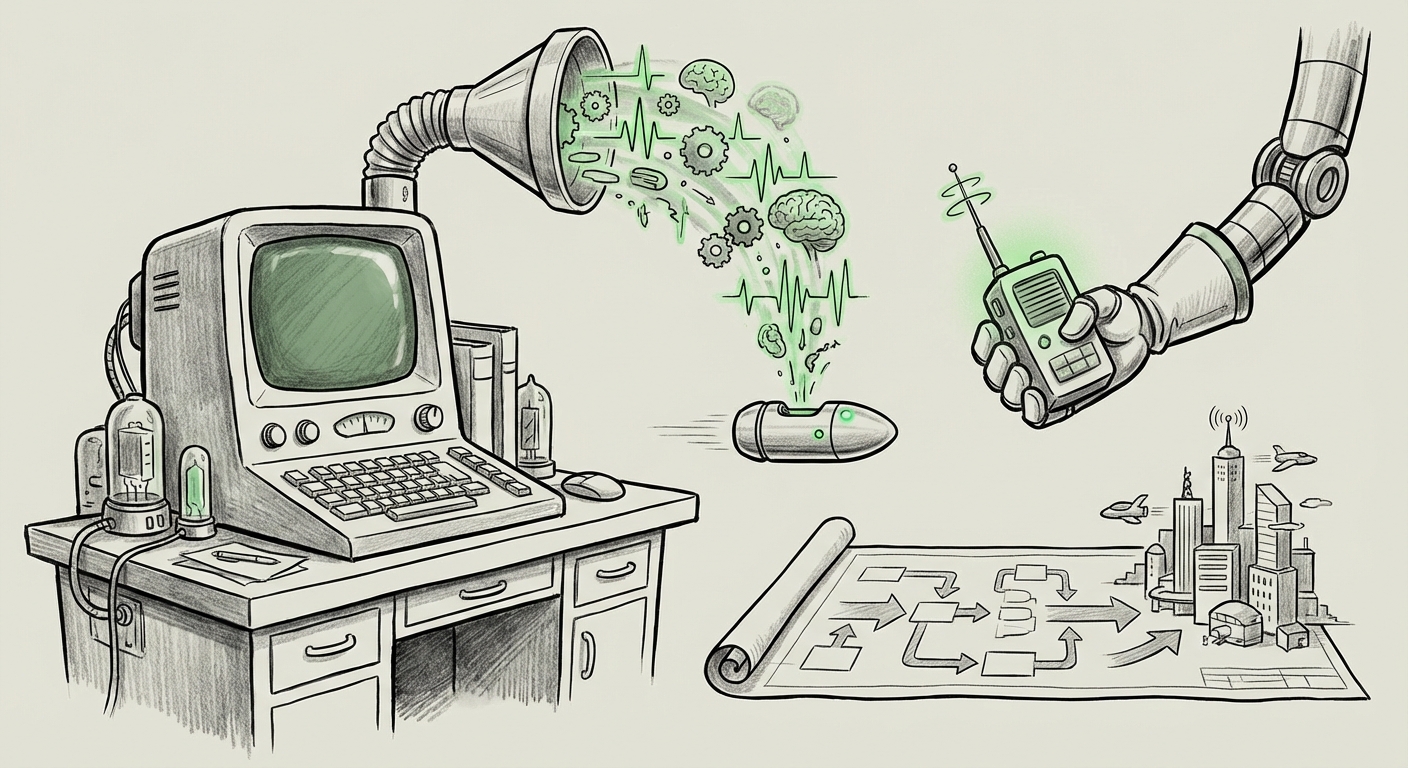
Think of model distillation as a way to shrink a giant brain into a tiny one without losing the smartness. The big, expensive AI models that cost millions to run can teach smaller models to do almost the same work for a fraction of the cost. This is not just a clever trick. It is changing how companies think about AI, how fast AI can run on your phone, and who gets to use the most advanced AI tools.
What Is Model Distillation, Really?
To understand model distillation, imagine a master chef who has spent decades learning to cook perfect meals. Now imagine that master chef writes a cookbook that captures the most important recipes and techniques. A younger chef can read that book and cook meals almost as good as the master without spending decades in training. That is what distillation does for AI.
In technical terms, a large "teacher" model — usually a massive neural network with billions of parameters — is trained on huge amounts of data. This teacher model is powerful but also slow and expensive to run. A smaller "student" model is then trained not just on the original data, but on the outputs and behavior of the teacher model. The student learns to mimic the teacher's decisions, patterns, and even its mistakes. Over time, the student becomes almost as accurate as the teacher, but it uses far less computing power and memory.
This is different from training a small model from scratch. A small model trained only on raw data might never learn the subtle patterns that a large model can discover. But by learning from the teacher model's already refined knowledge, the student can punch far above its weight class.
A Brief History: How Distillation Became a Game Changer
The concept of model distillation has been around for years, but it has evolved dramatically. The earliest versions came from a simple observation: big models contain a lot of redundant information. Researchers asked a simple question — do we really need all those billions of parameters? The answer was no. Much of the knowledge in a large model is compressed and can be transferred to a smaller model.
Early distillation methods were crude. They focused on matching the teacher model's final predictions. But as the field matured, researchers found ways to capture much more. Modern distillation techniques look at the internal representations of the teacher model — the hidden layers, the attention patterns, the probabilities for every possible answer. This allows the student model to learn not just what answer to give, but how the teacher model thinks.
The biggest leap came when companies realized that distillation could make AI work on devices like smartphones and smart speakers. A distilled model can run locally on your phone without needing to send data to the cloud. That means faster responses, better privacy, and no internet requirement. This was a turning point. Suddenly, AI was not just a cloud service — it was something that could live in your pocket.
Another milestone was the rise of open-source distilled models. Large companies began releasing smaller, distilled versions of their most powerful models for free. This democratized access. Small businesses and independent developers who could never afford to run a giant model could now use a tiny version that was nearly as capable. The playing field began to level.
Why Distillation Matters More Than Ever
The AI industry is in a race to build bigger and bigger models. Every new generation packs more parameters, more training data, and more computing power. But bigger is not always better. Here is why distillation is becoming the essential counterbalance.
Cost. Running a large AI model costs a fortune. One query to a massive model can consume as much energy as a small household for a day. Distilled models cut that cost by 90% or more. For businesses that need to run AI at scale — think customer service chatbots, recommendation engines, or fraud detection — the savings are enormous.
Speed. Big models are slow. They take time to load, process, and respond. Distilled models are snappy. They can return answers in milliseconds instead of seconds. For applications like real-time translation, autonomous driving, or voice assistants, speed is not a luxury — it is a necessity.
Privacy. When a distilled model runs on a local device, your data stays on that device. No need to send sensitive information to the cloud. This is huge for healthcare, finance, and any industry where privacy matters. Users get the benefit of AI without the risk of their data being stored or mishandled somewhere else.
Accessibility. Not every organization has a massive data center. Small teams, startups, and developers in developing countries often cannot access the most powerful AI models. Distillation makes advanced AI available to everyone. A distilled model can run on a laptop, a phone, or even a microcontroller. This opens doors that were previously locked.
What This Means for the Future of AI
The rise of model distillation is not just a technical improvement — it is a shift in the entire direction of AI development. Here is what that future looks like.
AI Becomes Embedded in Everything
When models are small and efficient, they can be placed inside everyday objects. Your refrigerator could suggest recipes based on what is inside. Your thermostat could learn your schedule and optimize energy use. Your car could diagnose its own problems before they become serious. All of this is possible because distillation allows complex AI to run on simple, low-power chips. The era of ambient intelligence — where AI is everywhere but invisible — depends on distillation.
Specialization Over Generalization
Large models are generalists. They can do a little bit of everything. But for many tasks, a generalist is overkill. Distillation allows companies to create specialized models that are tiny, fast, and excellent at one specific job. A distilled model for medical diagnosis might be trained only on radiology data. It will never win a poetry contest, but it will spot tumors faster and more accurately than a giant general model. The future is not one massive AI — it is thousands of tiny, specialized AIs working together.
Democratization of Innovation
When distilled models become widely available, the barrier to entry for AI innovation drops dramatically. A single developer with a good idea can build a powerful AI application without needing millions of dollars in computing resources. This will unleash a wave of creativity and entrepreneurship. The next great AI company might start in a dorm room, not a data center.
Rethinking the Bigger-Is-Better Race
For years, the AI industry has focused on building the largest possible models. Distillation challenges that assumption. If a distilled model can do 95% of what a giant model can do at 5% of the cost, then bigger may not be worth it for most applications. This could shift investment away from massive training runs and toward efficient architectures and knowledge transfer techniques. The future may belong to models that are smart, not just big.
Practical Implications for Businesses
If you run a business, model distillation is not a distant research topic — it is a tool you can use right now. Here are some actionable ways to think about it.
Audit your AI costs. If you are using a large cloud-based AI model for routine tasks, ask whether a distilled alternative could do the job. Many companies are overpaying for AI because they use the biggest model available when a smaller one would work perfectly well. Switching to a distilled model can cut costs immediately.
Consider on-device AI for customer-facing products. Users value speed and privacy. If your app or service uses AI, running a distilled model on the user's device can provide a better experience. No loading spinners, no data leaving the phone. This can be a competitive advantage in crowded markets.
Build specialized models for your domain. Instead of relying on a generic AI that knows a little about everything, consider distilling a model that is an expert in your field. Take a large model, fine-tune it on your specific data, then distill it down to a compact model that runs efficiently. You get the expertise without the overhead.
Plan for edge computing. As the Internet of Things grows, the ability to run AI on small, low-power devices becomes critical. Distillation is the key to making that work. If your business involves sensors, cameras, or any connected device, start exploring how distilled models can bring intelligence to the edge.
How Society Will Be Affected
The implications of model distillation go beyond business. They reach into education, healthcare, public services, and everyday life.
Education. Distilled models can run on cheap hardware, making AI tutoring and personalized learning available in schools with limited budgets. Imagine a small device that can answer students' questions, explain difficult concepts, and adapt to each student's learning style. Distillation makes this affordable enough to deploy in every classroom.
Healthcare. Rural clinics and developing countries often lack access to advanced diagnostic tools. A distilled AI model running on a simple tablet could help doctors interpret scans, suggest treatments, and spot warning signs. This could save lives without requiring expensive infrastructure.
Environmental impact. Large AI models consume massive amounts of energy. The carbon footprint of training a single giant model can be equivalent to the lifetime emissions of several cars. Distillation dramatically reduces that impact. By using smaller, efficient models, the AI industry can grow while shrinking its environmental footprint. This is a critical win for sustainability.
Digital divide. The internet has already created gaps between those with access and those without. AI could widen that gap further if only wealthy countries and companies can afford the best models. Distillation is a tool for equity. It allows advanced AI to reach communities that would otherwise be left behind. This is not just about technology — it is about fairness.
Challenges and Cautionary Notes
Distillation is not magic, and it is not without risks. There are important challenges to keep in mind.
Quality trade-offs. A distilled model will never be exactly as good as the teacher. In some high-stakes applications — like medical diagnosis or autonomous driving — even small drops in accuracy can be dangerous. It is essential to rigorously test distilled models before deploying them in critical systems.
Bias amplification. If the teacher model has biases — and most large models do — the student model will inherit those biases. Distillation can even amplify them because the student learns from the teacher's mistakes. Careful auditing and bias mitigation are necessary.
Security concerns. Small, efficient models that run on devices can be more vulnerable to hacking and reverse engineering. Protecting distilled models requires additional security measures, especially when they handle sensitive data.
Over-reliance on proprietary teachers. Many of the best teacher models are owned by a small number of large companies. If distillation becomes the norm, those companies could control the knowledge pipeline. Open-source alternatives and transparent distillation practices are important to prevent a new kind of AI monopoly.
The Road Ahead
Model distillation is not a new idea, but it is becoming a central strategy in the AI world. As models grow larger, distillation grows more essential. It is the tool that makes big AI practical, affordable, and accessible.
In the coming years, we will see distillation techniques become more sophisticated. Researchers are already working on "distillation chains" where multiple small models learn from each other, and "online distillation" where the teacher and student learn simultaneously. The boundaries between big and small AI are blurring.
For anyone building with AI, the message is clear: do not assume you need the biggest model. Distillation offers a path to smarter, faster, cheaper, and more private AI. It is the hidden engine driving AI into every corner of our lives.
The future of AI is not just about building bigger brains. It is about making those brains small enough to fit anywhere, cheap enough for anyone, and smart enough to matter. Model distillation is how we get there.