AI’s Next Wave: Smarter Models, Embodied Machines, and a Rapidly Expanding Stack
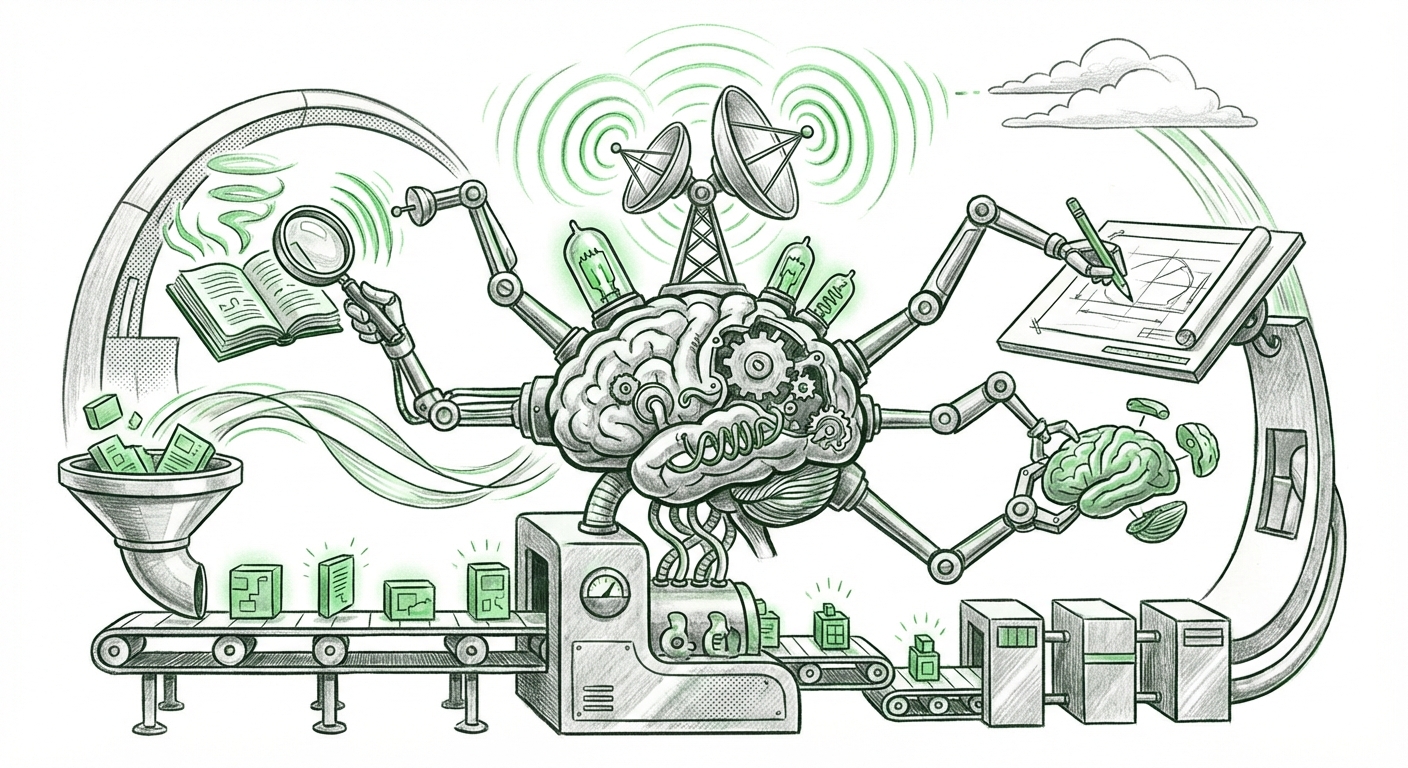
The artificial intelligence landscape is undergoing a fundamental transformation. For the past several years, the story of AI was dominated by a single, powerful trend: scaling. Bigger models, more data, and enormous clusters of GPUs were the formula for progress. But the ground has shifted beneath our feet. The cutting edge of AI is no longer about simply building a larger brain. It is about building a fundamentally smarter one, giving it a body to interact with the physical world, and surrounding it with a robust industrial ecosystem.
We have entered a distinct new phase of the AI revolution. This phase is defined by three concurrent and reinforcing pillars: the rise of deeply Smarter Models that reason rather than just predict, the powerful convergence of AI with Physical Machines that act in the real world, and the rapid maturation of the Expanding AI Stack that turns experimental technology into a reliable business utility. Understanding these three pillars is essential for anyone looking to navigate the next decade of technology and business.
Part 1: The Age of Smarter Models — Moving Beyond Scaling Laws
For a long time, the conventional wisdom was simple: if you wanted a smarter AI, you built a bigger one. The promise of "scaling laws" suggested that performance would continue to improve predictably as models grew in size and were fed more data. While that trend hasn't entirely disappeared, it has plateaued in effectiveness. The overhead of larger models is becoming a challenge, and the data we have to train them is finite.
This has led to a radical shift in focus. Today, making a model "smarter" means teaching it to think more effectively rather than simply having more parameters. The biggest breakthroughs are now coming from what is called inference-time compute. Instead of a model firing off an answer immediately, it takes time to reason through a problem, exploring different paths and checking its own logic before responding. This is a profound change. It is the difference between a student who blurts out the first answer that comes to mind and one who carefully works through the problem step-by-step.
This new wave of smarter models is defined by a few key characteristics:
- Reasoning over Recall: Models are now capable of complex chain-of-thought reasoning, which allows them to tackle advanced mathematics, intricate coding challenges, and nuanced strategic planning with far greater accuracy.
- Efficiency Gains: Perhaps the most exciting aspect is that these reasoning techniques allow smaller, highly specialized models to outperform their much larger, general-purpose predecessors. A compact model that is fine-tuned for a specific task and allowed to "think" for a few seconds can beat a massive model that gives an instant, unreasoned answer.
- Hybrid Architectures: We are seeing a blending of different model types. Combining the strengths of transformer models with other architectures allows for systems that are both powerful and incredibly efficient.
What This Means for Business
The era of the monolithic, one-size-fits-all model is ending. For businesses, this is a massive opportunity. The cost of intelligence is dropping dramatically. You no longer need to rent an enormous, expensive foundation model for every single task. You can deploy a fleet of smaller, specialized, reasoning-driven models.
Actionable Insight: Start auditing your workflows. Identify tasks that require deep reasoning, such as complex data analysis, legal document review, or automated code debugging. These are perfect candidates for the new wave of smarter models. The competitive advantage will go to companies that can effectively use these specialized "reasoners" to augment their highly skilled human workers, rather than just trying to automate the simplest tasks.
Part 2: Physical Machines — When AI Leaves the Screen and Gets a Body
The second pillar of this new AI era is perhaps the most tangible and exciting: the convergence of advanced AI models with physical systems. The brain we have been building in the cloud is finally getting a body. This is the age of Embodied AI, where intelligent software meets the gritty, complex reality of the physical world.
We are seeing massive, coordinated investments in a range of physical machines. This includes general-purpose humanoid robots designed to operate in factories and warehouses, next-generation autonomous vehicles navigating challenging urban and rural environments, advanced drones managing logistics and infrastructure inspection, and a new breed of industrial robotic arms that can be controlled through natural language.
What is different this time is the "brain" that controls these machines. Instead of being tirelessly hand-coded by engineers for every specific motion, these machines are controlled by foundation models that can translate vision and language directly into physical action. You don't program the robot to pick up a specific part; you tell it to "go find the red widget and place it in the bin," and the AI figures out the precise sequence of movements itself. This ability to generalize, to react to changing environments, and to learn from experience is what makes this revolution different from previous robotics booms.
What This Means for Society and Labor
The implications of AI-driven physical machines are profound. We are looking at a fundamental redefinition of labor and logistics. The businesses that will lead in this environment are those that can identify the physical tasks in their workflow that are repetitive, dangerous, or prohibitively expensive and match them with the capabilities of these new intelligent machines.
Actionable Insight: Look at your physical operations. Where do you have labor bottlenecks? Where are the safety risks highest? In manufacturing, warehousing, agriculture, and construction, the technology has matured to the point where pilot programs are not just feasible but economically advantageous. The future won't be about replacing all workers, but about augmenting them with a workforce of physical machines that handle the dull, dirty, and dangerous tasks, allowing human talent to focus on oversight, strategy, and complex problem-solving.
Part 3: The Expanding AI Stack — Infrastructure Becomes the Moat
The final piece of the puzzle is the infrastructure that holds the new AI ecosystem together. In the early days, the "stack" was incredibly simple: choose a model and call an API. That era is over. As AI moves from experimental chat tools and image generators into mission-critical systems, the supporting tech stack has exploded in complexity. This expansion is a clear sign of the industry's maturity.
The modern AI stack now encompasses a dizzying array of specialized layers and tools. It includes robust data ingestion pipelines to feed models high-quality information. It relies on vector databases to give models long-term memory and the ability to search through vast amounts of information. It requires sophisticated fine-tuning platforms to adapt base models to specific domains. Crucially, it now demands thick layers of guardrails, safety systems, and evaluation frameworks (evals) to ensure the models are behaving as expected, are free from bias, and are operating safely in the real world. Furthermore, the rise of "agentic" workflows—where an AI system plans and executes a series of actions across different tools—requires complex orchestration frameworks to manage the process.
This expanding stack represents both a challenge and an opportunity. It is a challenge because it requires deep expertise to assemble and maintain. No single solution solves everything. It is an opportunity because it creates massive value for companies that can build the glue between these different components. The competitive advantage in the era of smarter models and physical machines will not come from the model itself—which is increasingly a commodity—but from the quality and reliability of the system built around it.
What This Means for Technology Leaders
For CTOs, CIOs, and technology leaders, the biggest risk right now is not choosing the "wrong" model. The biggest risk is ignoring the stack. A weak data layer, a lack of proper monitoring, or a brittle orchestration system can cripple even the most powerful foundation model. Security and safety are also paramount; as AI systems gain more autonomy and access to sensitive data, the attack surface expands.
Actionable Insight: Shift your focus from model selection to system architecture. Invest heavily in your data pipelines—garbage in, garbage out remains the first law of AI. Build out robust evaluation and monitoring systems to track the performance and safety of your AI systems in production. The company that builds the most reliable, safe, and integrated AI stack will be the one that ultimately wins in the market.
Conclusion: The Convergence is the Story
These three trends—Smarter Models, Physical Machines, and the Expanding AI Stack—do not exist in isolation. They are deeply interconnected, feeding off each other in a powerful feedback loop. Smarter models that can reason are necessary to control complex physical machines safely and effectively. The extreme demands of real-time robotics and autonomous vehicles push the boundaries of the AI stack, forcing it to become faster, more reliable, and more robust. And as the stack matures and becomes more accessible, it lowers the barrier to entry for developers to build and deploy both smarter software agents and physical machines.
We are moving decisively from an era of pure digital intelligence, locked inside a data center, into an era of integrated, actionable, and embodied intelligence. The digital and the physical are converging at an astonishing rate. For businesses, the message is crystal clear: invest in building specialized reasoning capabilities, look seriously for opportunities in physical automation, and, above all, build your infrastructure to last. The next wave of AI is not just arriving on the horizon—it is already washing over us, and it promises to reshape our world far more dramatically than the last.