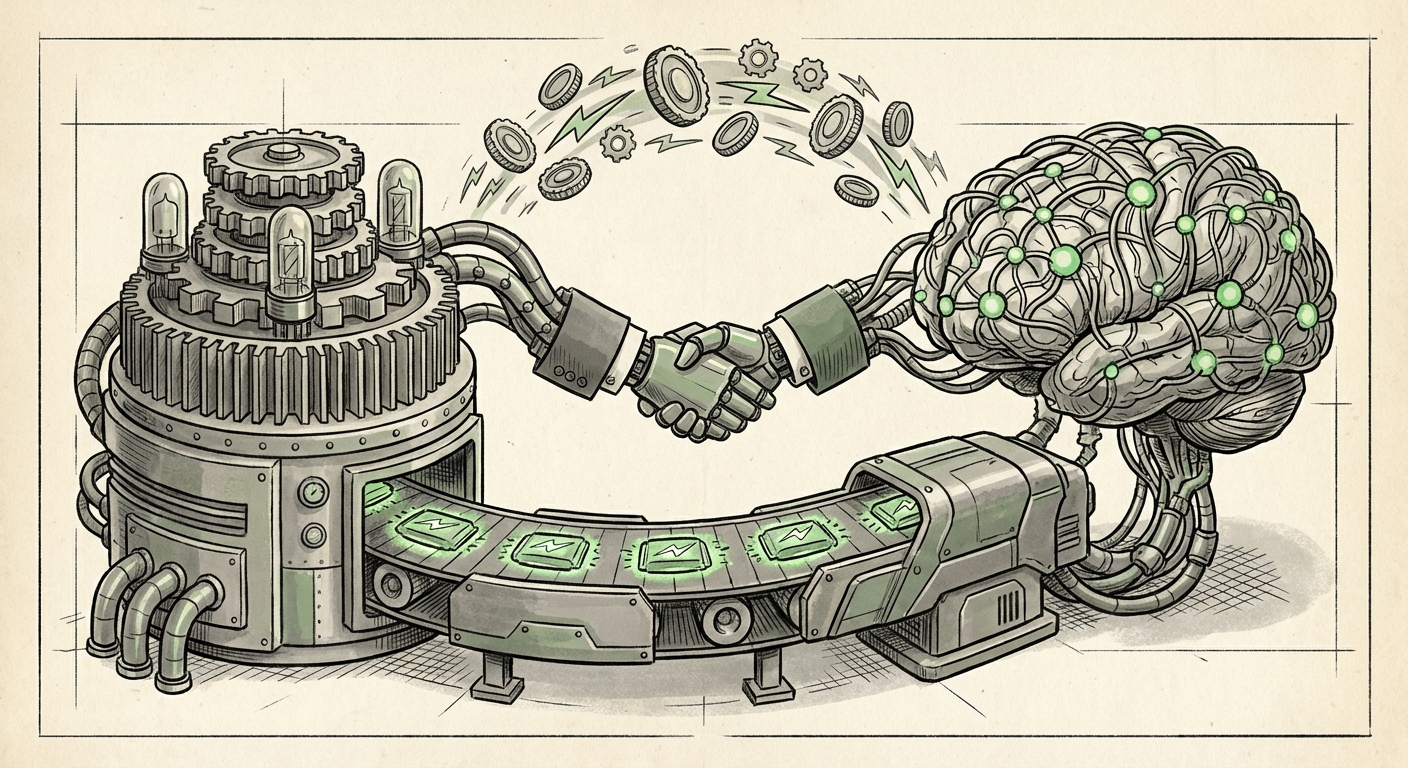
The New Metric That Tells You Exactly When AI Agents Cost More Than Humans – And Why It Matters
For years, business leaders have asked a simple question: "When will AI agents become cheaper than hiring a person?" The answer has always been fuzzy — cloud costs go down, AI models get smarter, but human wages also fluctuate. Now, a breakthrough metric finally brings clarity. A new measurement tool, developed by METR, calculates the precise point at which using an AI agent becomes more expensive than a human worker. This isn't just a number; it's a roadmap for the future of work, automation, and business strategy.
This article dives into what this metric means, how it works, and why every decision-maker in tech and business needs to understand it. We'll explore the trends behind the metric, the practical implications for companies, and the bigger picture for society. Whether you're a CTO weighing an automation budget or a worker curious about your job's future, this is the shift you've been waiting for.
What Is the New Metric?
METR (the organization behind the research) introduces a formal way to compare the total cost of an AI agent versus a human performing the same task over a given period. The metric factors in everything: compute power, energy consumption, software licensing, maintenance, and even the cost of supervision or error correction. On the human side, it includes wages, benefits, training, and productivity rates. The result is a single number — the Agent Cost Parity Point — that tells you exactly when automation becomes more expensive than a person, or vice versa.
For example, a customer-support AI agent might cost $0.05 per interaction for the first thousand queries, but after that, scaling costs could spike. If a human agent handles 50 calls per hour at $20/hour, the metric shows where the line crosses. The key insight: it's not just about today's costs. The metric projects future curves based on trends in AI efficiency (Moore's Law for chips, algorithmic improvements) and human wage growth. This makes it a strategic planning tool, not just a static snapshot.
Why This Metric Matters Now
The timing is perfect. We're seeing an explosion of AI agents — from coding assistants to legal document reviewers to warehouse robots. Companies are eager to automate, but many have been burned by hidden costs. A bot that seems cheap at first can become a budget nightmare when you factor in retraining, infrastructure scaling, and handling edge cases. METR's metric brings transparency. It answers the million-dollar question: "Should I build an AI agent or hire a human?"
Consider three key trends driving the need for this metric:
- Rapid AI performance gains: Models like GPT-5 and its peers are now capable of complex multi-step tasks. But these advanced models often require expensive inference hardware. The metric helps compare a $100/hour AI agent against a $30/hour human specialist.
- Falling compute costs – but not uniformly: While GPU prices decline, energy and cooling costs can rise. The metric accounts for total operating expense, not just unit price.
- Workforce redefinition: As more tasks become automatable, companies need a clear framework to decide which roles to augment versus replace. The metric provides a defensible, data-driven approach.
How the Metric Changes Business Decisions
1. Cost-Benefit Analysis Becomes Concrete
Before this metric, automation decisions were based on gut feel or rough estimates. Now, a procurement manager can run a report: "For data entry, the AI agent is cheaper for volumes above 10,000 records per month, but below that, human data entry is more economical." This precision prevents over-automation and under-automation.
2. Dynamic Pricing for AI Services
Cloud providers and AI vendors can use this metric to design pricing that aligns with value. If an agent crosses the human-cost threshold at certain usage levels, vendors can offer tiered plans to keep automation competitive. This could lead to new subscription models where companies pay per task only when AI is cheaper.
3. Workforce Planning Becomes Smarter
HR departments can map which job families are approaching parity. For example, a financial analyst role involving standard reports might be at 0.8× human cost today, meaning automation is cheaper. But roles requiring judgment calls might be at 1.5×, meaning humans are still cheaper. This allows companies to invest in reskilling for roles that will remain human-dominated and automate the rest.
What This Means for the Future of AI Agents
The metric reveals that AI agents won't simply "replace all jobs" overnight. Instead, there will be a gradual, measurable shift. Here's what the future looks like through the lens of this new metric:
- Hybrid workforces become the norm: The metric shows that for many tasks, the most efficient solution is a mix – an AI agent handles routine bulk work while a human handles exceptions. The parity point varies by task, so companies will optimise on a granular level.
- More investment in AI reliability: The metric penalizes high-error agents. If an AI agent makes mistakes that require human oversight, its effective cost rises. This will push developers to build more reliable, self-correcting agents.
- New job categories emerge: As AI handles cost-effective tasks, humans will shift to supervising, designing, and handling the non-routine. The metric helps identify which human skills remain valuable – empathy, creativity, negotiation.
One stunning implication: the metric may accelerate the adoption of "agent-as-a-service" models. Imagine a company that subscribes to an AI legal research agent that is always cheaper than a paralegal for certain types of searches. The metric makes that promise verifiable.
Practical Implications for Businesses
If you run a business, here's how to act on this metric today:
Step 1: Map your tasks – Break down every process into measurable units (e.g., cost per invoice processed, cost per customer query resolved). Feed those numbers into METR's framework (or a tool that implements it).
Step 2: Run scenario models – Use the metric to see when each task crosses parity. Some tasks may already be cheaper with AI; others may never be due to regulatory or quality constraints.
Step 3: Plan for a 2–5 year horizon – The metric can extrapolate based on expected improvements in AI efficiency (e.g., 30% cost reduction per year) and changes in human wage costs. This gives you a roadmap for when to invest in automation vs. hiring.
Step 4: Monitor continuously – Costs change. The cloud bill might spike, or a new model version may halve inference costs. Recalculate the parity point quarterly.
For society, the metric offers a way to have an honest conversation about job displacement. Instead of vague fears, we can say: "By 2028, for this task, AI will be cheaper. Here's the transition plan." Governments and educational institutions can use the data to forecast training needs and social safety nets.
The Bigger Picture: A New Economic Unit
Think of this metric like "cost per mile" or "cost per kilowatt-hour." It becomes a standard unit for comparing human and machine labor. Once it's widely adopted, we'll see boardroom presentations anchored on the parity point. Investors will ask: "What's your agent-to-human cost ratio?" This could reshape entire industries.
Consider customer service. Today, many call centers are offshore. Tomorrow, they might be automated – but only for tasks where the metric says it's cheaper. Premium service for high-value customers might always remain human. The metric makes that distinction quantitative.
In software development, AI coding assistants have already changed workflows. The metric will tell you exactly at what complexity level a human developer is more cost-effective than an agent. Code review, debugging, and architecture design might stay human for years, while boilerplate generation becomes fully automated.
Conclusion
METR's new metric is more than a research paper – it's a decision-making tool that brings science to the age-old question of human vs. machine. By providing a clear, data-driven way to calculate when AI agents become more expensive than humans, it empowers businesses to automate intelligently, workers to adapt proactively, and society to plan for a balanced future.
The era of gut-feel automation is over. From now on, the numbers will guide us. The key takeaway: start using this metric today. Whether you're building an AI startup or managing a traditional workforce, the parity point is your new North Star. It won't give you a single answer for every case, but it will give you the clarity needed to make the right move at the right time.
As AI agents become more capable and costs continue to shift, the only constant will be the need for accurate measurement. This metric delivers that. The future of work isn't about humans vs. machines – it's about knowing exactly when each makes sense, and acting on that knowledge.