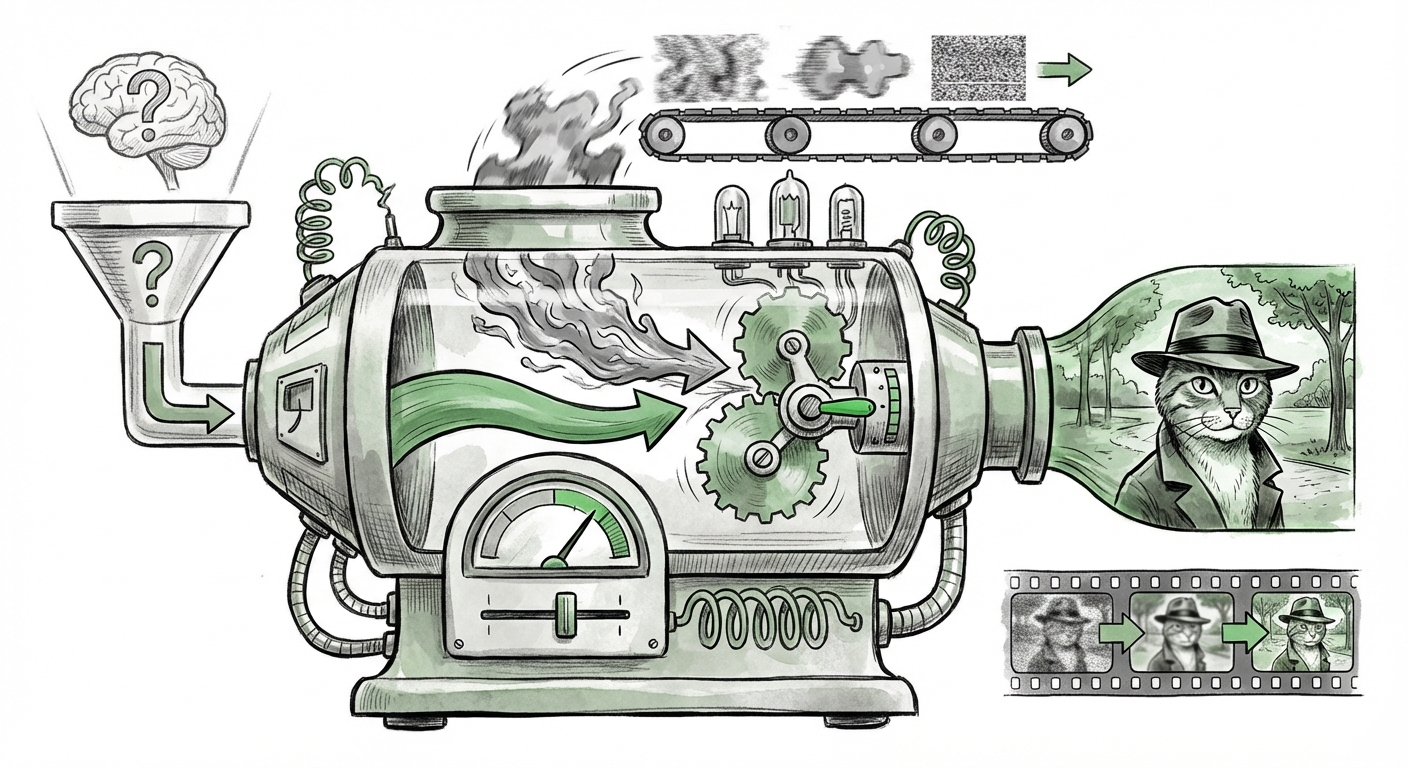
When the Dataset Becomes the Teacher: How Knowledge Distillation Is Rewriting the Rules of AI Training
For years, the AI world has operated on a simple mantra: bigger is better. Bigger models, bigger datasets, bigger compute clusters. But a quiet revolution is underway that flips this assumption on its head. The idea is simple yet profound: instead of training a new model from scratch on mountains of raw data, you can train a smaller, faster, cheaper model using the outputs of a larger, more capable model. The dataset itself becomes the teacher. This approach, known as knowledge distillation, is not just an efficiency hack. It is reshaping how we think about intelligence, access, and the future of AI itself.
The Core Idea: Learning from Answers, Not Just Examples
Traditional machine learning works like a student studying from a textbook. You show the model millions of examples—say, pictures of cats and dogs—along with the correct labels. The model learns patterns, develops rules, and eventually can classify new images on its own. The raw data is the teacher. But there is a limit to how much a model can learn this way. The signal is noisy. The data is messy. The process is incredibly expensive in terms of compute, energy, and time.
Knowledge distillation changes the game. Instead of learning from the raw textbook, the student model learns from the answers that a much larger, already-trained teacher model gives. The teacher model processes vast amounts of data and produces predictions, probabilities, and decision-making logic in a highly refined form. The student model then trains on these outputs—essentially learning the teacher's reasoning shortcuts. The result is a compact model that can often match or even exceed the teacher's accuracy on specific tasks, while being orders of magnitude faster and cheaper to run.
This is not a niche technique anymore. It is becoming a core part of how AI is deployed in the real world. When you use a voice assistant on a smart speaker, a recommendation engine on a streaming service, or a real-time language translation tool, you are often benefiting from a distilled model. The heavy lifting was done by a massive cloud-based teacher, and a nimble student runs on your device.
Why This Matters Now More Than Ever
The timing of this shift is no accident. The AI industry is hitting a series of hard walls. Training the largest models—the GPTs, the Bard successors, the open-source giants—requires data center clusters that cost tens of millions of dollars and consume as much electricity as a small town. The cost of training a single frontier model can exceed $100 million, and the environmental footprint is staggering. At the same time, the pace of progress is slowing. We are running out of high-quality public data, and the returns from simply adding more parameters are diminishing.
Knowledge distillation offers a way out. By decoupling the learning process from the raw data, it allows companies and researchers to reuse intelligence in a way that was not possible before. A single massive teacher can spawn thousands of student models, each optimized for a specific task or device. This dramatically lowers the barrier to entry. A startup with a modest budget can fine-tune a student model that delivers 95% of the performance of a frontier model for their particular problem. That is a game-changer.
Key Trends Driving the Distillation Revolution
Several powerful trends are converging to make knowledge distillation a defining force in AI over the next few years.
Trend 1: The Rise of Synthetic Teaching Data
The most radical implication of knowledge distillation is this: the teacher model can generate infinite synthetic data for the student. This completely solves the data scarcity problem. A large language model can produce millions of examples of question-answer pairs, code snippets, summaries, translations, or reasoning chains. The student never needs to see the original human-generated data at all. This is a paradigm shift because it means the teacher model's knowledge becomes a reusable asset that can be distilled, refined, and transferred indefinitely. It also raises fascinating questions about the quality of the knowledge being passed down—if the teacher has biases or errors, those will be amplified in the student.
Trend 2: Specialization and Multi-Distillation
Instead of one giant model trying to do everything, we are moving toward an ecosystem of specialized student models. A single teacher can distill different versions for different domains: one student for medical text, one for legal documents, one for customer service chatbots, one for code generation. Each student can be smaller, faster, and more accurate in its niche than a general-purpose giant. This is the multi-distillation approach, and it aligns perfectly with the business need for efficiency and customization. Companies no longer have to choose between a one-size-fits-all model and building expensive custom models from scratch.
Trend 3: On-Device AI Becomes Practical
The holy grail for many tech companies is running AI directly on phones, laptops, smartwatches, and IoT devices. The latency, privacy, and offline advantages are immense. But the largest models require cloud servers. Distillation solves this. A distilled model can be small enough to fit on a smartphone chip, yet smart enough to handle tasks like real-time translation, image recognition, or natural language understanding. This is already happening. The next wave of consumer electronics will be defined by how well they can run capable AI locally, powered entirely by distilled knowledge.
Trend 4: The Commoditization of AI Capabilities
When knowledge distillation becomes widespread, the cost of accessing advanced AI capabilities plummets. A company that once had to spend millions to train a custom model can now spend thousands to distill a version of an existing model. This democratization has risks—bad actors can also afford powerful models—but the overall effect is a dramatic lowering of the barrier to entry. Small businesses, non-profits, and individual developers can now harness AI capabilities that were previously available only to tech giants. This will accelerate innovation across every sector, from agriculture and healthcare to education and the creative arts.
What This Means for the Future of AI
The long-term implications of knowledge distillation are profound and will reshape the AI landscape in three major ways.
First, we will see a separation between "teacher" and "student" as distinct market categories. The teacher models will be rare, expensive, and owned by a handful of organizations with the resources to train them. They will be the foundational intellectual property. Student models, on the other hand, will be abundant, cheap, and diverse. A thriving ecosystem of distilleries will emerge—companies and open-source projects that specialize in taking a teacher model and creating high-quality student variants for specific use cases. This mirrors the relationship between research universities and commercial product development.
Second, the nature of intelligence itself will be rethought. If a student model can be trained solely on the outputs of a teacher, without ever seeing real-world data, what does that mean for the concept of "understanding"? The student is not learning from ground truth; it is learning from a representation of reality that has already been processed and interpreted. This creates layers of abstraction and potential for error, but it also opens the door to a new kind of learning where intelligence is transmitted, compressed, and refined across generations of models. We may see the emergence of "knowledge pedigrees"—tracking the lineage of a student model back to its teacher and the teacher's training data to ensure transparency and accountability.
Third, the cost structure of AI will be inverted. Currently, the bulk of spending goes into training large models from scratch. In the future, the bulk of spending will go into distillation, fine-tuning, and deployment. The initial training of a frontier teacher model remains a massive sunk cost, but the marginal cost of creating a new student model will approach zero. This will shift the economic incentives in the AI industry. The winners will not necessarily be the companies with the most data or the biggest clusters. They will be the companies that best understand how to compress, transfer, and monetize knowledge across different contexts and scales.
Practical Implications for Businesses and Society
For business leaders and decision-makers, the rise of distillation as a core AI strategy is both an opportunity and a challenge. Here are the key practical takeaways.
- Focus on use-case specialization: The era of trying to build a general-purpose AI in-house is coming to an end for most organizations. Instead, identify the specific tasks where AI can deliver the most value—customer support, inventory forecasting, content generation, medical diagnosis—and invest in distillation pipelines that produce a custom student model for that task. This is far more cost-effective than attempting to replicate a general-purpose model.
- Audit the teacher's biases: Since student models inherit the strengths and weaknesses of their teacher, due diligence on the teacher's training data and behavior is essential. If your teacher model has a known bias, your distilled model will amplify it. Build verification steps into your distillation workflow to detect and correct for these issues before deployment.
- Re-think your data strategy: Raw data is no longer the only precious resource. The real value lies in the knowledge extracted and compressed into teacher model outputs. Companies should start curating and storing high-quality teacher outputs—chain-of-thought reasoning, probability distributions, correct and incorrect predictions—as a new type of strategic asset. This synthetic teaching data can be reused across multiple distillation projects and can be a source of competitive advantage.
- Plan for on-device deployment: If your business relies on mobile apps, edge devices, or any scenario where latency and privacy matter, invest in distillation strategies now. The ability to run capable AI locally, without a cloud round-trip, is becoming a key differentiator. The earlier you build this capability, the more you will benefit as the hardware catches up.
- Monitor the regulatory landscape: Knowledge distillation creates unique regulatory challenges. If a teacher model is trained on copyrighted data, and its student is sold commercially, who is liable? Governments are starting to examine the legal implications of model lineage and distilled knowledge. Be prepared for a future where you may need to document the training provenance of every AI model you deploy, including whether it was distilled and from which teacher.
For society at large, distillation offers a double-edged sword. On the positive side, it dramatically expands access to advanced AI. A farmer in a remote area can use a distilled model running on a basic smartphone to get crop disease advice that was previously only possible with a cloud connection to a billion-parameter model. On the negative side, distillation can propagate and amplify harms. If a teacher model contains toxic biases or misinformation, every distilled student inherits and potentially magnifies those flaws. The responsibility lies with the distilleries—the organizations that create and distribute student models—to ensure they are not spreading harm in the pursuit of efficiency.
Actionable Insights for the Next 12 Months
If you take nothing else from this analysis, here are five concrete steps to consider right now.
- Experiment with distillation in-house: Pick a small, well-defined problem. Take an existing large model (open-source or API-based) as your teacher. Use its outputs to train a smaller student model using a simple distillation framework. Compare the results. This hands-on experiment will teach you more about the opportunities and pitfalls than a hundred research papers.
- Build a high-quality teacher output dataset: Start logging the predictions, confidence scores, and reasoning traces from the models you already use. Over time, this dataset becomes the raw material for your own distillation projects. Treat it as a corporate asset with the same care as your source code or customer data.
- Evaluate distillation vendors and platforms: A new wave of startups is emerging that offer "distillation-as-a-service." They take a teacher model of your choice and produce a customized student model for your use case. Evaluate these offerings now, because the market is still young and the best partnerships are being formed early.
- Educate your leadership team: Most executives still think of AI as "big model, big data, big compute." Explain to them that the future is more like a library—one master reference work (the teacher) and thousands of specialized, portable editions (the students). This framing will help them make smarter investment decisions.
- Prepare for transparency requirements: Whether due to regulation or customer demand, you will likely need to disclose the training provenance of your AI models. Develop a system for tagging and documenting each model you create: which teacher was used, what distillation technique was applied, and what data was used to fine-tune the student. Start this work before it becomes mandatory.
Conclusion: The Quietest Revolution in AI
Knowledge distillation does not make headlines like a new record on a benchmark or a flashy demo of a chatbot. But it is quietly becoming the most important operational technology in the AI industry. It is the mechanism by which intelligence is compressed, transferred, and democratized. It is the reason why a smartphone can run a powerful language model, why a medical startup can afford a diagnostic system, and why AI can be deployed in settings where compute is scarce and data is sensitive.
The idea that the dataset can become the teacher—that raw data is no longer the only path to learning—represents a fundamental shift in how we think about building intelligence. We are moving from a world where every model must be trained from scratch in a firehose of data, to a world where intelligence is passed down like a torch from one model to the next, getting smaller, faster, and more specialized with each transfer. The implications are as profound as the rise of the library, the printing press, or the internet. Knowledge, once created, can be distilled and spread infinitely. That changes everything.