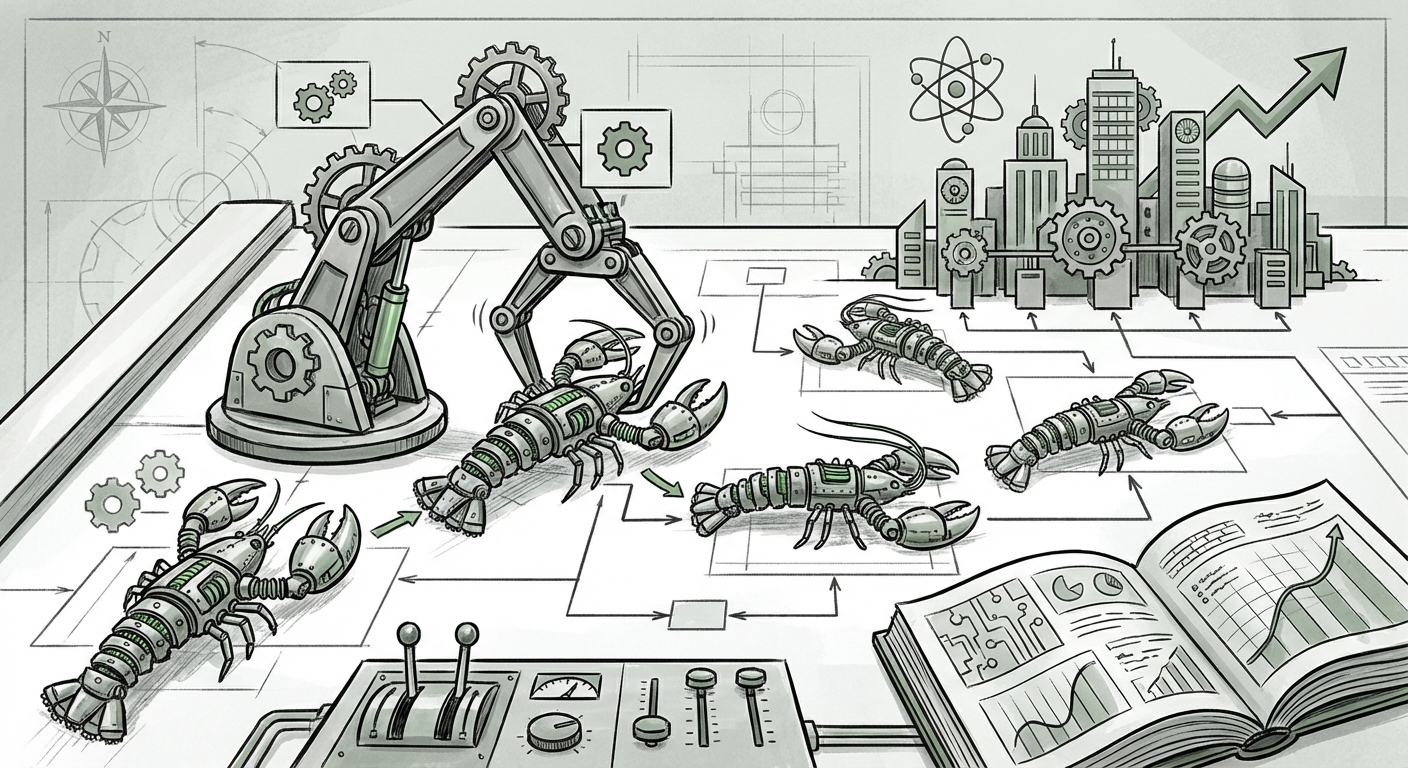
Why Language Models Alone Won't Spark the Next Scientific Revolution — and What Will
Every few decades, a breakthrough idea reshapes the world. We call these moments scientific revolutions: the shift from Newtonian physics to quantum mechanics, the discovery of DNA's structure, the rise of germ theory. These weren't just new facts — they were new ways of seeing reality itself.
Today, many people wonder whether artificial intelligence can trigger the next such revolution. After all, AI systems already write code, generate research papers, and even help design drugs. But there's a growing realization that the most popular form of AI — large language models — has a built-in limit. They can process and remix existing human knowledge, but they cannot, by themselves, spark a true scientific revolution. For that, we may need something far more powerful: world models.
This article explores the critical distinction between language models and world models, what it means for the future of AI, and how businesses and society should prepare for a shift that could change everything.
The Fundamental Limit of Language Models
Large language models (LLMs) like GPT-4 and its successors are extraordinary tools. They can summarize textbooks, write poetry, pass professional exams, and hold conversations that feel almost human. But beneath the surface, these models operate on a simple principle: they predict the next word in a sequence based on patterns learned from enormous amounts of text.
This means LLMs are masters of linguistic pattern matching. They know that "E = mc²" often follows discussions of relativity, and they can explain the equation beautifully. But they do not actually understand why energy and mass are equivalent. They have no internal representation of the physical world, no causal model of how one thing leads to another. They are, in essence, brilliant mimics of human language.
And that's a problem if we're hoping AI will lead us to the next paradigm shift. Scientific revolutions don't come from rearranging existing knowledge — they come from breaking it. Einstein didn't just rephrase Newton; he overturned Newton's assumptions. Darwin didn't just restate creationism; he replaced it with a radically different framework. These leaps required a deep, causal understanding of the world, not just fluency in the language used to describe it.
Language models, for all their power, are stuck in the past. They can only remix what has already been written or said. They cannot generate truly novel hypotheses because they lack a model of how the world actually works. They don't ask "what if?" in a causal sense. They ask "what word comes next?" in a statistical sense. Those are worlds apart.
What Are World Models?
The term "world model" comes from robotics and cognitive science, but it's quickly becoming central to the future of AI. A world model is an internal representation of how the environment behaves — not just what things look like or what they're called, but how they interact, how they change over time, and what causes what.
Think of it this way: a language model might know that "dropping a glass" is often followed by "it breaks." But a world model would represent the glass as a physical object with mass, fragility, and a position in space. It would simulate the consequences of dropping it — the acceleration due to gravity, the impact force, the stress on the glass structure — and predict the breakage, even if it had never read a single story about a broken glass.
That kind of causal understanding is what makes world models potentially revolutionary. Instead of learning from text alone, they learn from interaction — from data about how the world actually behaves. That could come from sensors, simulations, robotics, or even video. The key is that the model builds a representation of reality that supports counterfactual reasoning: "what would happen if I changed this variable?"
This is exactly the kind of thinking that powers scientific discovery. When a physicist asks "what if the speed of light were not constant?" or a biologist asks "what if this gene were switched off?" they are using a form of world model — a mental simulation of reality that lets them test ideas without having to run every experiment physically.
Why World Models Could Spark Scientific Revolutions
Science progresses in two ways: by accumulating facts (normal science) and by overturning frameworks (revolutionary science). Language models are excellent at the first. They can help researchers keep up with the flood of papers, identify correlations, and even suggest experiments based on known patterns. But the second — the paradigm shift — requires a tool that can challenge its own assumptions.
World models offer that possibility because they are not anchored to existing text. They are anchored to reality — or an approximation of it. If a world model is trained on real-world data (or high-fidelity simulations), it can discover patterns that no human has ever written down. It can notice that a certain physical law doesn't quite fit the data, or that a biological mechanism behaves differently under certain conditions. And crucially, it can propose a new model that explains the anomaly better.
That's how scientific revolutions happen: someone sees a crack in the existing framework and imagines a new one. A world model could do the same, but at a scale and speed that no human could match. It could run millions of simulated experiments, test thousands of competing hypotheses, and converge on a new theory — all while we sleep.
Of course, this vision is not yet realized. Building robust world models is incredibly difficult. They require vast amounts of high-quality data, sophisticated algorithms for causal inference, and ways to validate their internal representations against the real world. But the direction is clear: the future of AI for science lies not in making language models bigger, but in building models that actually understand.
Implications for the Future of AI
If world models become the next major frontier in AI, the implications are profound. First, it means the current race to build ever-larger language models may be reaching its limits — not in terms of capability, but in terms of the kind of capability that matters for breakthrough science. Bigger LLMs will still be useful for chatbots, content generation, and knowledge retrieval. But they won't lead to paradigm shifts.
Second, it means the AI field will need to invest heavily in new architectures. Transformers — the technology behind today's LLMs — are not inherently designed for causal reasoning. They excel at sequence prediction, but they don't naturally build world models. Researchers are already exploring hybrid approaches that combine language understanding with simulation-based reasoning, but this is still early work.
Third, it shifts the focus from data quantity to data quality. LLMs need terabytes of text. World models need the right kind of data — data that captures causal relationships, dynamics, and interactions. That might come from physics simulators, robotics logs, or carefully designed experiments. Companies that can generate or access such data will have a significant advantage.
Finally, it changes the conversation about AI safety and alignment. World models that can simulate reality and test counterfactuals could become powerful tools for understanding complex systems — including social and economic systems. But they could also be used to manipulate those systems if not properly constrained. The ethical questions around world models are deeper than those around language models because the potential for real-world impact is so much greater.
What This Means for Businesses
For business leaders, the message is clear: don't bet everything on language models if your goal is innovation. LLMs are great for automating customer service, drafting emails, and analyzing text. But if you want to discover a new material, design a novel drug, or invent a more efficient engine, you need AI that understands causality, not just language.
This has practical implications for R&D budgets. Companies that invest in simulation-based AI, digital twins, and causal reasoning tools are positioning themselves for the next wave. Those that only invest in LLM-based chatbots may find themselves outpaced by competitors who can simulate and test ideas at scale.
Industries like pharmaceuticals, materials science, climate modeling, and robotics are likely to be early adopters of world models. In drug discovery, for example, a world model that simulates molecular interactions could propose entirely new classes of compounds — not by scanning existing patents, but by understanding the underlying biology. That's the difference between incremental improvement and true breakthrough.
But there's also a warning: world models are harder to build, harder to validate, and harder to explain. They require deep domain expertise and significant computational resources. Businesses should not expect plug-and-play solutions anytime soon. The path from today's LLMs to tomorrow's world models will be long and complex.
What This Means for Society
On a societal level, the shift from language models to world models could redefine the relationship between humans and machines. Today, AI is mostly a tool for manipulating information. Tomorrow, it could become a tool for manipulating reality — or at least, for understanding it at a depth that was previously impossible.
That raises big questions about who controls the data needed to build world models. If the key to scientific revolution is high-quality causal data, then the organizations that own that data (governments, large corporations, research institutions) will wield enormous power. Ensuring broad access to world-model technology — and to the discoveries it enables — will be a critical challenge.
There's also the question of trust. Language models can be evaluated by how well they predict words. World models need to be evaluated by how well they predict real-world outcomes. That's a much higher bar, and it means mistakes could be more consequential. A flawed world model used to design a new drug or a new energy system could cause real harm. Robust validation frameworks will be essential.
Finally, there's the upside: world models could help us tackle problems that have so far resisted human ingenuity. Climate change, pandemics, aging, and fusion energy are all areas where causal understanding is key. If world models can accelerate our understanding of these complex systems, the benefits could be extraordinary.
Actionable Insights for Leaders
For those who want to prepare for the world-model era, here are concrete steps:
- Invest in simulation infrastructure. Whether it's physics engines, biological simulators, or economic models, the data that powers world models comes from simulations. Start building or acquiring them now.
- Hire for causal reasoning skills. Look for data scientists and researchers who understand causal inference, not just machine learning. The ability to ask "what causes what?" will be increasingly valuable.
- Diversify AI investments. Don't put all your resources into LLMs. Explore startups and research groups working on world models, embodied AI, and simulation-based learning.
- Collaborate with domain experts. World models need deep knowledge of specific fields — physics, biology, chemistry, economics. Partner with experts who can define the causal structures that matter.
- Prepare for a longer timeline. World models are not a 2026 or 2027 technology. They may take a decade to mature. But the groundwork laid now will determine who leads when they arrive.
Conclusion: The Next Frontier Is Understanding
Language models are a remarkable achievement. They have transformed how we interact with information, automate tasks, and even generate creative content. But they are not the final chapter of AI. In fact, they may best be understood as a stepping stone — a powerful tool for processing human knowledge, but not for transcending it.
The next great leap will come from AI that doesn't just predict words, but understands worlds. AI that can run experiments in its mind, test counterfactuals, and propose new theories about how reality works. That's what a scientific revolution requires, and that's what world models promise.
The race is on to build them. Those who succeed won't just improve AI — they will change the very process of discovery itself. And that is a revolution worth waiting for.